The Art of Looking Carefully
by Christina Stefani for House of Stefani
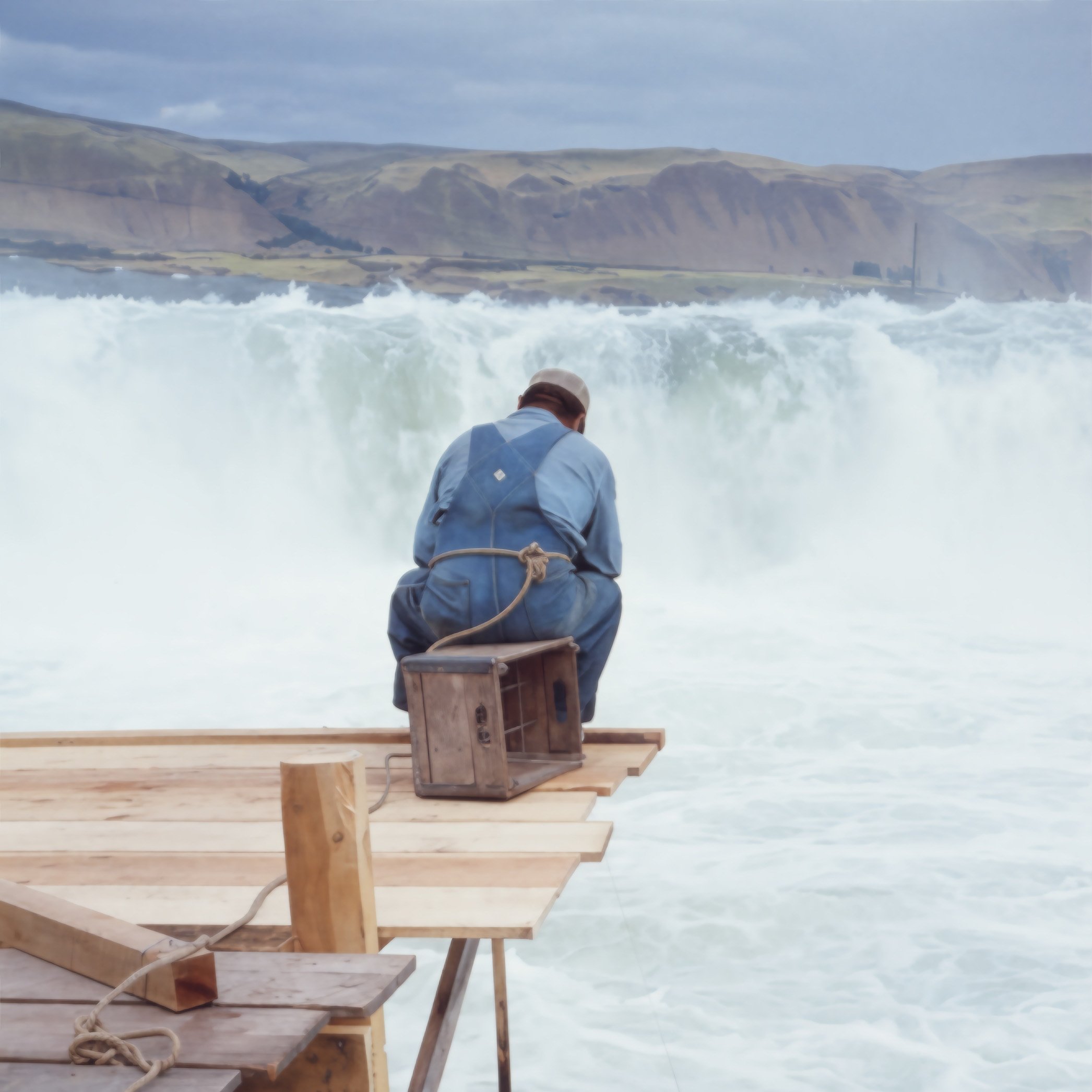
There was no screen on which to review what he had made. No nearly limitless supply of digital frames. No opportunity to photograph everything and decide what mattered later. He had to choose. ©Richard Stefani Estate
What Richard Stefani's photographs can teach us about attention, uncertainty, and seeing what is actually there.
We rarely notice how quickly we decide that we have seen something.
A face.
A river.
A photograph.
Within seconds, the mind begins naming what is in front of us. We recognize. We categorize. We interpret.
And once we have named something, we tend to believe we understand it.
But recognition is not the same as seeing.
I have been thinking about this distinction often lately.
In another essay, I wrote about the kind of knowledge that comes from staying with something long enough to know it: the painter returning to a canvas, the gardener learning a plant, the hand becoming familiar with a well-used tool.
Richard's photographs from Celilo Falls have been teaching me something related.
Sometimes we return because familiarity deepens our understanding.
And sometimes we return because our first understanding was incomplete.
The longer I spend with these photographs, the more I realize how much careful looking asks of us.
Not simply attention.
Humility.
The First Glance
At first glance, Richard's photographs seem easy to describe.
Celilo Falls.
Fishermen.
Wooden platforms.
Dip nets.
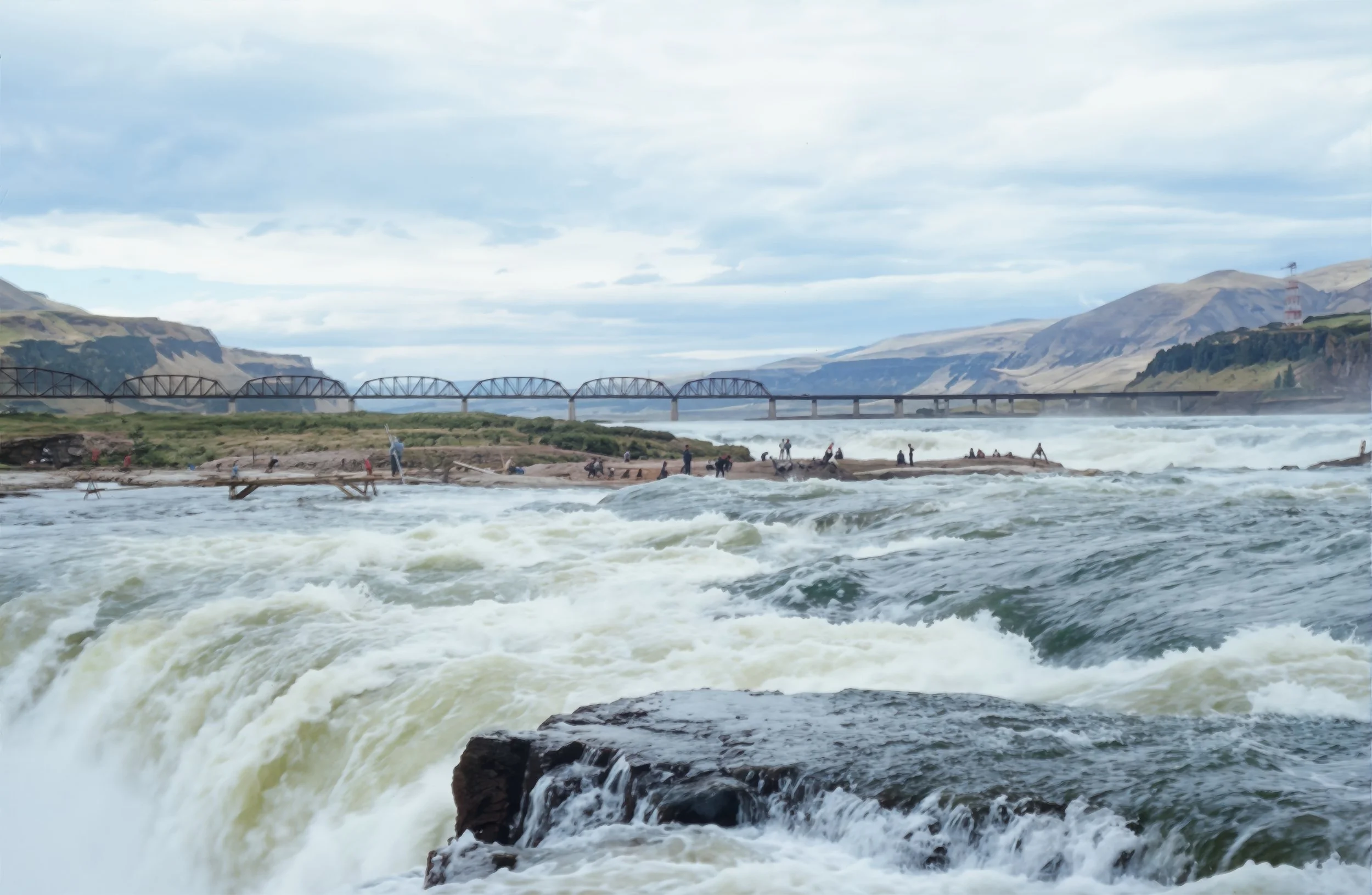
People gathered beside the Columbia River.
Color photographs from 1956.
All of those descriptions are accurate.
None of them tells us very much.
Look longer and the categories begin to break apart.
A fisherman becomes a particular man, sitting in a particular way above the river.
A fishing platform is no longer simply a wooden structure. Research tells us that fishing locations at Celilo were connected to generations of knowledge, family relationships, and rights to particular places along the river.
A historical photograph stops being merely "old."
There is blue in the water. Ochre in the hills. Red in a shirt. Sunlight on skin. Wet wood. White water. Expression.
And a place we might initially describe as "lost" becomes something more complicated when we learn that Celilo remains culturally significant and that descendants of Native families connected to the falls continue traditions and relationships with the Columbia.
The photograph has not changed.
We have.
We know more.
And so we see differently.
What Richard Chose to See
When Richard arrived at Celilo in the fall of 1956, he was twenty-three years old.
He carried two cameras and two rolls of color film.
That limitation matters.
Every time Richard released the shutter, he used one of a finite number of exposures.
There was no screen on which to review what he had made. No nearly limitless supply of digital frames. No opportunity to photograph everything and decide what mattered later.
He had to choose.
And the surviving negatives preserve some of those choices.
The river.
The falls.
Fishing platforms.
Nets.
Work.
People.
Faces.
Again and again, Richard moved between the scale of the landscape and the individuality of the people within it.
We should be careful not to turn those choices into a story Richard did not leave us.
We cannot know exactly what he was thinking each time he raised the camera.
But we can see where he pointed it.
Sometimes that is enough.
Looking Seventy Years Later
Now the act of looking belongs to us.
I have been returning to Richard's original film as we prepare Before the Water Rose.
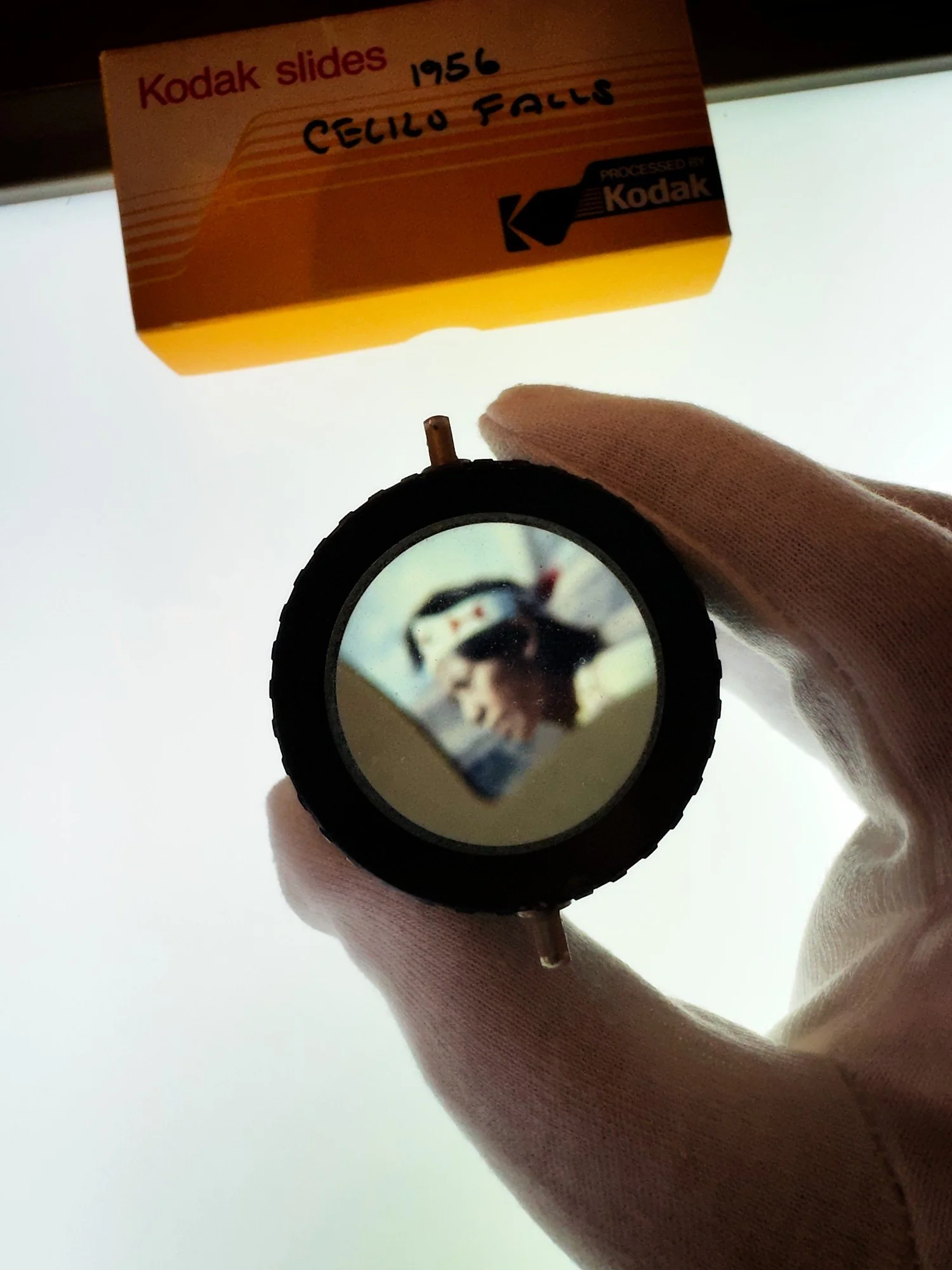
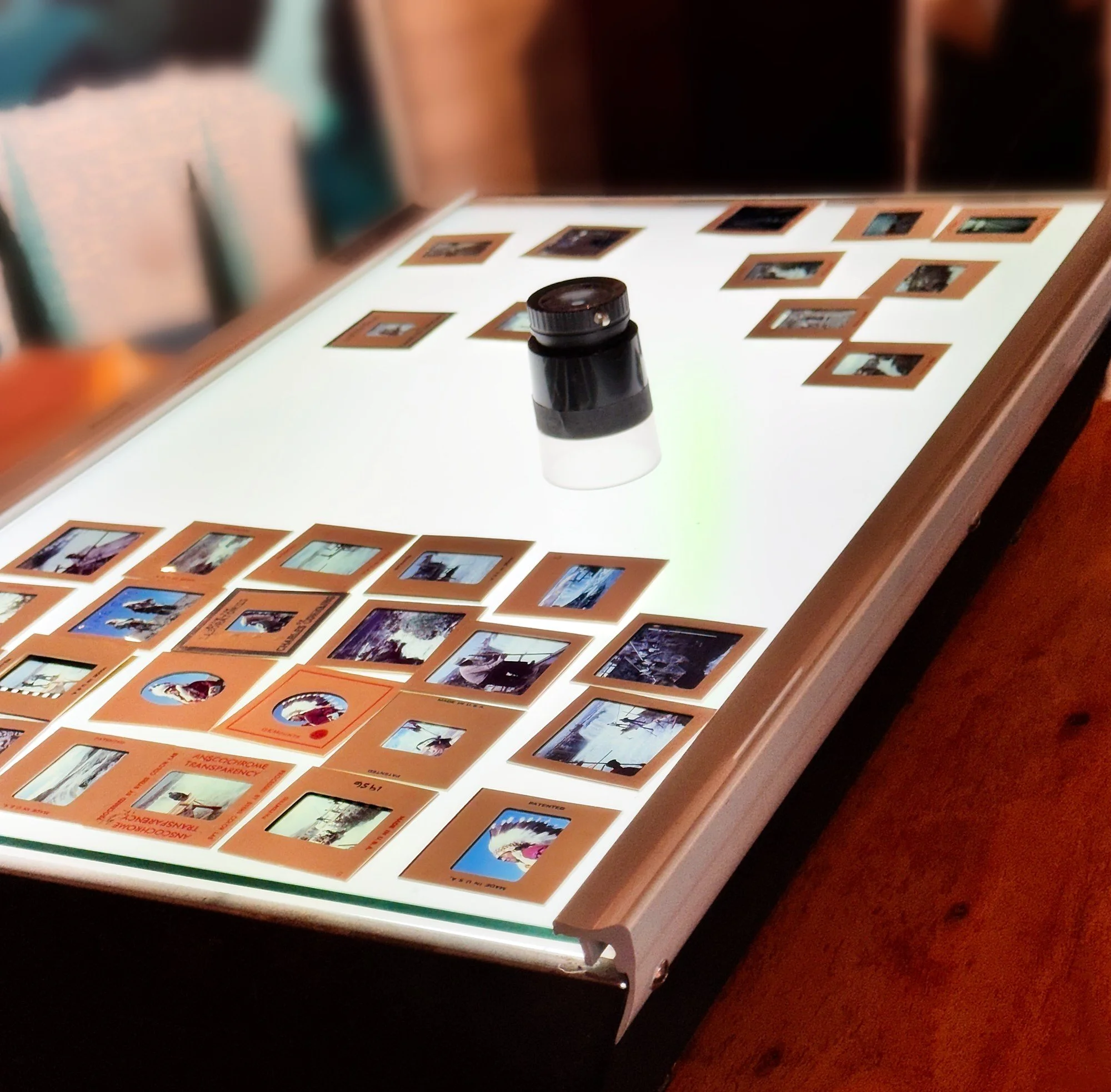
The negatives go onto a light table.
A loupe comes down.
A face becomes larger.
A piece of clothing becomes clearer.
A structure in the background becomes something to investigate.
The film is scanned at high resolution, and suddenly details that were difficult to see in the small original negative become available for study.
Then the questions begin.
Who is this person?
What exactly is happening here?
What kind of structure are we seeing?
Was this photograph made on the same day as another?
Do two frames show the same individual?
What do historical records tell us?
What do they not tell us?
One photograph has been identified to us as possibly depicting Chief Tommy Thompson, the longtime Salmon Chief at Celilo.
Possibly.
There are reasons to investigate the identification. Tommy Thompson was an important figure at Celilo during this period, and historical photographs of him survive.
But "possibly" matters.
We have not verified the identity of the man in Richard's photograph.
So we do not call him Chief Tommy Thompson.
We look.
We compare.
We research.
We ask people who may know more than we do.
And until the evidence allows us to say something more, we leave the question open.
When Looking Gives Us Fewer Answers
This may be one of the unexpected lessons of working with an archive.
Careful looking does not always give us answers.
Sometimes it gives us better questions.
Sometimes it reveals that something we thought we knew was only an assumption.
Sometimes new information makes a simple story more complicated rather than less.
And sometimes the most responsible conclusion is simply:
We do not know yet.
There is humility in that.
And there is respect.
The temptation to fill an empty space is powerful, particularly when the story we might tell seems plausible.
But plausibility is not evidence.
A photograph may show us a person.
It may show us clothing, expression, posture, surroundings, and relationships between people in a particular moment.
Historical research may tell us something about the place and period in which the photograph was made.
Someone with community or family knowledge may eventually recognize the individual.
But until then, the photograph does not give us permission to invent a name.
The unknown person remains a person.
Not a blank space waiting for us to complete.
Seeing and Assuming
This distinction extends far beyond an archive.
We do it with art.
We look at a painting for a few seconds and decide what kind of painting it is.
Abstract.
Landscape.
Decorative.
Difficult.
Beautiful.
Not for me.
We do it with places.
We arrive somewhere, photograph it, identify the landmarks, and believe we have experienced it.
We do it with history.
We learn a date and an event and begin to mistake the chronology for understanding.
And, of course, we do it with people.
We see appearance, occupation, age, clothing, manner, and circumstance, and the mind begins constructing a story almost immediately.
Careful looking interrupts that process.
It creates a small space between observation and conclusion.
That space is where curiosity can enter.
What am I actually seeing?
What do I know?
How do I know it?
What am I assuming?
Who might know something I don't?
What would happen if I looked again?
These are useful questions in front of a photograph.
They may be useful almost everywhere else, too.
When a Photograph Becomes Evidence
One of the reasons archives matter is that objects can outlive the knowledge surrounding them.
A negative survives.
A name disappears.
A photograph remains.
The circumstances of its making become uncertain.
That is why stewardship involves more than keeping something physically safe.
Preservation protects the object.
Research begins restoring context.
Documentation records what has been learned.
And careful language preserves the distinction between fact, informed possibility, and what remains unknown.
Each of those things matters.
Because once an assumption enters the historical record as fact, it can be repeated.
A caption becomes a website description.
The website becomes a source.
The source is quoted somewhere else.
And eventually no one remembers where the original certainty came from.
Looking carefully therefore carries a responsibility.
We are not merely deciding what we think a photograph means.
We are deciding what we are willing to say about another person's life.
The People in the Photographs
This responsibility feels especially important with Richard's Celilo archive.
Many of the people he photographed are not yet identified.
I find myself wanting to know their names.
The young man Richard photographed more than once.
The woman sitting above the river.
The fishermen standing on the platforms.
The young people gathered among the rocks.
Who were they?
Where did they go after Richard lowered his camera?
Who remembers them?
Are their children or grandchildren alive today?
Does someone have another photograph of the same person in a family album?
Perhaps some of those questions will eventually be answered.
Contemporaneous photographic collections exist. Historical records exist. Tribal archives and historians hold knowledge we do not. Families may recognize faces that are anonymous to us.
That possibility is one reason we are approaching the photographs as a living archive rather than a finished story.
New knowledge may come.
If it does, we will add it.
Until then, we will leave room.
Learning to See
Looking carefully has been at the center of House of Stefani from the beginning.
I have often thought about it in relation to art.
The more time we spend with paintings, photographs, architecture, gardens, handmade objects, music, or beautifully prepared food, the more distinctions we begin to notice.
Making something deepens that ability further.
Once you have painted, you notice paintings differently.
Once you have photographed, you begin noticing light.
Once you have built something, you notice joints, materials, weight, and proportion.
Attention creates discernment.
But Richard's photographs have been reminding me that there is another dimension to learning to see.
It isn't only about noticing more.
It is also about assuming less.
Perhaps mature looking involves both.
The confidence to notice what is there.
And the humility to acknowledge what is not yet known.
Look Again
In 1956, Richard stood beside the Columbia River and paid attention.
He looked at water.
At work.
At structures.
At people.
At faces.
He made twenty-three surviving color photographs.
He could not have known that seventy years later I would be sitting with those negatives beneath a loupe, trying to understand everything they might contain.
He could not have known that historians, tribal sources, archives, and perhaps eventually families would help us see things in his photographs that neither he nor I could establish alone.
And he could not have known that the act of looking he began in 1956 would continue long after his own life.
But perhaps that is one of the extraordinary things photographs can do.
They allow one person's attention to survive.
Then they ask another person to take up the work.
Look.
Look longer.
Question what seems obvious.
Learn what you can.
Leave room for what you do not know.
Then look again.
There is almost always more there.
Editor's Note
This essay is part of The Before the Water Rose Journal, an ongoing series exploring Celilo Falls, Richard Stefani's 1956 photographs, the people and places they preserve, and the process of bringing this remarkable archive forward with care. The series will continue through the presentation of Before the Water Rose: Celilo Falls, 1956, and beyond, as research and new understanding of the photographs continue to emerge.