by Christina Stefani for House of Stefani
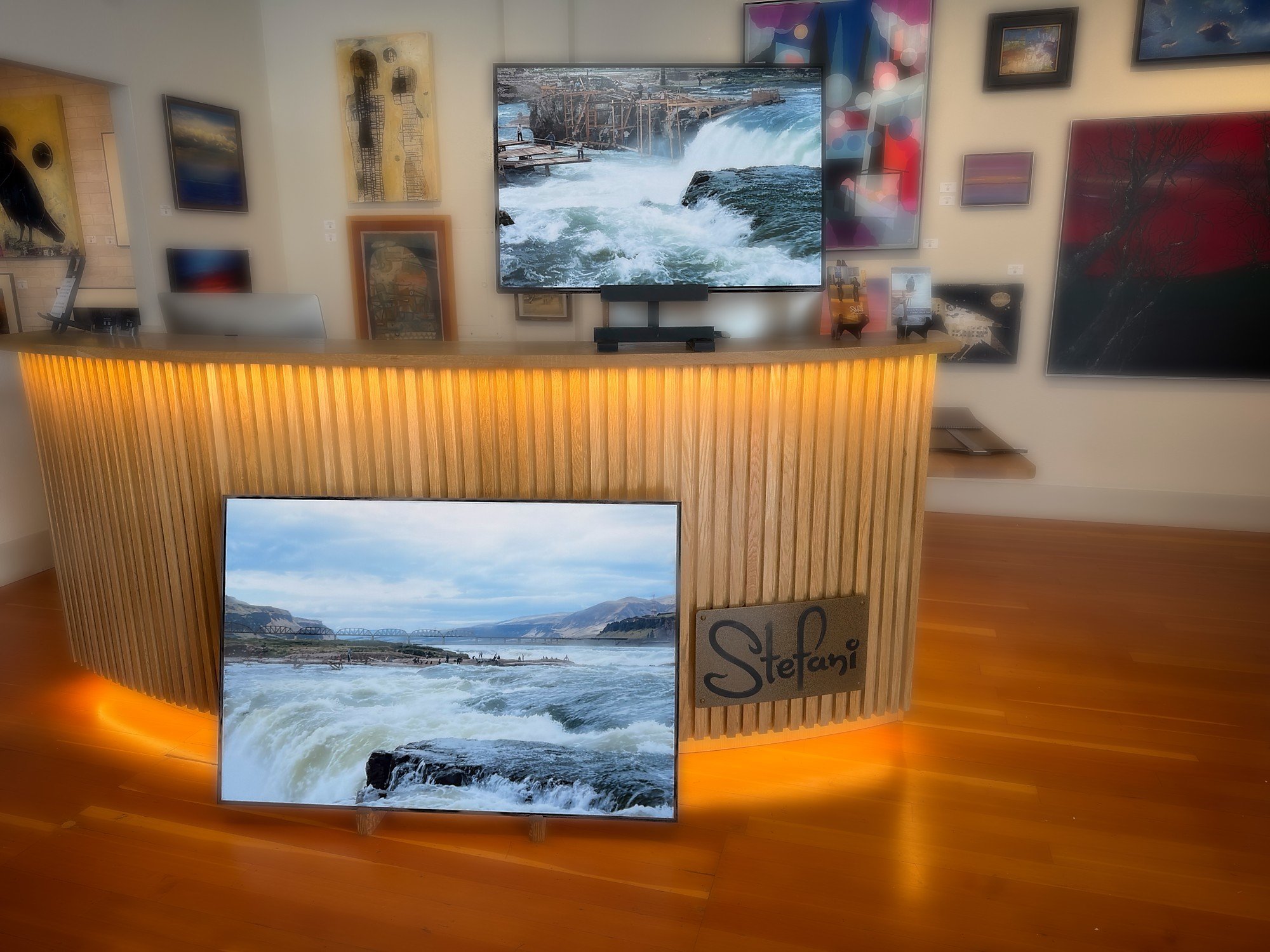
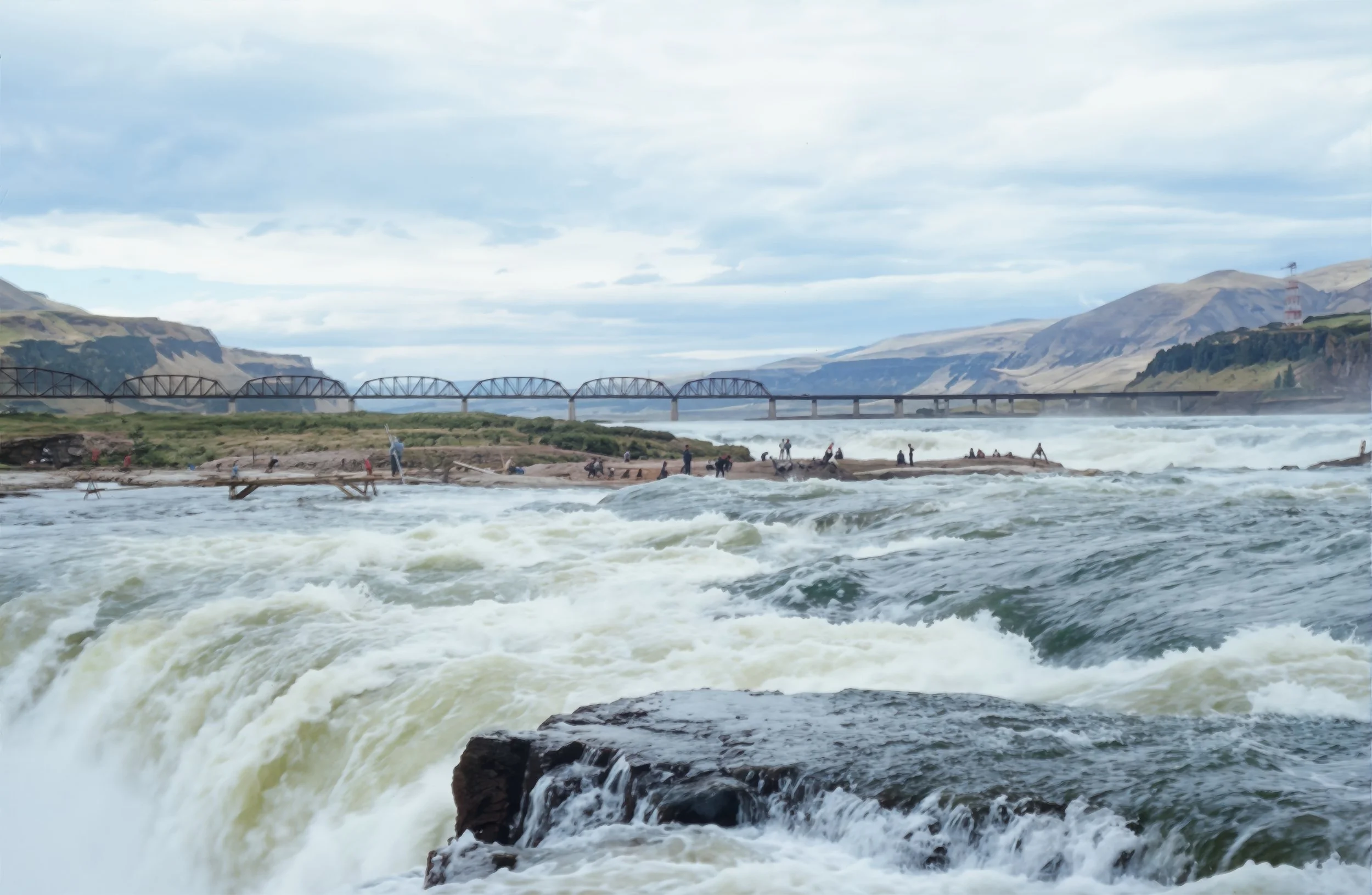
A sweeping view of Celilo Falls during its final fishing season captures the immense power of the Columbia River and one of North America's oldest continuously inhabited places. ©Richard Stefani Estate
A place of water, salmon, trade, community, and continuity on the Columbia River
What was Celilo Falls?
It sounds like a simple question.
A waterfall on the Columbia River. An ancient Indigenous fishing place. A landscape submerged by the reservoir behind The Dalles Dam in 1957.
All of those things are true.
None of them is enough.
To understand Celilo, we have to begin not with the dam, but with the river, the salmon, and the generations of people who gathered there long before anyone imagined stopping the Columbia.
And perhaps we also have to reconsider the question itself.
Because although the physical falls disappeared beneath the water, Celilo did not simply become a place of the past.
The River Before the Dam
Celilo Falls was located on the mid-Columbia River, about twelve miles east of The Dalles, Oregon.
It was not a single picturesque waterfall in the way we might imagine one today. Celilo was part of an approximately nine-mile stretch of rapids, falls, channels, rocks, and fishing places along the Columbia.
At the falls, the river narrowed dramatically. In places, the Columbia was forced through a passage as narrow as forty feet. Over roughly half a mile, the river dropped more than eighty feet.
The result was extraordinary.
Water rushed through channels and over basalt ledges with tremendous force. The roar could be heard from a distance. Mist rose above the river. For people traveling by water, the rapids presented a formidable obstacle.
For salmon moving upstream, the turbulent water created something else.
Opportunity.
The fish slowed and gathered as they negotiated the falls, making Celilo one of the most productive fishing places on the Columbia River.
And people had understood that landscape for an extraordinarily long time.
A Place Older Than Recorded History
Archaeological evidence documents human occupation of village sites around Celilo for at least 11,000 years.
Adjacent to the falls on the Oregon side of the river, Celilo Village is considered Oregon's oldest continuously occupied site. The larger mid-Columbia region brought together Chinookan and Sahaptin-speaking peoples and became a place of remarkable cultural exchange.
That length of time is difficult to comprehend.
Eleven thousand years before Richard Stefani arrived with his cameras, people were already living beside this river.
Generations were born there.
Families returned there.
Knowledge was passed from one person to another.
Salmon returned, season after season.
The falls were not simply scenery around which human activity happened.
The river shaped life.
And people understood how to live with the river.
The Great Trading Place
Celilo was also one of the great centers of exchange in western North America.
Seasonal visitors came to fish, socialize, trade, and renew relationships. Goods exchanged at Celilo traveled across enormous distances. Trade networks reached north toward present-day Alaska, south toward California, and east beyond the Rocky Mountains.
That makes it useful to imagine Celilo not as an isolated village beside a waterfall, but as a crossroads.
People arrived with food, tools, materials, stories, news, languages, and relationships.
Salmon was central to this world. Dried and pounded salmon could be stored and transported, making it both an essential food and an important trade commodity throughout the Columbia River region.
The river brought people together.
The falls gave them reason to stay.
Fishing the Falls
This is the world we begin to see in Richard Stefani's photographs.
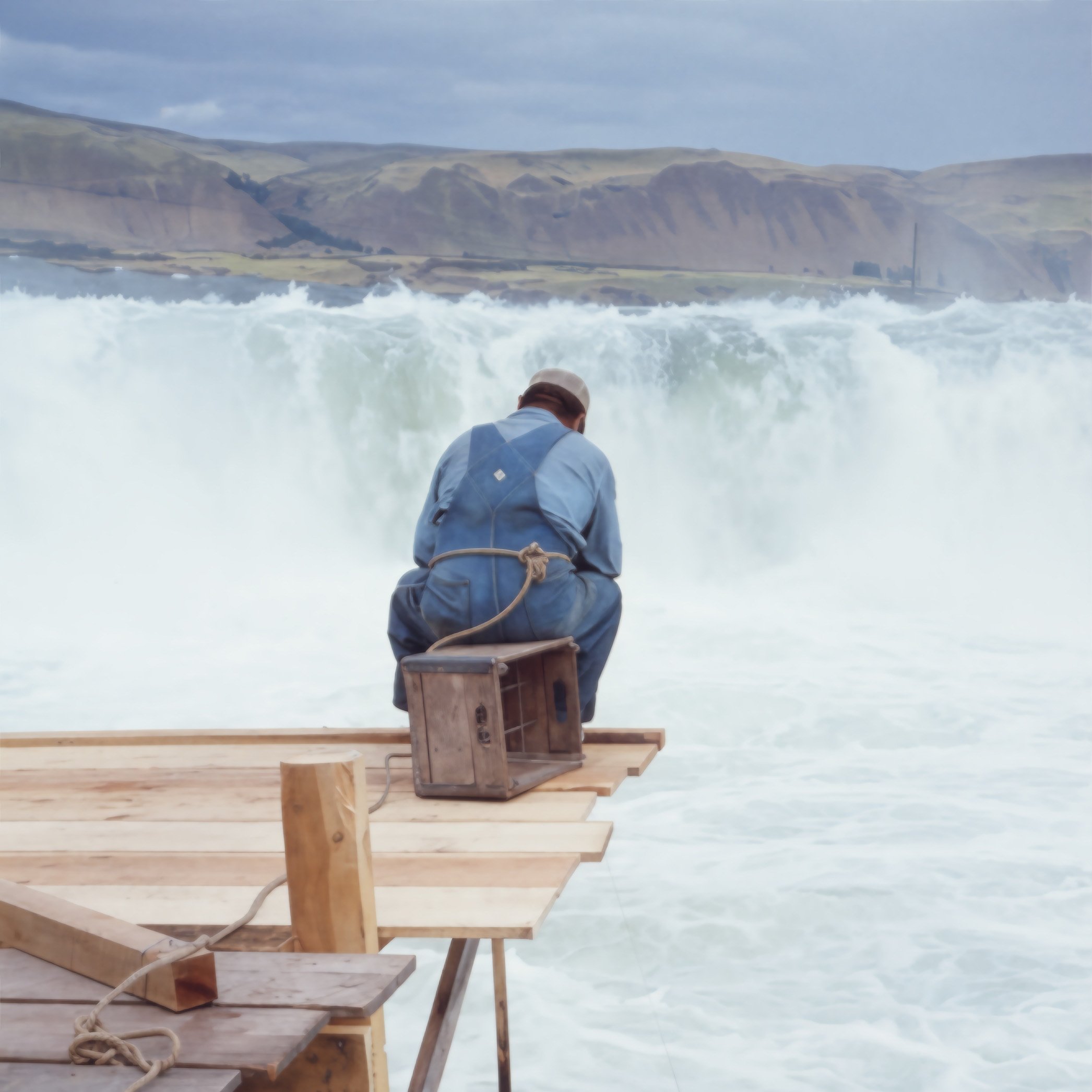
Wooden scaffolds extend over the river.
Long-handled dip nets reach toward the water.
People stand on narrow platforms above powerful currents.
From a distance, the structures can look precarious.
They were anything but arbitrary.
Wishram and Wasco fishers built wooden scaffolds at productive locations and used long-handled dip nets to take salmon from the turbulent water. Fishing sites were connected to kinship. Rights to particular locations could be inherited and passed from generation to generation.
That changes the way we look at the platforms in Richard's photographs.
A platform was not simply lumber extending over the river.
It occupied a known place.
Someone understood the current there.
Someone knew how salmon moved through that channel.
Someone had learned how to stand above that water and work safely within its force.
And that knowledge had a history.
By the middle of the twentieth century, hundreds of fishing platforms were in use at Celilo. Oregon Encyclopedia estimates that more than 450 platforms were being used to catch migrating fish.
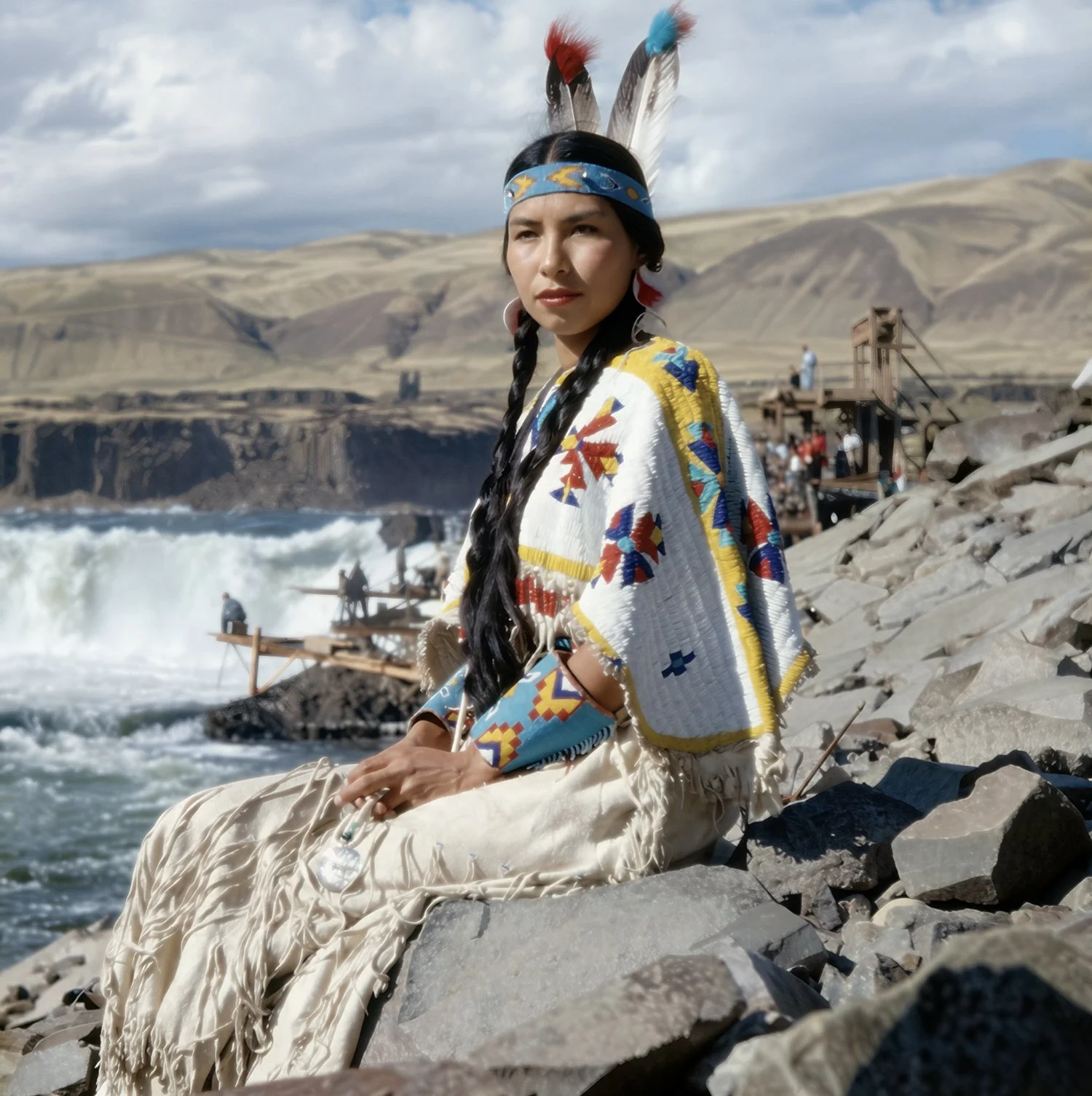
Richard photographed some of them during the fall of 1956.
But his photographs show something else as well.
People sitting.
People watching.
Young people among older generations.
Groups gathered on the rocks.
Portraits.
Moments between the obvious moments.
Celilo was a fishery.
It was also a lived place.
Treaty Rights and a Changing River
By the nineteenth century, the world around Celilo was changing rapidly.
Euro-American settlement, commercial fishing, transportation projects, government regulation, and eventually hydroelectric development placed increasing pressure on Indigenous communities and the Columbia River fishery.
In treaties negotiated in 1855, Columbia Plateau tribes reserved the right to continue fishing at their "usual and accustomed places," including sites away from reservations.
Those rights became enormously important as Native people faced increasing restrictions on access to traditional fishing places. They would also become the subject of decades of legal conflict and later federal court decisions affirming treaty fishing rights.
Meanwhile, the river itself was increasingly viewed through another lens.
To Indigenous communities, Celilo was an ancestral fishery and cultural landscape.
To many commercial and governmental interests, the falls and rapids were obstacles to navigation and opportunities for power generation.
Those two ways of understanding the same river would eventually collide.
The Dalles Dam
Construction of The Dalles Dam began in 1953.
Native leaders opposed the project and warned of what would be lost. The dam promised hydroelectric power and improved navigation on the Columbia. It also meant that the reservoir behind it would inundate the fishing sites at Celilo Falls.
The federal government negotiated compensation related to the loss of fishing sites and village property. Historical accounts differ in how they characterize the legal effects of those settlements, but the broader treaty right to fish at usual and accustomed places remained and was subsequently affirmed through federal litigation.
Then came March 10, 1957.
As the reservoir filled behind The Dalles Dam, the water rose over Celilo Falls and inundated part of Celilo Village.
The rapids disappeared.
The fishing platforms disappeared.
The physical landscape that people had known for thousands of years was transformed.
There are photographs of people standing beside the river that day.
Watching.
Waiting.
The water rose.
And the falls went quiet.
Richard Arrives Before the Water Rose
Several months earlier, in the fall of 1956, a twenty-three-year-old photographer named Richard Stefani came to Celilo.
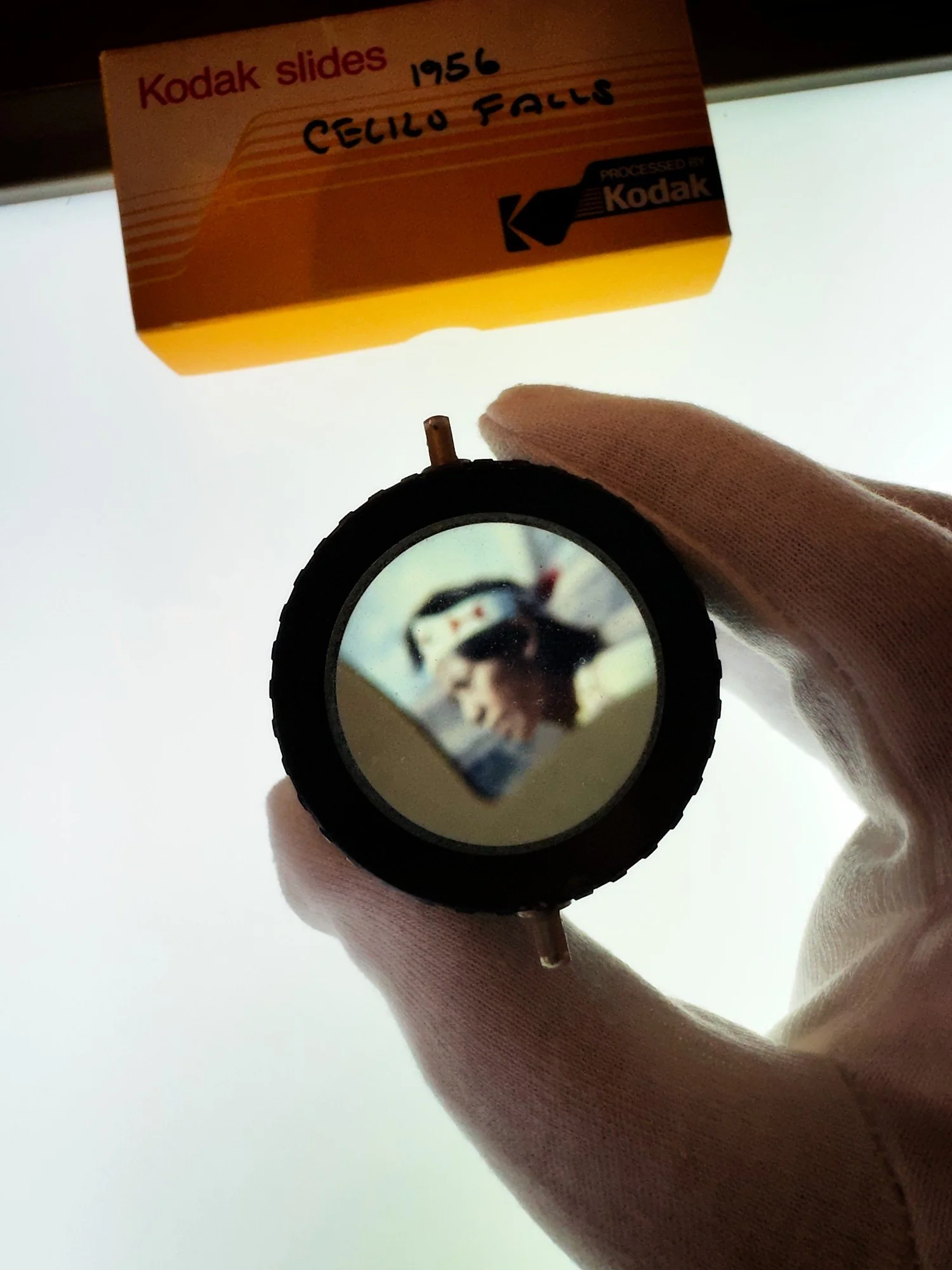
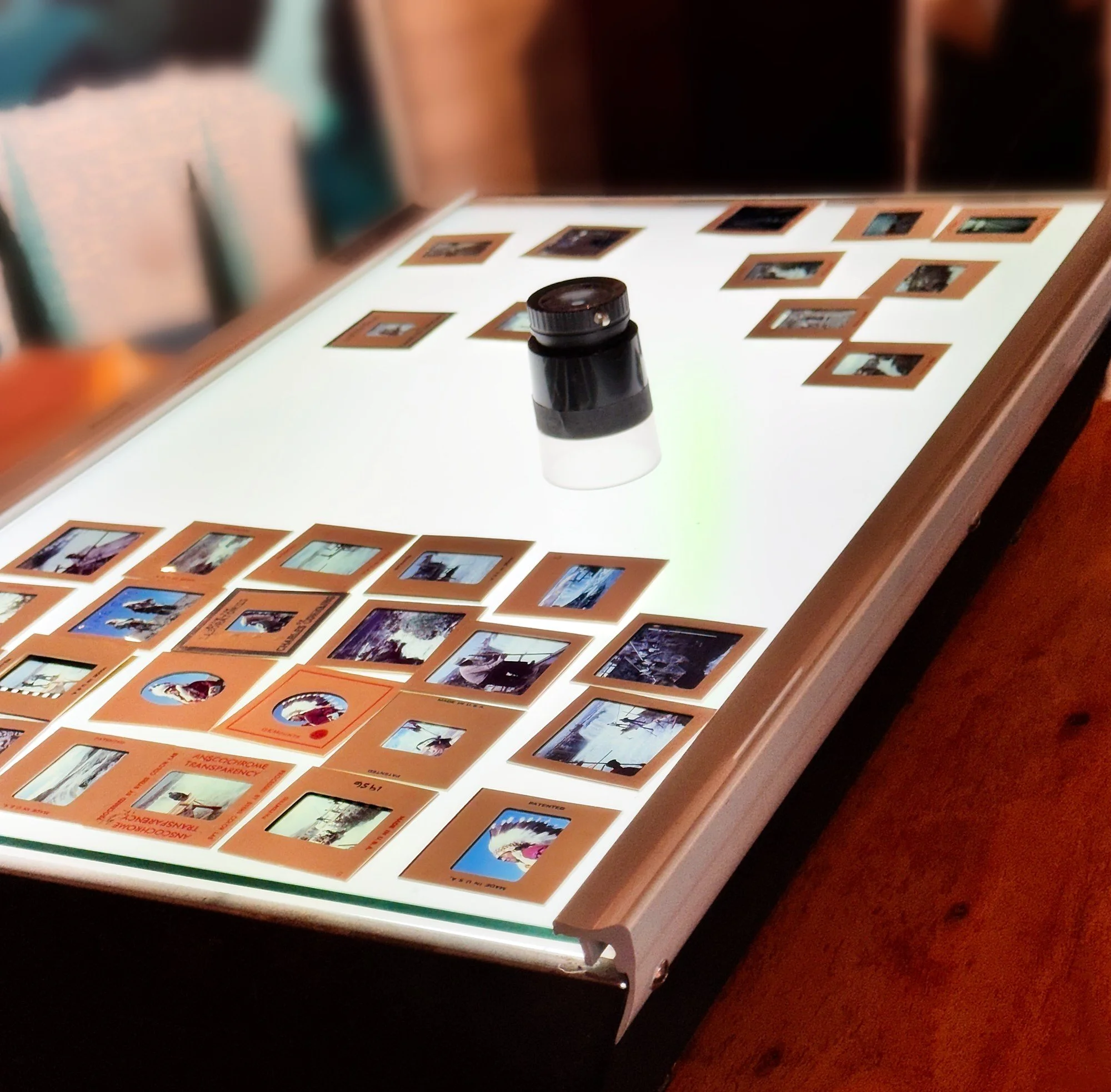
He carried two cameras and two rolls of color film.
He was not making photographs after the fact.
He was not photographing ruins.
And he was not looking back at a place already defined by its loss.
Celilo was still there.
The river still thundered through the rocks.
Fishermen still stood on platforms above the current.
Young people gathered nearby.
Families and groups occupied the landscape.
Richard moved between wide views of the river and close portraits of individual people.
Twenty-three surviving negatives remain from that visit.
Looking at them now, knowing what happened only months later, it is almost impossible not to read the future into the photographs.
But Richard couldn't.
And neither could the people he photographed.
That may be one reason the images feel so alive.
They belong entirely to the present tense.
“Celilo still reverberates in the heart of every Native American who ever fished or lived by it.”–Ted Strong, Yakama elder, Columbia River Inter-Tribal Fish Commission
Celilo Did Not End in 1957
This is where the story requires particular care.
The falls were submerged.
Celilo's people were not erased.
Neither were the treaties, the cultural relationships, or the connection to the river.
Descendants of Native families connected to Celilo continue to fish along the Columbia and maintain salmon traditions. The four Columbia River treaty tribes continue to exercise treaty-reserved fishing rights and participate actively in the management and restoration of the river's fisheries today.
Celilo therefore belongs simultaneously to history and to the present.
The loss of the physical falls remains profound.
But describing Celilo only as something that disappeared risks repeating another kind of erasure.
It turns living people into historical subjects.
It makes a continuing culture sound concluded.
And it allows the dam to become the final chapter of a story that began thousands of years before it and continued afterward.
March 10, 1957 matters enormously.
It just isn't the end.
Looking Again
This is part of what makes Richard Stefani's photographs so important to us now.
They do not show us "the lost Celilo."
They show us Celilo.
A fisherman sits above the river.
Another works with an enormous dip net.
Young people gather among the rocks.
A woman looks toward Richard's camera.
An older man stands beneath a clear blue sky.
The Columbia moves behind them.
Richard did not know he was photographing the final months of the falls.
He simply looked at what was in front of him.
Nearly seventy years later, perhaps that is what these photographs ask us to do as well.
Look carefully.
Learn what we can.
Resist filling what we do not know with assumptions.
Remember that landscapes contain human stories.
And understand that history is rarely divided as neatly into before and after as we might like it to be.
To ask what was Celilo Falls? is necessary.
But perhaps the better question, once we have begun to understand it, is larger:
What is Celilo?
An ancestral fishery.
A village.
A gathering place.
A living cultural landscape.
A history of salmon and trade, family and treaty, loss and continuity.
A place whose physical form changed profoundly, but whose meaning did not disappear beneath the water.
And in twenty-three color photographs made during the fall of 1956, a place Richard Stefani happened to see before the water rose.
Editor's Note
This essay is part of The Before the Water Rose Journal, an ongoing series exploring Celilo Falls, Richard Stefani's 1956 photographs, the people and places they preserve, and the process of bringing this remarkable archive forward with care. The series will continue through the presentation of Before the Water Rose: Celilo Falls, 1956, and beyond, as research and new understanding of the photographs continue to emerge.
Sources & Further Reading
The Oregon Encyclopedia, “Celilo Falls,” by Katrine Barber.
Columbia River Inter-Tribal Fish Commission, “Celilo Falls.”
The Oregon Encyclopedia, “Native American Treaties, Northeastern Oregon.”
The Oregon Encyclopedia, “Celilo Fish Committee (1935–1957).”
Death of Celilo Falls, by Katrine Barber.
In Defense of Wyam: Native White Alliances and the Struggle for Celilo Village, by Katrine Barber.