THE CELILO FALLS COLLECTION
Before the Water Rose, 1956
Photographs by Richard Stefani
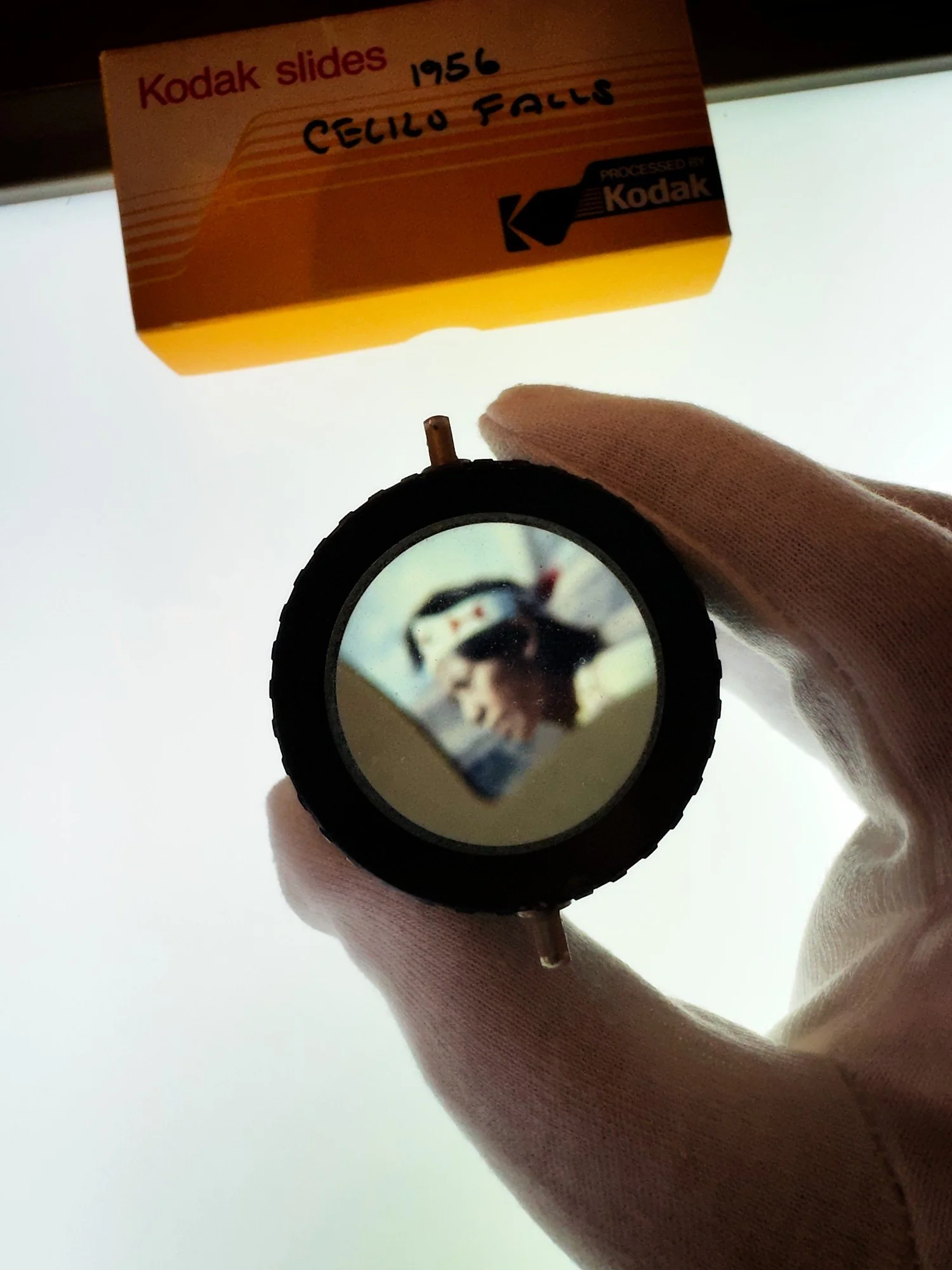
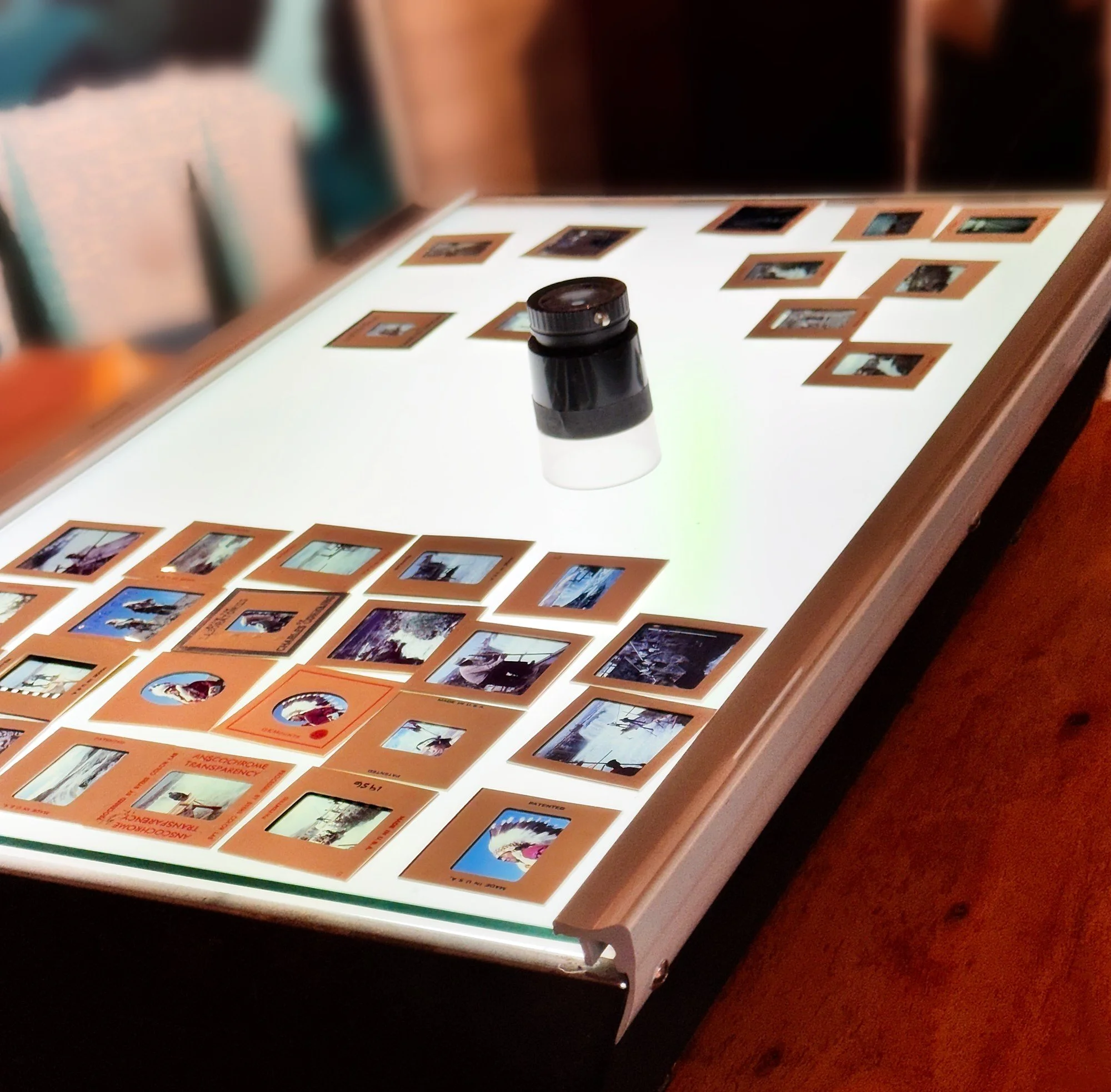
In the fall of 1956, twenty-three-year-old photographer Richard Stefani traveled to Celilo Falls on the Columbia River with two cameras and two rolls of color film.
The surviving photographs preserve the river, fishing platforms, fishermen, gatherings, and individual faces only months before the falls were submerged beneath the reservoir created by The Dalles Dam.
Nearly seventy years later, the Richard Stefani Estate has brought these photographs forward as a carefully produced series of limited Estate Editions.
Explore the collection below.
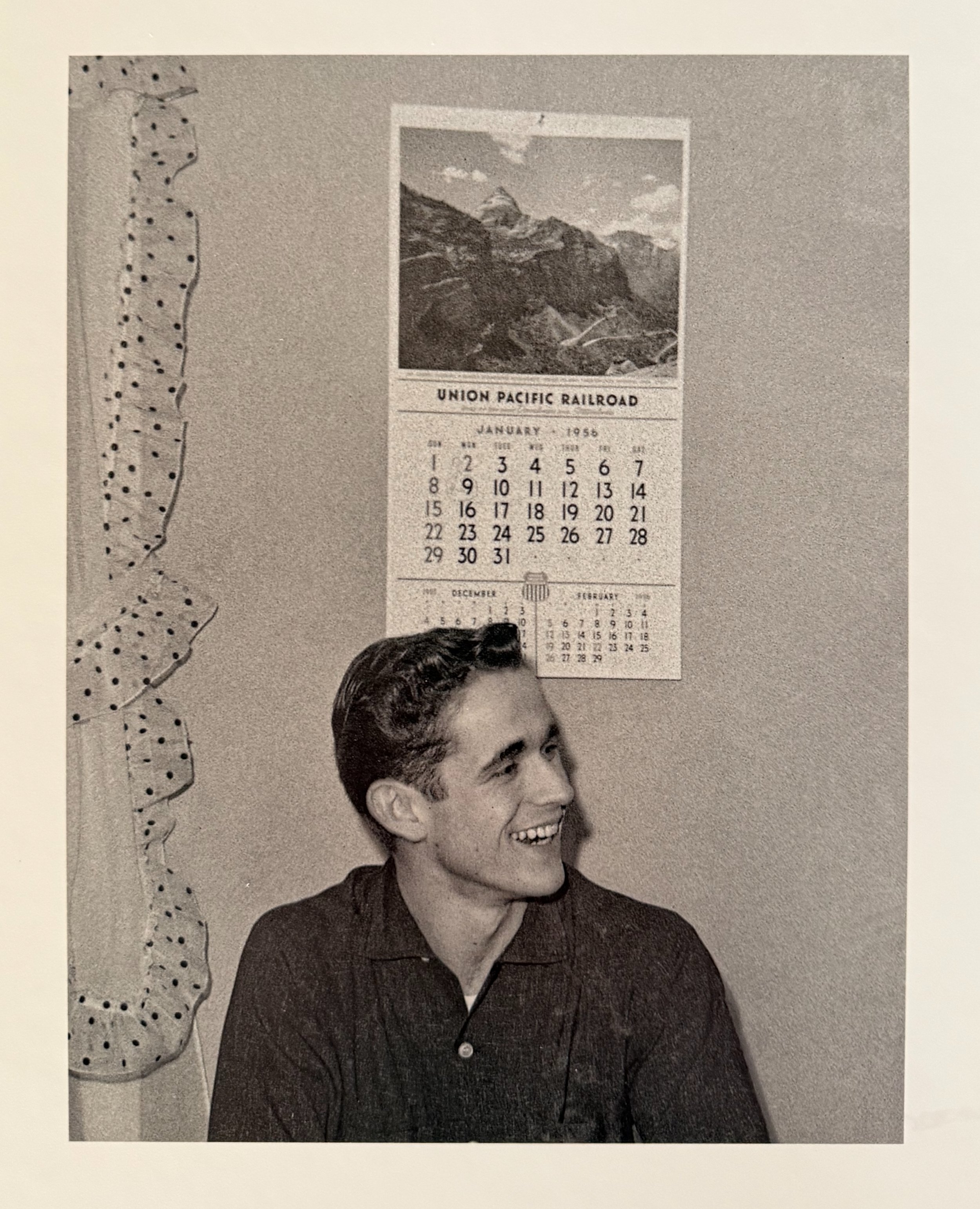
Richard Stefani (1933–2022)
From Before the Water Rose: Celilo Falls, 1956
Some photographs reveal a place.
Others reveal a way of life.
This photograph does both.
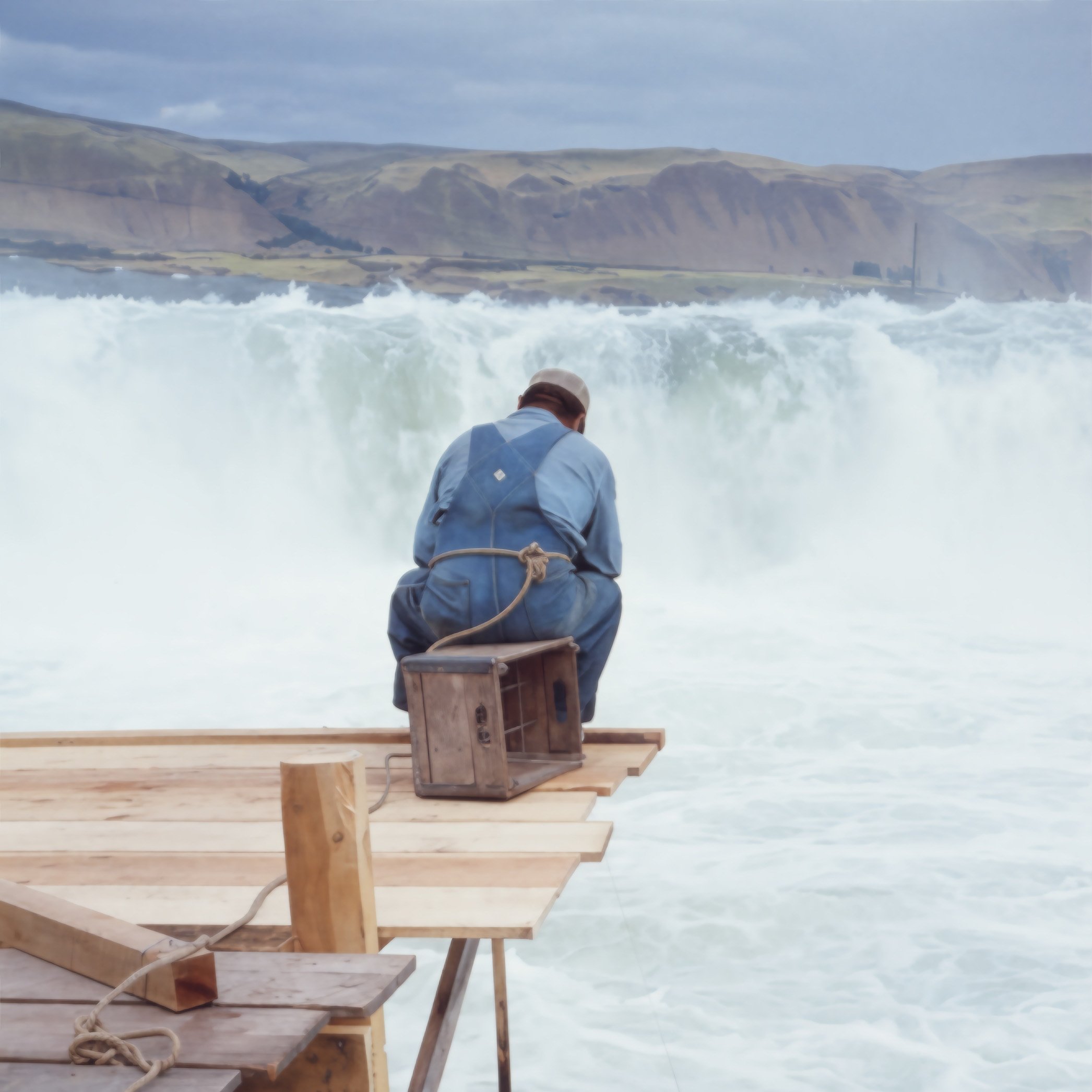
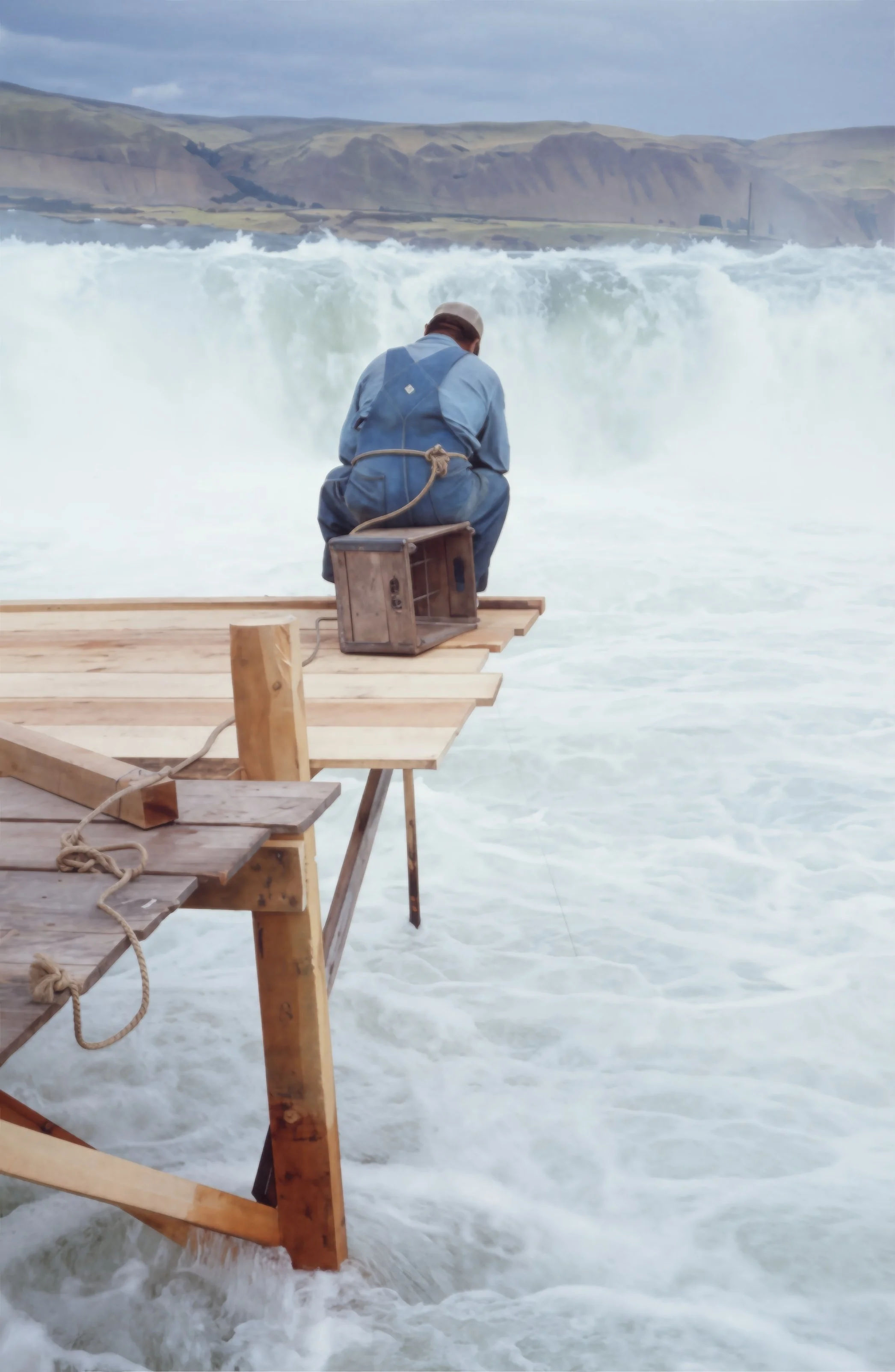
In the fall of 1956, twenty-three-year-old Richard Stefani stood beside the Columbia River with two cameras loaded with color film. Before him, an Indigenous fisherman sat quietly on a wooden platform extending over the immense current of Celilo Falls. There is no dramatic gesture, no acknowledgment of the camera. The fisherman is completely absorbed in his work.
The image speaks to a tradition refined over countless generations. Fishing platforms like this one were carefully positioned above the rushing water, allowing fishermen to dip net salmon as they moved upstream. Success depended not only on strength but on patience, experience, and an intimate understanding of the river.
Richard did not photograph this moment because he believed it would become historically important. He photographed it because it deserved his attention.
Within months, Celilo Falls would disappear beneath the reservoir created by The Dalles Dam. The falls themselves were lost from view, but the cultural traditions and treaty rights connected to this place continue today.
Looking back, this photograph reminds us that history is often preserved through quiet observation. It invites us to pause, to notice, and to recognize the dignity of ordinary work carried out in an extraordinary place.
Estate Edition
Printed from Richard Stefani's original 1956 color negative.
Chromogenic photographic print on Fuji Crystal Archive DP II paper, produced in Germany and mounted under matte, reflection-reducing acrylic glass with aluminum Dibond backing. Presented in a handcrafted Basel black oak floater frame. Ready to hang.
Each work is accompanied by Richard Stefani Estate documentation recording the photograph, edition number, edition size, production specifications, and provenance.
8 × 12 in.
Edition of 25
$1,500
16 × 24 in.
Edition of 15
$3,200
20 × 30 in.
Edition of 10
$6,500
Edition sizes are fixed and will not be increased.
Richard Stefani (1933–2022)
From Before the Water Rose: Celilo Falls, 1956
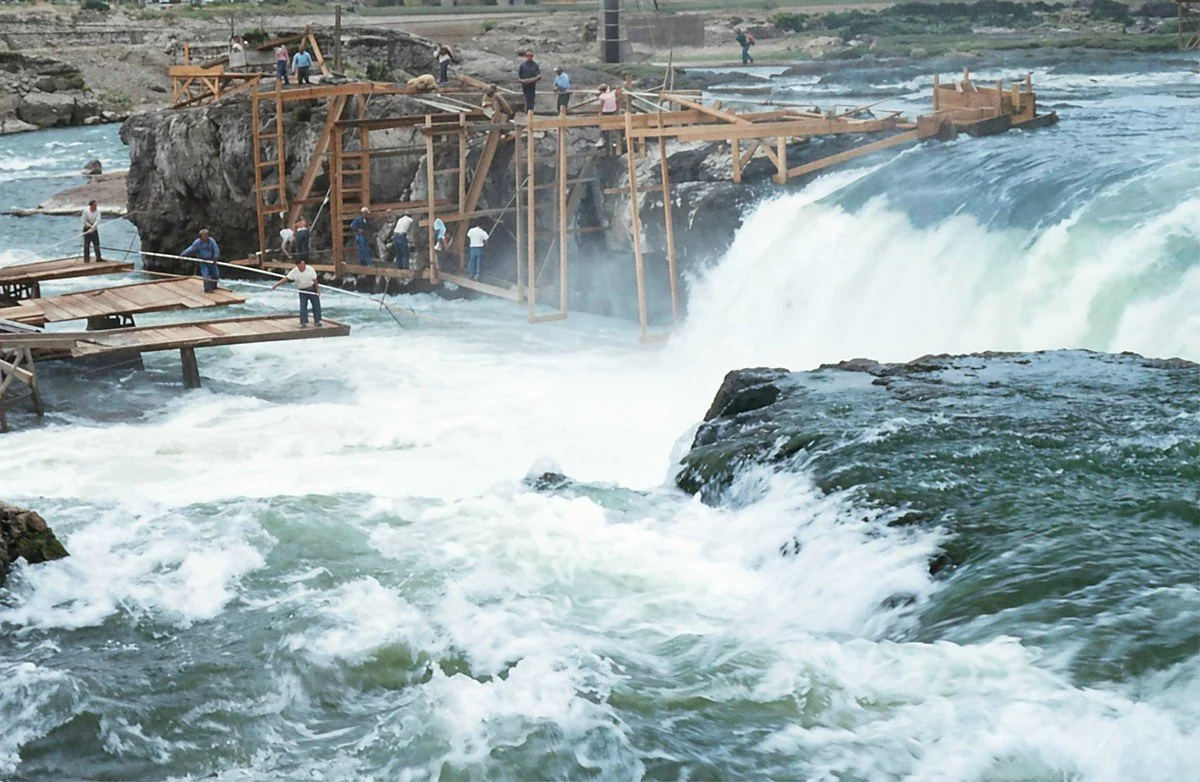
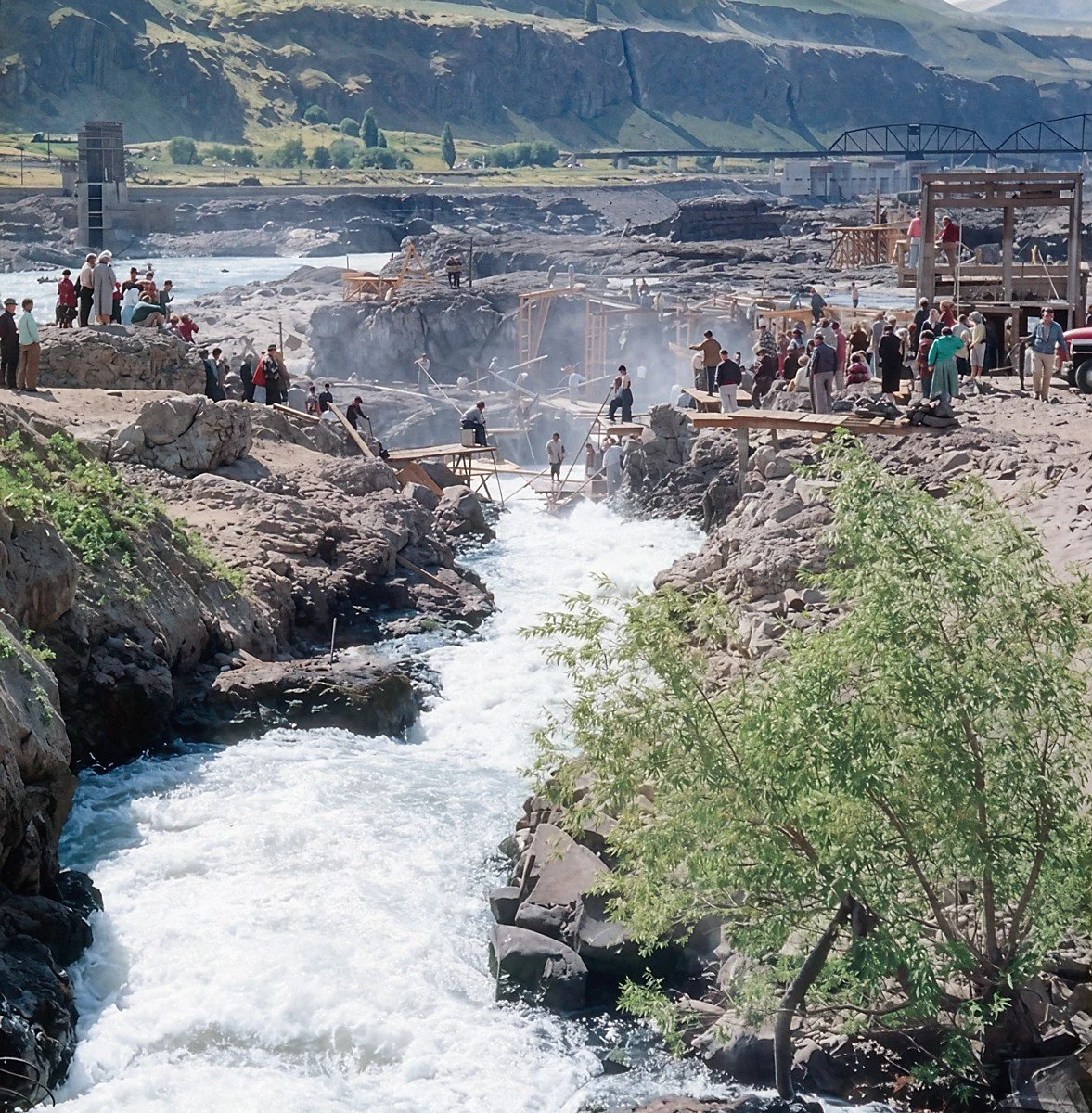
At first, the water dominates this photograph.
Then the structures begin to emerge.
Wooden platforms reach across rock and current. Ladders descend toward the river. Narrow walkways connect one working position to another. Figures stand at different heights, some close enough to the rushing water to be surrounded by spray.
Richard Stefani's photograph reveals Celilo Falls not simply as a landscape, but as a place shaped by generations of human knowledge.
The wooden structures appear almost delicate beside the tremendous volume of the Columbia. Yet their placement suggests something very different: an intimate understanding of where to stand, where the salmon moved, how the current behaved, and how people could work within a river of extraordinary force.
Richard was twenty-three when he made this photograph in the fall of 1956. He did not isolate a single fisherman or attempt to simplify the scene. Instead, he allowed its complexity to remain.
That decision gives the photograph unusual historical value today. We can study the construction of the platforms, the positions of the fishermen, the relationship between rock and water, and the extraordinary physical environment in which the work took place.
Only months later, the landscape would be transformed by the reservoir behind The Dalles Dam.
Here, however, everything is still in motion.
The river rushes through the frame.
People work.
And Celilo is alive.
Estate Edition
Printed from Richard Stefani's original 1956 color negative.
Chromogenic photographic print on Fuji Crystal Archive DP II paper, produced in Germany and mounted under matte, reflection-reducing acrylic glass with aluminum Dibond backing. Presented in a handcrafted Basel black oak floater frame. Ready to hang.
Each work is accompanied by Richard Stefani Estate documentation recording the photograph, edition number, edition size, production specifications, and provenance.
12 × 8 in.
Edition of 25
$1,500
24 × 16 in.
Edition of 15
$3,200
30 × 20 in.
Edition of 10
$6,500
Edition sizes are fixed and will not be increased.
Richard Stefani (1933–2022)
From Before the Water Rose: Celilo Falls, 1956
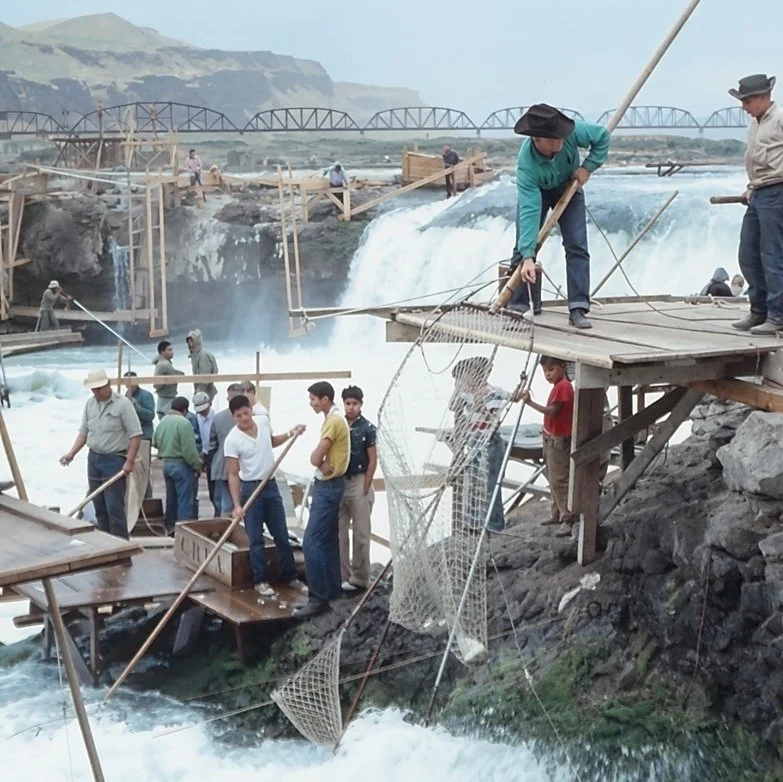
There is almost no empty space in this photograph.
People, timber, nets, rocks, water and sky overlap one another from foreground to distance.
At the upper right, a fisherman leans over the edge of a platform with a long-handled net. Below him, others occupy platforms closer to the water. Across the falls, more wooden structures extend between the rocks. The railroad bridge traces a horizontal line through the distance.
Richard Stefani has photographed an entire working environment.
It would have been easy to make this scene picturesque. Instead, Richard embraced its complexity.
That choice matters.
Celilo Falls was not merely something to look at. It was a place in use. Generations of accumulated knowledge were embedded in where platforms were constructed, where fishermen positioned themselves, how nets were handled, and how people moved through a landscape dominated by powerful water.
The photograph also helps correct an easy misconception about historic places. We often encounter them after the people have disappeared, as landscapes, ruins, or markers.
Richard encountered Celilo while it was alive with activity.
His camera preserves that distinction.
The result is not a photograph of what had been.
It is a photograph of what was.
Estate Edition
Printed from Richard Stefani's original 1956 color negative.
Chromogenic photographic print on Fuji Crystal Archive DP II paper, produced in Germany and mounted under matte, reflection-reducing acrylic glass with aluminum Dibond backing. Presented in a handcrafted Basel black oak floater frame. Ready to hang.
Each work is accompanied by Richard Stefani Estate documentation recording the photograph, edition number, edition size, production specifications, and provenance.
10 × 10 in.
Edition of 25
$1,500
20 × 20 in.
Edition of 15
$3,200
30 × 30 in.
Edition of 10
$6,500
Edition sizes are fixed and will not be increased.
Richard Stefani (1933–2022)
From Before the Water Rose: Celilo Falls, 1956
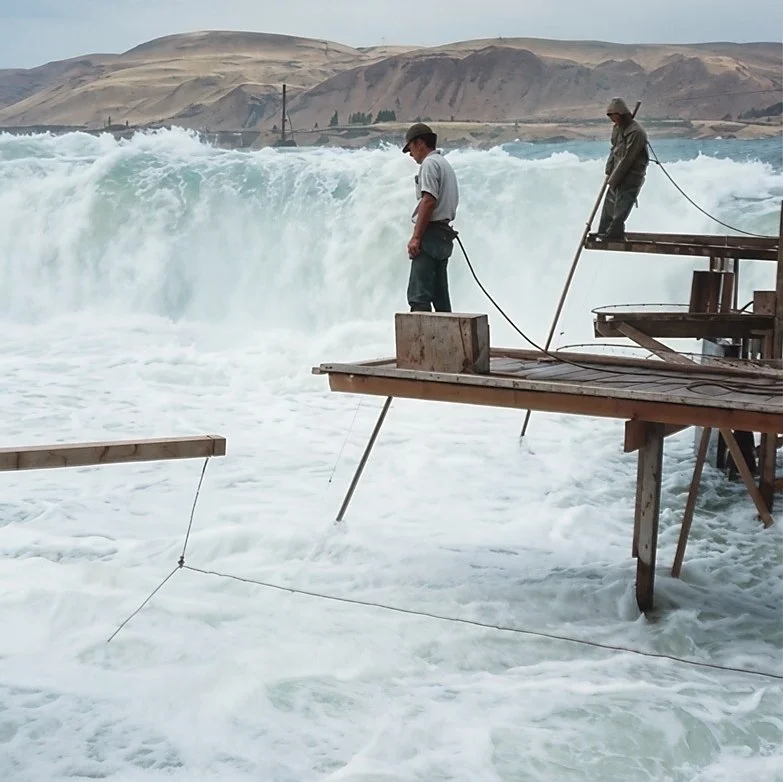
There is an unusual amount of space in this photograph.
Richard Stefani gives much of the frame to water.
Two figures stand apart from one another on wooden platforms. Behind them, the river rises into a broad wall of white and pale green. Beyond it, the dry hills of the Columbia Gorge stretch beneath an overcast sky.
The photograph feels almost suspended.
Unlike some of Richard's more densely populated Celilo scenes, there is little here to distract the eye. The geometry is simple. Horizontal platforms meet vertical supports. Thin ropes and poles cross the water. Human figures stand against a river vastly larger than themselves.
Yet the men do not appear overwhelmed by the landscape.
They belong within it.
That may be one of the most important things Richard's photographs allow us to understand about Celilo. Photographs of dramatic landscapes often reduce people to scale markers. Here, the relationship is more complicated. The river is immense, but the people are not incidental.
The wooden structures, ropes, tools, and positions occupied above the current speak to knowledge acquired through experience.
Richard's photograph holds that relationship without explaining it.
He simply lets us look.
Estate Edition
Printed from Richard Stefani's original 1956 color negative.
Chromogenic photographic print on Fuji Crystal Archive DP II paper, produced in Germany and mounted under matte, reflection-reducing acrylic glass with aluminum Dibond backing. Presented in a handcrafted Basel black oak floater frame. Ready to hang.
Each work is accompanied by Richard Stefani Estate documentation recording the photograph, edition number, edition size, production specifications, and provenance.
10 × 10 in.
Edition of 25
$1,500
20 × 20 in.
Edition of 15
$3,200
30 × 30 in.
Edition of 10
$6,500
Edition sizes are fixed and will not be increased.
Richard Stefani (1933–2022)
From Before the Water Rose: Celilo Falls, 1956
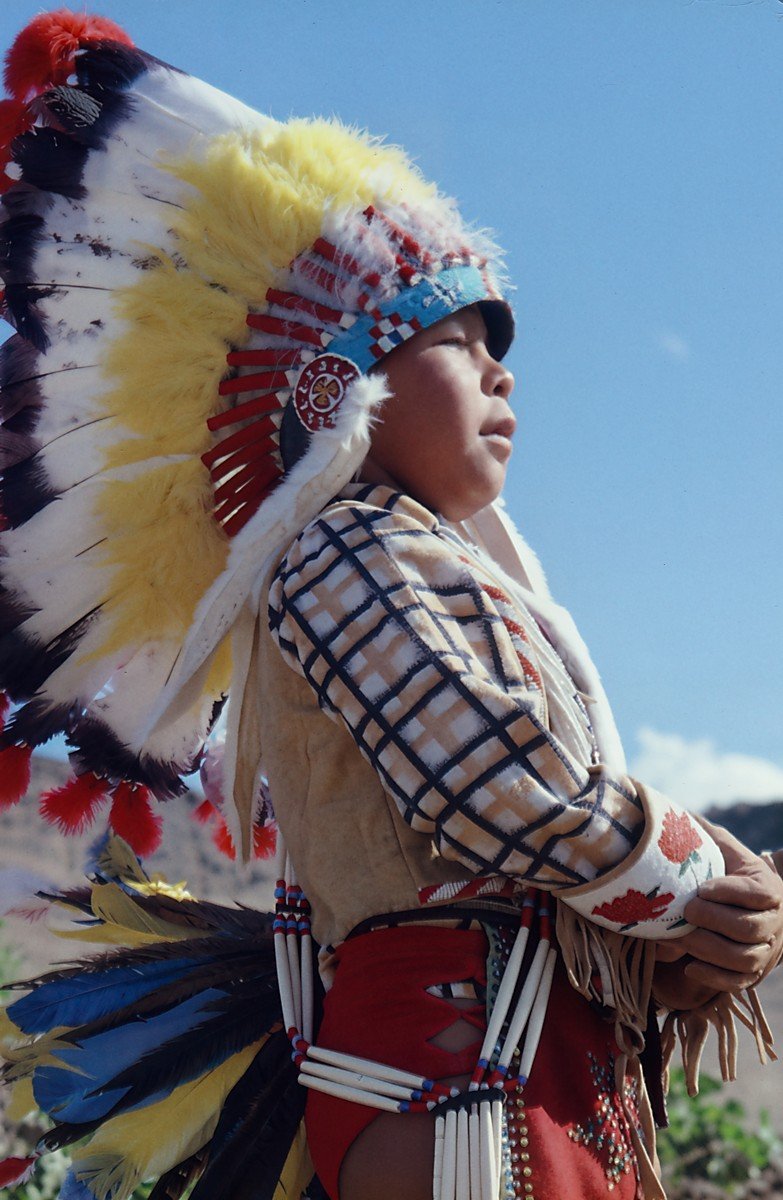
He is not looking at Richard.
That small fact gives this portrait much of its power.
The young man's face is shown in profile, his attention directed beyond the edge of the photograph. His hands rest together. Behind him is mostly blue sky, with only a small suggestion of landscape near the bottom of the frame.
Richard Stefani has removed nearly everything that might distract us from the person before him.
The result is one of the most visually striking photographs in the Celilo series.
Color is essential to it.
Yellow, red, blue, white, black, tan. Pattern sits beside pattern. Feathers extend beyond the body into the sky. Beadwork and other carefully made elements become part of the visual structure of the portrait.
Yet the photograph should not be reduced to its color.
Its real strength is presence.
We do not currently know this young man's identity, tribal affiliation, or the precise context in which Richard photographed him. Those questions remain part of the continuing research surrounding the archive.
For now, the photograph asks something simpler of us.
Look at him.
Not as an illustration of 1956.
Not as a symbol of Celilo.
As an individual person who stood before Richard Stefani's camera on a particular day nearly seventy years ago.
Richard looked carefully.
Now we can, too.
Estate Edition
Printed from Richard Stefani's original 1956 color negative.
Chromogenic photographic print on Fuji Crystal Archive DP II paper, produced in Germany and mounted under matte, reflection-reducing acrylic glass with aluminum Dibond backing. Presented in a handcrafted Basel black oak floater frame. Ready to hang.
Each work is accompanied by Richard Stefani Estate documentation recording the photograph, edition number, edition size, production specifications, and provenance.
8 × 12 in.
Edition of 25
$1,500
16 × 24 in.
Edition of 15
$3,200
20 × 30 in.
Edition of 10
$6,500
Edition sizes are fixed and will not be increased.
Richard Stefani (1933–2022)
From Before the Water Rose: Celilo Falls, 1956
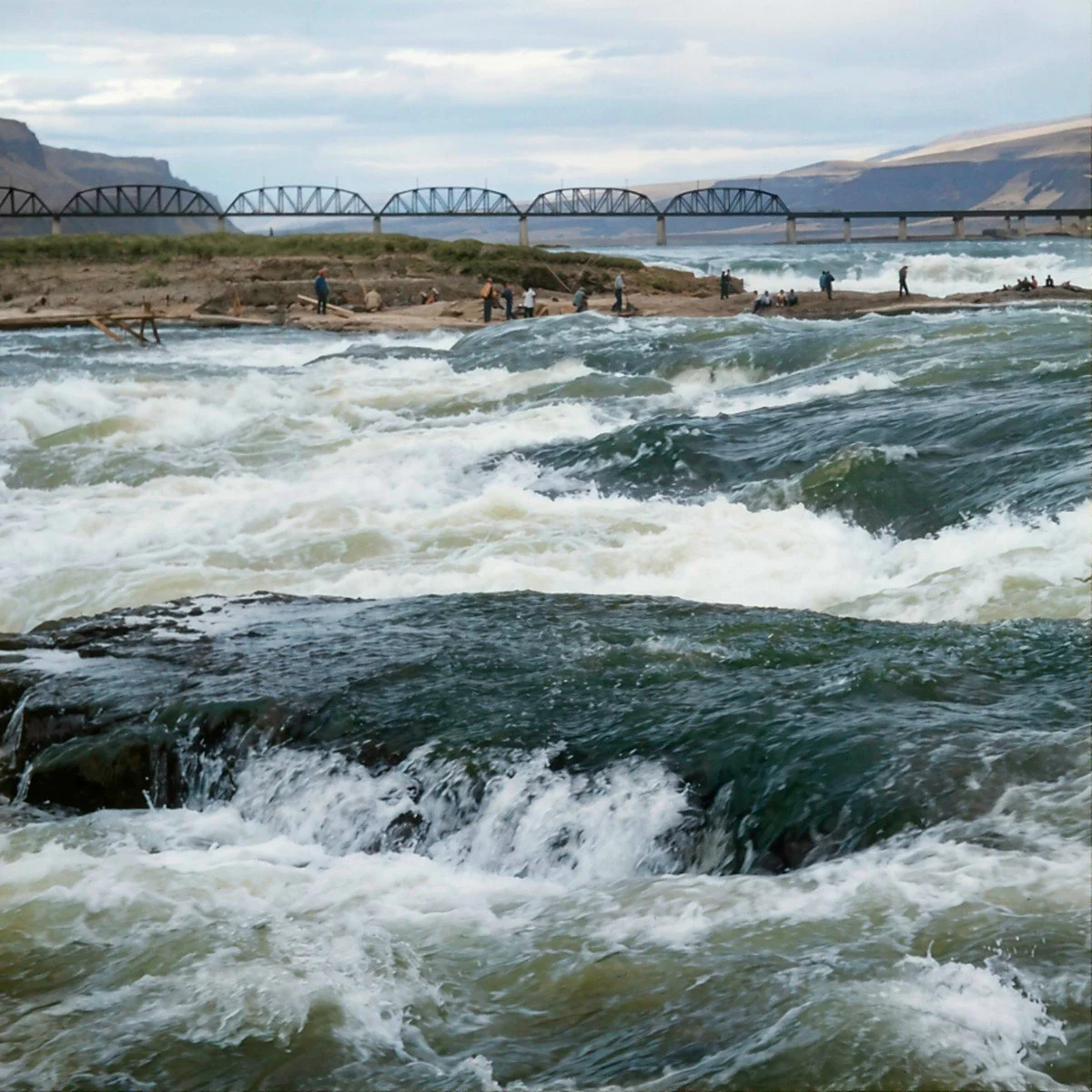
In this photograph, the river nearly wins.
Water fills the foreground and middle distance in successive layers of green, blue and white. The current rises, breaks, falls and gathers again. Richard places us close enough that the Columbia seems to move toward us.
Only gradually do we notice the people.
They are small.
Across the middle of the photograph, figures stand on a long strip of exposed rock. Behind them, the railroad bridge crosses the frame. Beyond it rise the hills of the Gorge.
The scale is extraordinary.
Yet Richard's photograph does something more subtle than demonstrate the power of the river.
It refuses to separate landscape from human presence.
Celilo was both.
A place of immense natural force and a place of human life.
The people may appear small against the Columbia, but they are not insignificant within the photograph. Once we see them, our understanding of the image changes. The river is no longer an empty landscape.
It is inhabited.
That idea runs quietly through Richard's entire Celilo archive.
Again and again, he reminds us that what disappeared beneath the reservoir was not simply a geological feature.
It was a place where people were.
Estate Edition
Printed from Richard Stefani's original 1956 color negative.
Chromogenic photographic print on Fuji Crystal Archive DP II paper, produced in Germany and mounted under matte, reflection-reducing acrylic glass with aluminum Dibond backing. Presented in a handcrafted Basel black oak floater frame. Ready to hang.
Each work is accompanied by Richard Stefani Estate documentation recording the photograph, edition number, edition size, production specifications, and provenance.
10 × 10 in.
Edition of 25
$1,500
20 × 20 in.
Edition of 15
$3,200
30 × 30 in.
Edition of 10
$6,500
Edition sizes are fixed and will not be increased.
Richard Stefani (1933–2022)
From Before the Water Rose: Celilo Falls, 1956
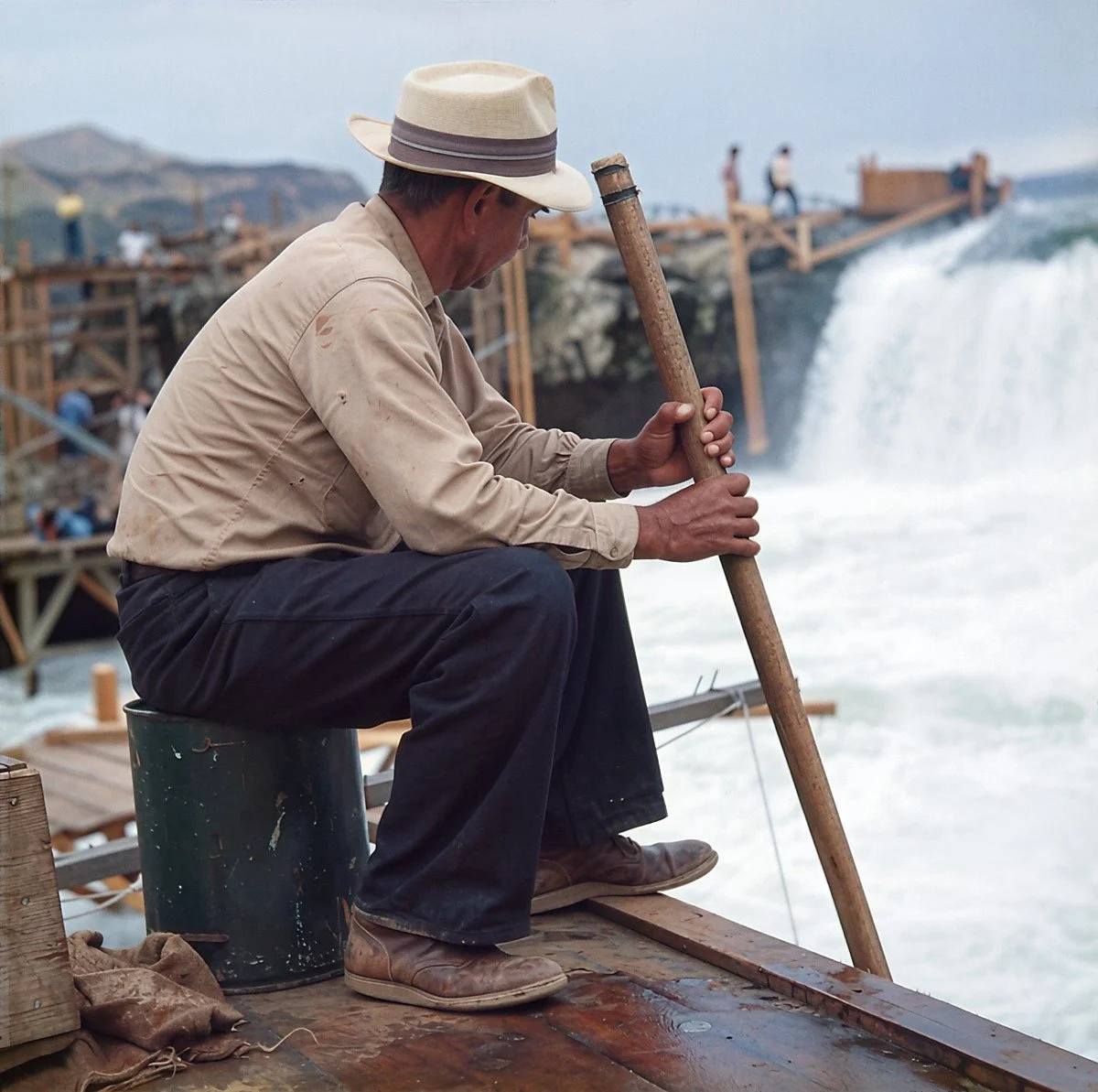
For a moment, the work stops.
A fisherman sits at the edge of the river.
His hands rest around a long wooden pole. His hat shades his face. His boots are planted on the wet boards beneath him. Behind him, Celilo Falls continues to thunder.
Richard notices the pause.
That may be what makes this photograph so affecting.
There is nothing theatrical about it. The man does not appear to be performing for the camera. He seems absorbed in his own moment between actions.
And Richard lets him be.
Look at how much the young photographer tells us without requiring his subject to face us.
The worn clothing.
The hands around the pole.
The boots.
The wet platform.
The equipment scattered nearby.
The falls blurred behind him.
This is portraiture through observation.
Decades later, Richard Stefani would become known for photographing people. Here, at twenty-three, we can already see one of the instincts that would serve him throughout that career.
He understood that a person's presence could sometimes be revealed most clearly when they were not looking at the camera at all.
Estate Edition
Printed from Richard Stefani's original 1956 color negative.
Chromogenic photographic print on Fuji Crystal Archive DP II paper, produced in Germany and mounted under matte, reflection-reducing acrylic glass with aluminum Dibond backing. Presented in a handcrafted Basel black oak floater frame. Ready to hang.
Each work is accompanied by Richard Stefani Estate documentation recording the photograph, edition number, edition size, production specifications, and provenance.
10 × 10 in.
Edition of 25
$1,500
20 × 20 in.
Edition of 15
$3,200
30 × 30 in.
Edition of 10
$6,500
Edition sizes are fixed and will not be increased.
Richard Stefani (1933–2022)
From Before the Water Rose: Celilo Falls, 1956
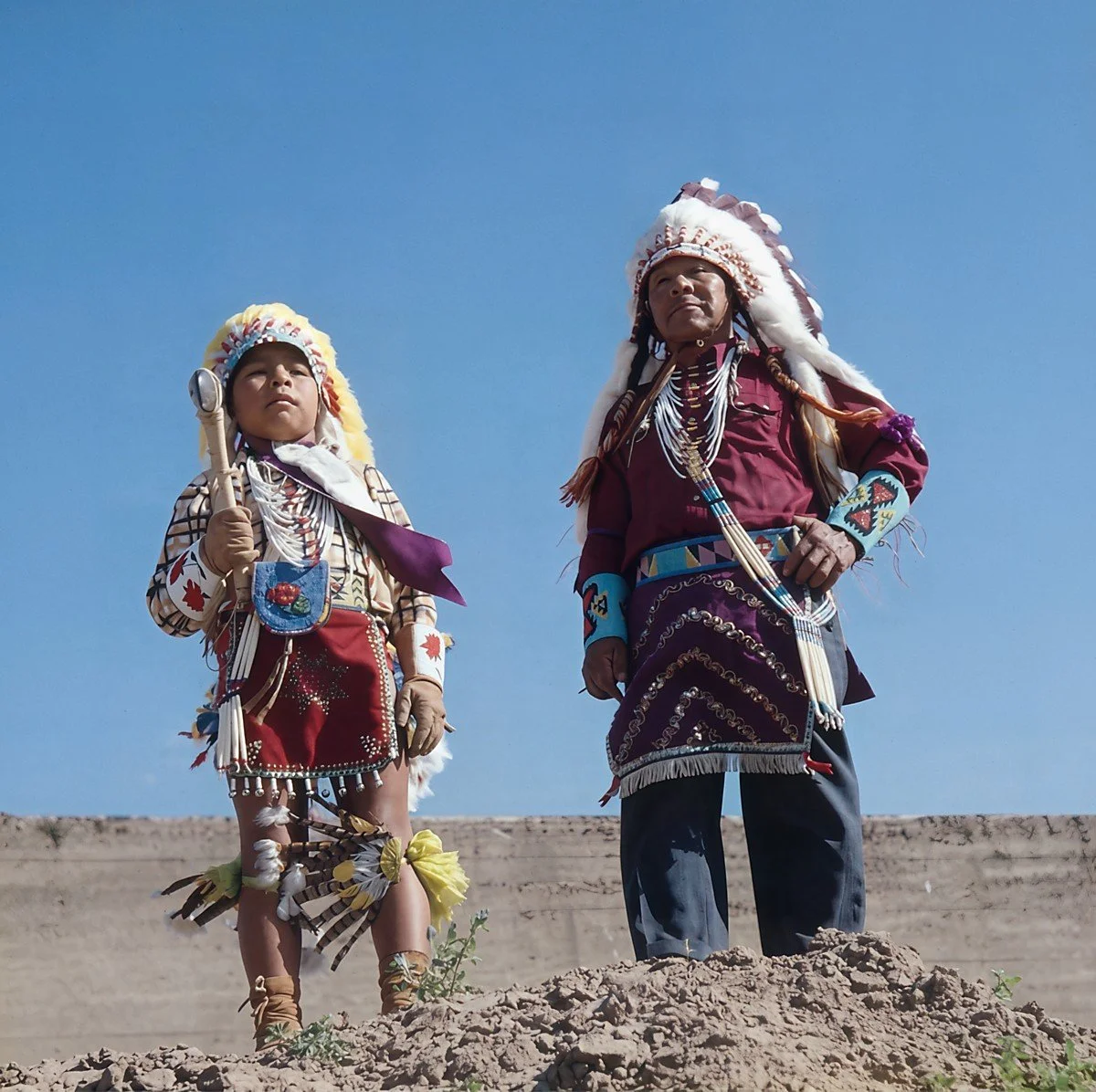
Two people stand against an enormous blue sky.
A boy at left.
An older man at right.
Richard photographs them from below, giving both figures a striking monumentality. There is almost nothing behind them except sky and a low horizontal structure.
Everything else falls away.
The result is among the most formally powerful portraits in the Celilo archive.
The boy holds an object in one hand. The older man stands beside him. Both wear elaborate clothing, beadwork and feathered headdresses. Their expressions are composed. Neither smiles for Richard's camera.
And here, perhaps more than anywhere else in this archive, we need to let the photograph outrun our desire to explain it.
We do not yet know who they are.
We do not know their relationship to one another.
We should not assume that they are grandfather and grandson, father and son, chief and successor, or participants in any particular ceremony.
Those stories would be tempting.
They would also be inventions.
What Richard actually preserved is already enough.
Two generations.
Two individual presences.
One extraordinary moment in the fall of 1956.
The title Generations at Celilo therefore describes what we can see without claiming what we cannot know.
Perhaps research will eventually give these two people their names.
Until then, we can honor them by resisting the urge to supply names or stories ourselves.
Estate Edition
Printed from Richard Stefani's original 1956 color negative.
Chromogenic photographic print on Fuji Crystal Archive DP II paper, produced in Germany and mounted under matte, reflection-reducing acrylic glass with aluminum Dibond backing. Presented in a handcrafted Basel black oak floater frame. Ready to hang.
Each work is accompanied by Richard Stefani Estate documentation recording the photograph, edition number, edition size, production specifications, and provenance.
10 × 10 in.
Edition of 25
$1,500
20 × 20 in.
Edition of 15
$3,200
30 × 30 in.
Edition of 10
$6,500
Edition sizes are fixed and will not be increased.
Richard Stefani (1933–2022)
From Before the Water Rose: Celilo Falls, 1956
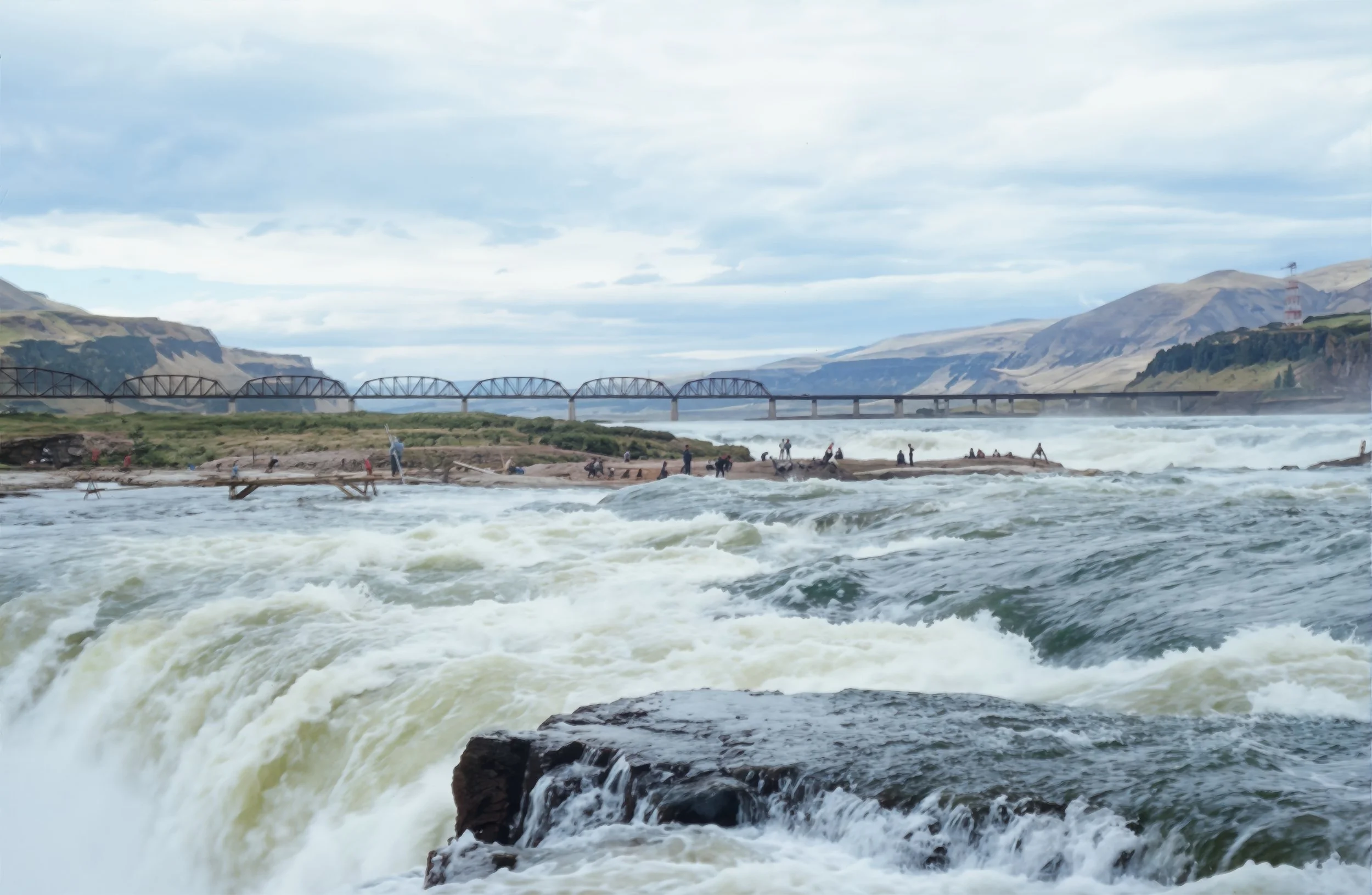
There are few photographs that allow us to stand within a landscape that no longer exists.
This is one of them.
Richard Stefani made this photograph in the fall of 1956 while exploring Celilo Falls with two cameras loaded with color film. Rather than focusing on a single individual, he stepped back to reveal the larger landscape: the immense force of the Columbia River, the fishing platforms extending into the current, and the broad sweep of hills rising beyond the water.
The scene feels timeless.
Yet we know it was not.
Only a few months after this photograph was made, the closing of The Dalles Dam inundated Celilo Falls beneath the waters of the newly formed reservoir. The physical landscape changed forever.
The photograph reminds us that places are more than geography. They are shaped by the people who gather there, the traditions they sustain, and the memories they create. For thousands of years, Celilo Falls was a place of fishing, trade, ceremony, and community. Those connections continue today, even though the falls themselves remain beneath the river.
Richard's photograph asks us to look carefully, not simply at a remarkable landscape, but at a place whose significance cannot be measured by scenery alone.
Estate Edition
Printed from Richard Stefani's original 1956 color negative.
Chromogenic photographic print on Fuji Crystal Archive DP II paper, produced in Germany and mounted under matte, reflection-reducing acrylic glass with aluminum Dibond backing. Presented in a handcrafted Basel black oak floater frame. Ready to hang.
Each work is accompanied by Richard Stefani Estate documentation recording the photograph, edition number, edition size, production specifications, and provenance.
12 × 8 in.
Edition of 25
$1,500
24 × 16 in.
Edition of 15
$3,200
30 × 20 in.
Edition of 10
$6,500
Edition sizes are fixed and will not be increased.
Richard Stefani (1933–2022)
From Before the Water Rose: Celilo Falls, 1956
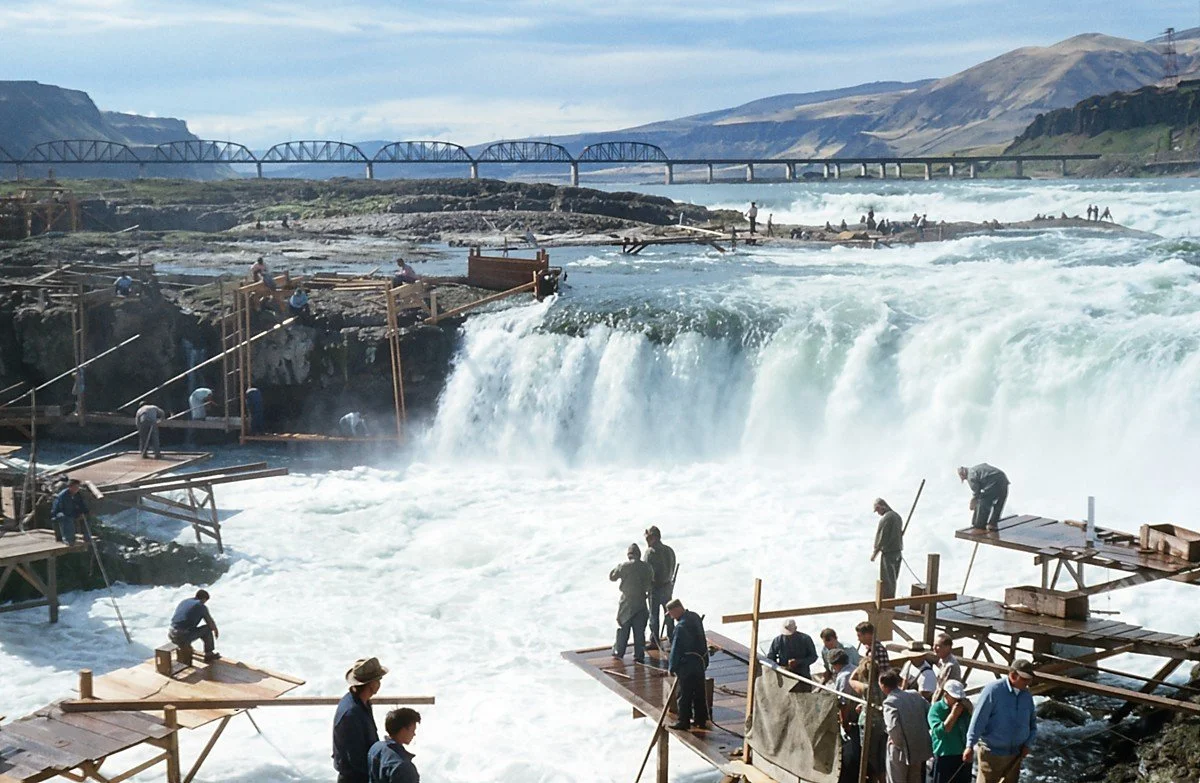
To understand Celilo Falls, it is not enough to look only at the water.
Look at the people.
Richard Stefani filled this photograph with them.
Some stand at the river's edge. Others occupy wooden platforms suspended above the current. Some appear to be fishing while others watch, wait, talk, or move through the scene. Behind them, the railroad bridge crosses the Columbia and the dry hills of the Gorge rise in the distance.
Nothing has been simplified for the camera.
That is precisely what makes the photograph so valuable.
Richard allows us to see Celilo as a working place. The river may be visually spectacular, but it is not empty wilderness. Human activity exists throughout the frame.
The photograph also rewards close looking. At first we see the falls. Then platforms. Then individual figures. Then nets, poles, timbers, pathways and gathering places. The longer we look, the more populated the landscape becomes.
Taken in the fall of 1956, the photograph preserves a place on the verge of profound physical change. Yet there is no sense of an ending within Richard's frame. People are simply going about what they came to the river to do.
That distinction lies at the heart of Before the Water Rose.
We know what happened next.
Richard's subjects were living in the present.
His photograph allows us, briefly, to enter it with them.
Estate Edition
Printed from Richard Stefani's original 1956 color negative.
Chromogenic photographic print on Fuji Crystal Archive DP II paper, produced in Germany and mounted under matte, reflection-reducing acrylic glass with aluminum Dibond backing. Presented in a handcrafted Basel black oak floater frame. Ready to hang.
Each work is accompanied by Richard Stefani Estate documentation recording the photograph, edition number, edition size, production specifications, and provenance.
12 × 8 in.
Edition of 25
$1,500
24 × 16 in.
Edition of 15
$3,200
30 × 20 in.
Edition of 10
$6,500
Edition sizes are fixed and will not be increased.
Richard Stefani (1933–2022)
From Before the Water Rose: Celilo Falls, 1956
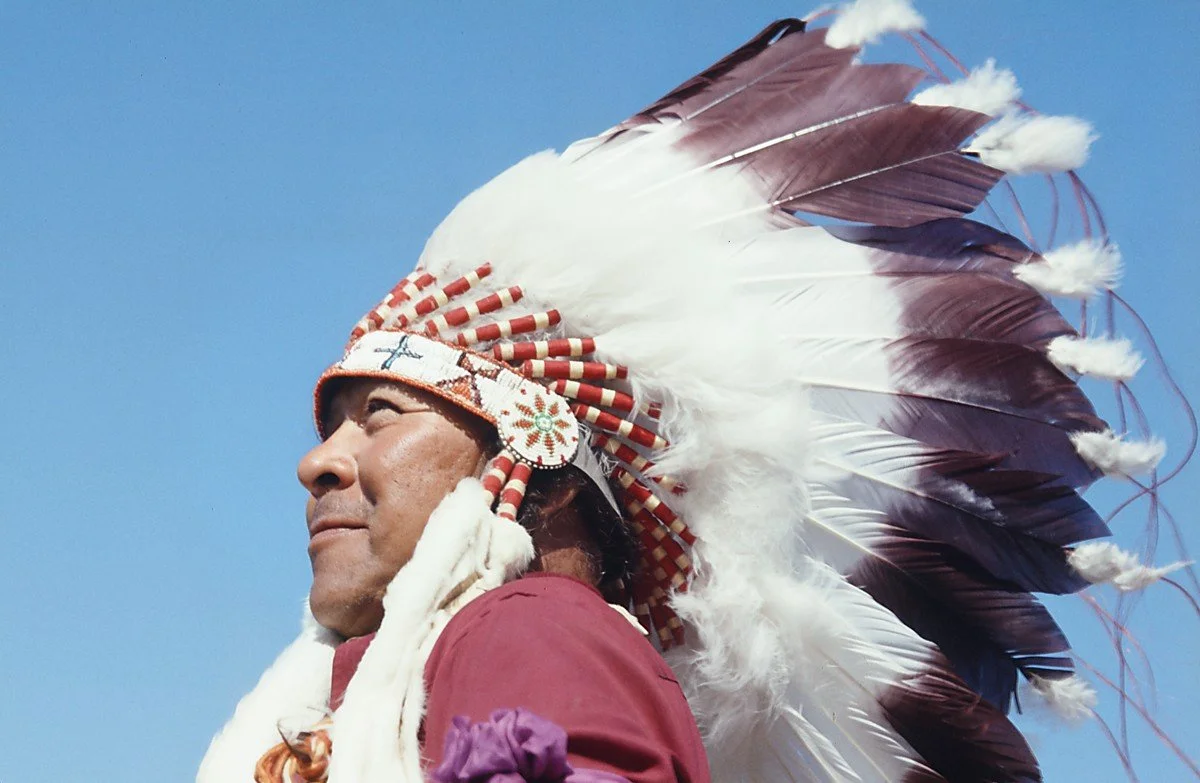
For a moment, the river disappears.
There are no falls.
No fishing platforms.
No railroad bridge.
No Columbia Gorge.
Only a man against an extraordinary blue sky.
The change in Richard Stefani's visual language is striking.
Throughout his Celilo photographs, Richard frequently places people within the landscape, allowing the river and the human presence to share the frame. Here, he does the opposite.
He comes close.
The man's face is shown in profile, his gaze directed beyond the photograph. The feathered headdress fills much of the composition, its white and dark feathers sharply defined against the blue. Beaded details, color, texture and light become unusually vivid.
We do not yet know this man's identity.
That absence matters.
Rather than filling the silence with assumptions, the Richard Stefani Estate has chosen to leave questions of identity, affiliation, and the specific context of the portrait open while research continues.
What the photograph itself tells us is considerable.
Richard saw a person worth stopping for.
He moved close enough to make a portrait.
And he composed the image with remarkable simplicity and confidence.
The photograph also gives us an early glimpse of the portrait photographer Richard would become. In later decades, he would build a career around his ability to make photographs in which people retained a sense of themselves before the camera.
Here, at twenty-three, that instinct is already present.
Estate Edition
Printed from Richard Stefani's original 1956 color negative.
Chromogenic photographic print on Fuji Crystal Archive DP II paper, produced in Germany and mounted under matte, reflection-reducing acrylic glass with aluminum Dibond backing. Presented in a handcrafted Basel black oak floater frame. Ready to hang.
Each work is accompanied by Richard Stefani Estate documentation recording the photograph, edition number, edition size, production specifications, and provenance.
12 × 8 in.
Edition of 25
$1,500
24 × 16 in.
Edition of 15
$3,200
30 × 20 in.
Edition of 10
$6,500
Edition sizes are fixed and will not be increased.
Richard Stefani (1933–2022)
From Before the Water Rose: Celilo Falls, 1956
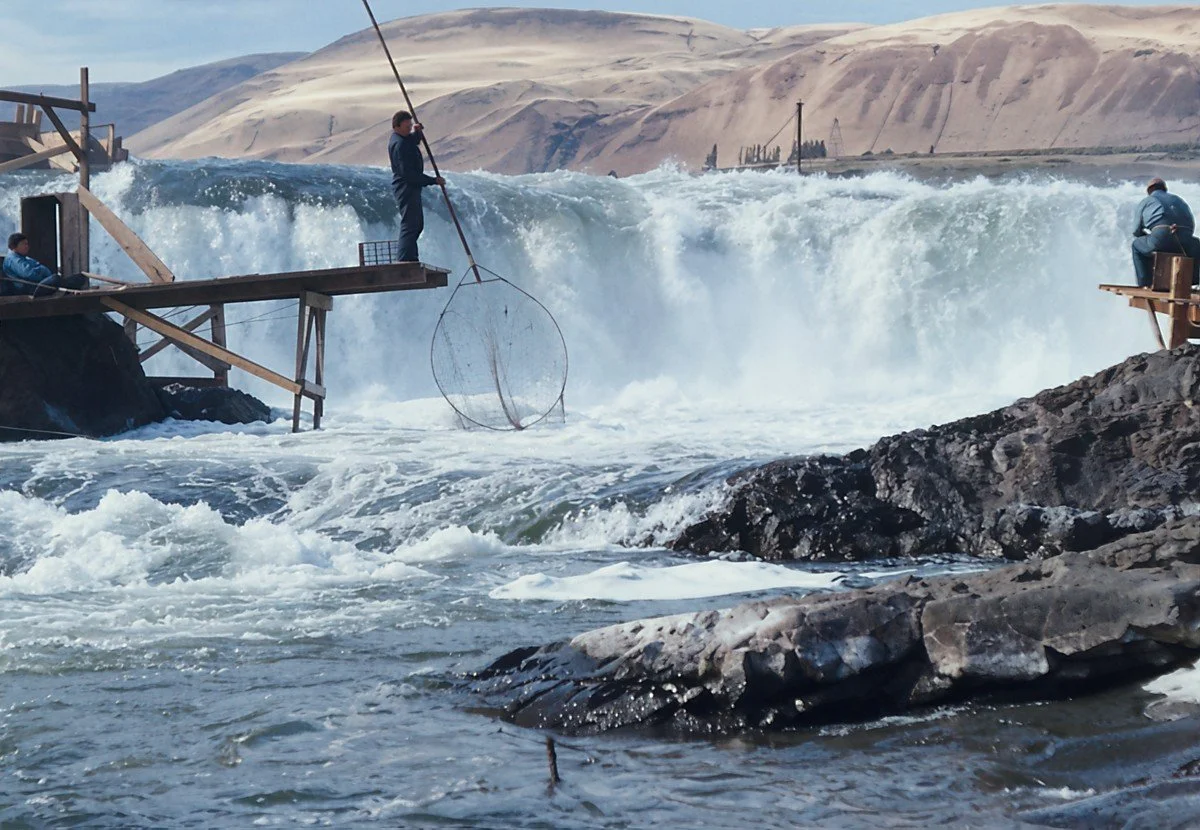
The net forms an enormous circle against the water.
A fisherman stands on a narrow wooden platform, holding a long pole upright while the net reaches into the Columbia below. Across the channel, another man sits alone on a small platform above the rocks.
Between them is the river.
Richard Stefani's composition is remarkably balanced. The fisherman at left, the seated figure at right, the dark rocks below, and the pale curtain of the falls behind them create a scene that feels almost elemental.
But this is not an abstract composition.
It is work.
The size of the dip net becomes especially apparent when seen beside the person handling it. So does the length of the pole and the narrowness of the platform from which he works.
Richard's photograph allows us to study those physical relationships without turning them into spectacle.
The fisherman is not performing for the camera. His attention remains on the river.
That quality appears again and again in these photographs. Richard seems most interested when people are absorbed in what they are doing.
Perhaps that is why the photographs feel so immediate today.
We are not being shown a demonstration of life at Celilo.
For a fraction of a second, we are witnessing it.
Estate Edition
Printed from Richard Stefani's original 1956 color negative.
Chromogenic photographic print on Fuji Crystal Archive DP II paper, produced in Germany and mounted under matte, reflection-reducing acrylic glass with aluminum Dibond backing. Presented in a handcrafted Basel black oak floater frame. Ready to hang.
Each work is accompanied by Richard Stefani Estate documentation recording the photograph, edition number, edition size, production specifications, and provenance.
12 × 8 in.
Edition of 25
$1,500
24 × 16 in.
Edition of 15
$3,200
30 × 20 in.
Edition of 10
$6,500
Edition sizes are fixed and will not be increased.
Richard Stefani (1933–2022)
From Before the Water Rose: Celilo Falls, 1956
Here, Richard steps back.
The decision transforms the portrait.
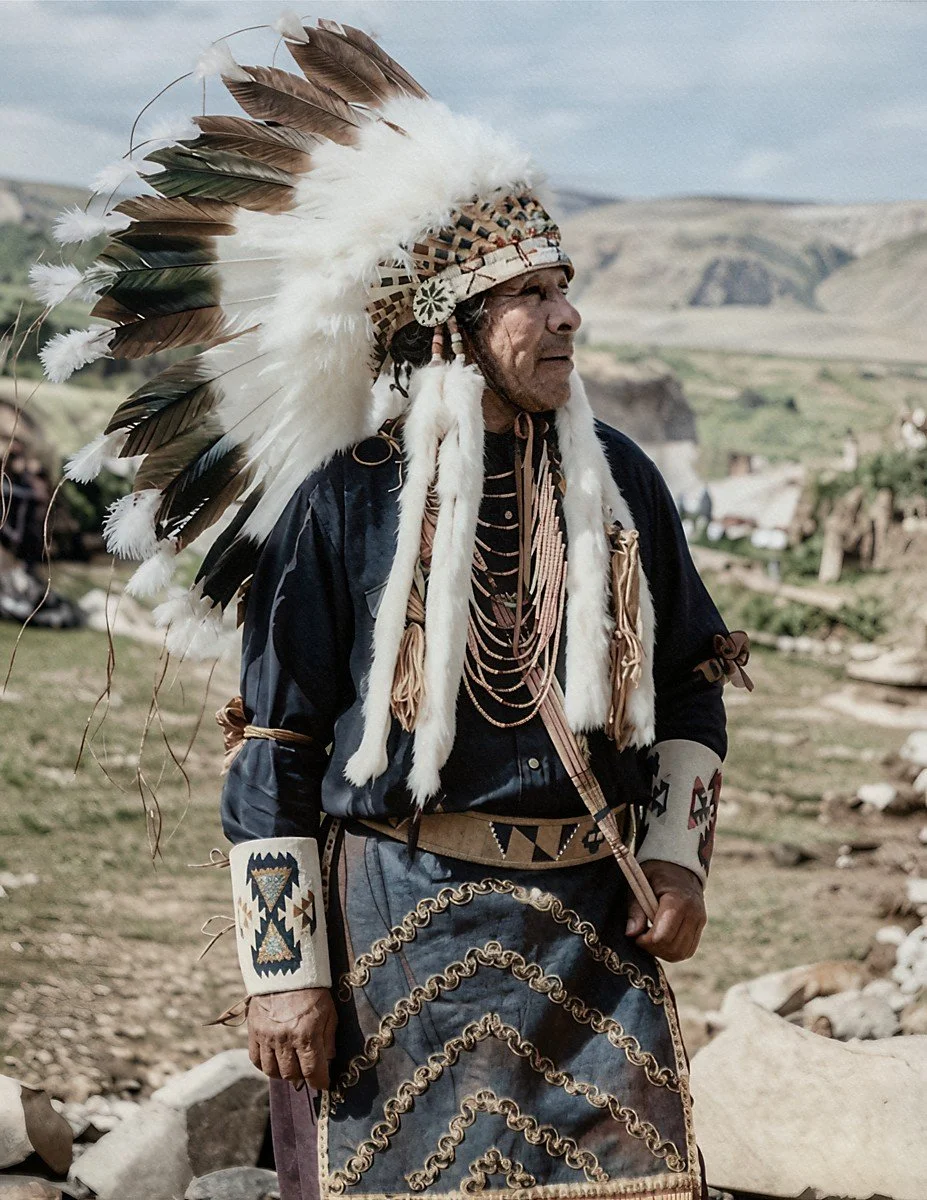
We see the man nearly full length, standing within the landscape at Celilo. His clothing, beadwork and feathered headdress fill much of the composition, but Richard also gives us the world around him: earth, rocks, vegetation, distant hills, structures and figures receding into the background.
Person and place coexist.
The man's gaze is directed away from the camera. His posture is composed and self-possessed. Richard does not appear to be searching for a fleeting expression. He allows the man simply to stand before him.
There is tremendous visual information in this photograph, and that is precisely where restraint becomes important.
We do not yet know enough to explain the cultural significance of what he wears. Nor should we infer identity or status from appearance alone.
Intriguingly, an archival scan of this photograph has been labeled "Celilo Chief." That may preserve important knowledge about the subject, or it may be a later descriptive filename. Until its origin can be established, the Richard Stefani Estate should treat it as a research lead rather than a confirmed identification.
What requires no speculation is the dignity of the portrait.
Richard gives the man room.
He gives the landscape room.
And he allows both to carry their own weight.
Estate Edition
Printed from Richard Stefani's original 1956 color negative.
Chromogenic photographic print on Fuji Crystal Archive DP II paper, produced in Germany and mounted under matte, reflection-reducing acrylic glass with aluminum Dibond backing. Presented in a handcrafted Basel black oak floater frame. Ready to hang.
Each work is accompanied by Richard Stefani Estate documentation recording the photograph, edition number, edition size, production specifications, and provenance.
8 × 12 in.
Edition of 25
$1,500
16 × 24 in.
Edition of 15
$3,200
20 × 30 in.
Edition of 10
$6,500
Edition sizes are fixed and will not be increased.
Richard Stefani (1933–2022)
From Before the Water Rose: Celilo Falls, 1956
This may become one of the most important photographs in the Celilo archive.
Not because it is the most dramatic.
Because of who is in it.
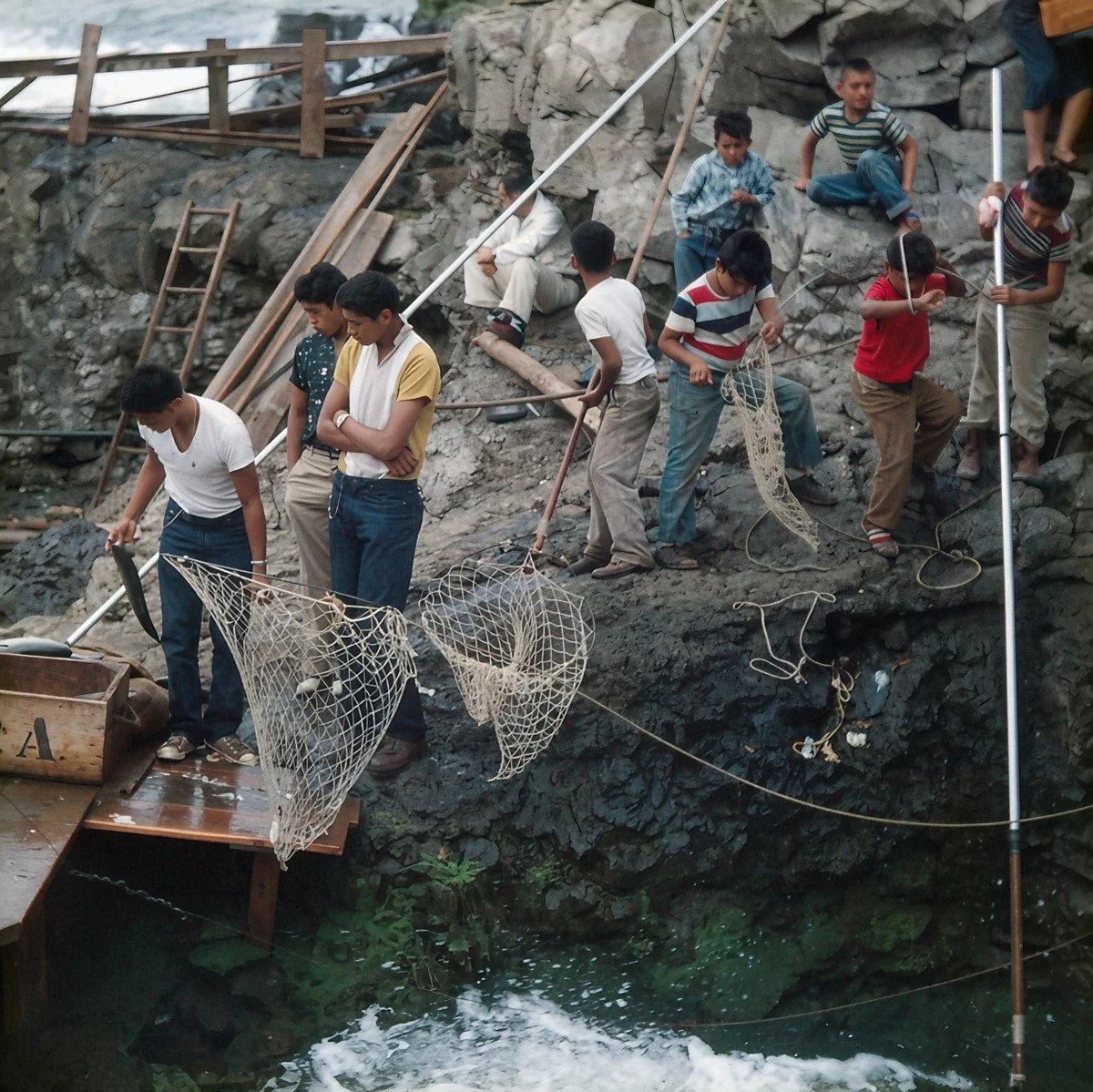
Boys and young men occupy almost every part of Richard Stefani's frame. Some hold long poles. Several handle nets. One young man at left appears to hold a fish. Others sit or stand among the rocks, watching or participating.
There are adults visible too, but youth dominates the photograph.
And that changes the story.
Much of the visual power of Before the Water Rose comes from knowing what happened only months after Richard made these photographs. The falls would be submerged. The physical landscape would change profoundly.
But this photograph complicates any temptation to treat Celilo only as something that ended.
Here we see another generation.
We see young people within the working environment of the river, surrounded by tools, structures and other people.
Without additional historical testimony, we should not claim precisely what each person was learning or doing. The photograph alone cannot tell us.
But it can show us participation.
It can show us proximity.
It can show us generations occupying the same place.
That matters enormously.
Richard's camera caught something larger than a fishing scene.
It caught continuity.
Estate Edition
Printed from Richard Stefani's original 1956 color negative.
Chromogenic photographic print on Fuji Crystal Archive DP II paper, produced in Germany and mounted under matte, reflection-reducing acrylic glass with aluminum Dibond backing. Presented in a handcrafted Basel black oak floater frame. Ready to hang.
Each work is accompanied by Richard Stefani Estate documentation recording the photograph, edition number, edition size, production specifications, and provenance.
10 × 10 in.
Edition of 25
$1,500
20 × 20 in.
Edition of 15
$3,200
30 × 30 in.
Edition of 10
$6,500
Edition sizes are fixed and will not be increased.
Richard Stefani (1933–2022)
From Before the Water Rose: Celilo Falls, 1956
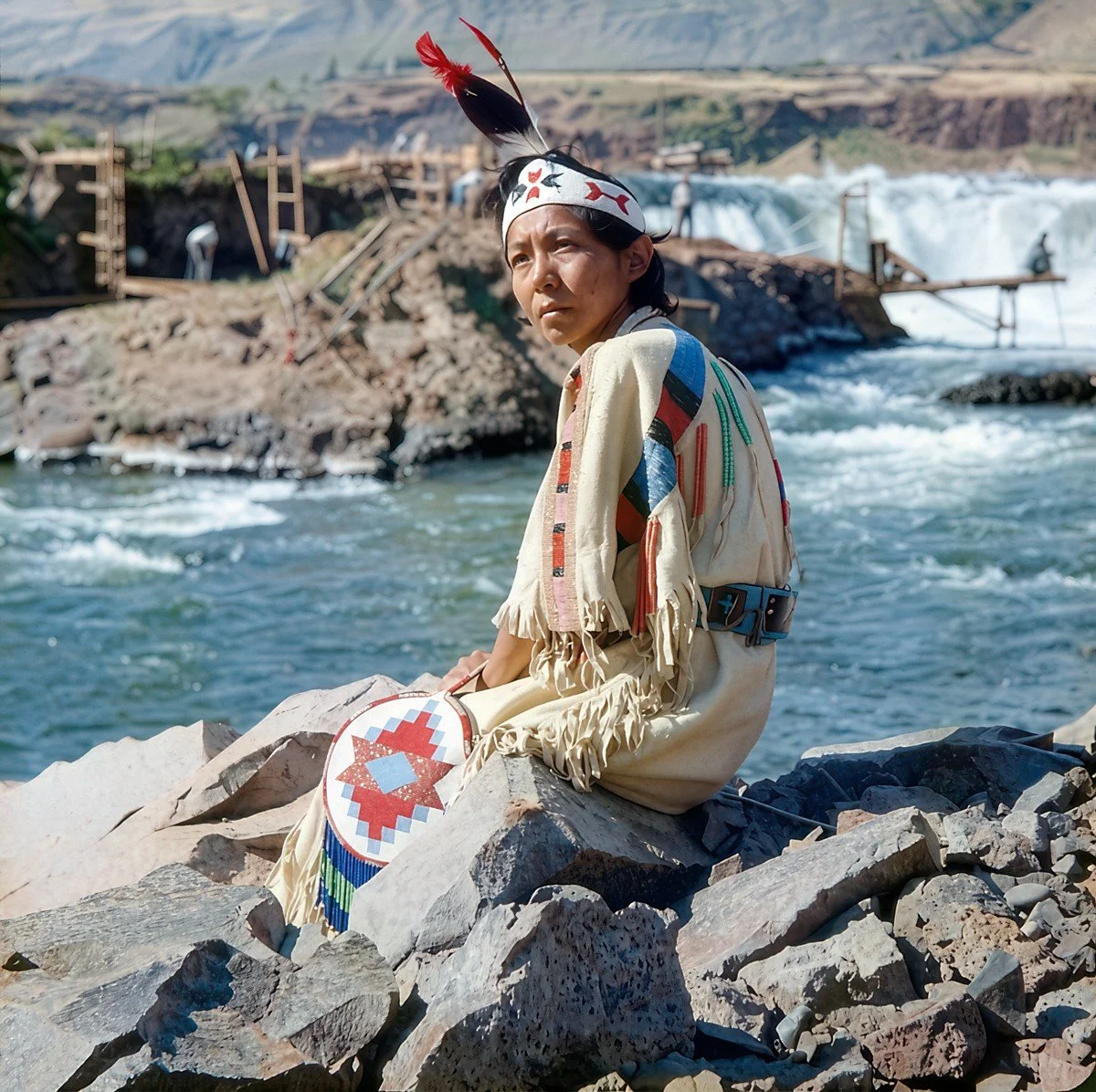
The young man sits among dark rocks beside the Columbia. Behind him the river moves through the frame, wooden fishing structures rise from the rocks, and Celilo Falls appears in the distance.
Now the portrait has a geography.
Richard has not made the landscape into a decorative background. He has allowed the person and the place to exist together.
The young man turns toward the photographer. His expression is direct but unforced.
There is an ease to the picture that feels strikingly mature for a twenty-three-year-old photographer.
This one studies presence within place.
The photograph begins to reveal how Richard was thinking. He was not simply collecting scenes. He was exploring what changed when he moved closer, stepped farther away, changed his background, or allowed the environment to become part of a portrait.
The master portrait photographer he would later become is not yet fully formed.
But he is unmistakably looking.
Estate Edition
Printed from Richard Stefani's original 1956 color negative.
Chromogenic photographic print on Fuji Crystal Archive DP II paper, produced in Germany and mounted under matte, reflection-reducing acrylic glass with aluminum Dibond backing. Presented in a handcrafted Basel black oak floater frame. Ready to hang.
Each work is accompanied by Richard Stefani Estate documentation recording the photograph, edition number, edition size, production specifications, and provenance.
10 × 10 in.
Edition of 25
$1,500
20 × 20 in.
Edition of 15
$3,200
30 × 30 in.
Edition of 10
$6,500
Edition sizes are fixed and will not be increased.

Richard Stefani (1933–2022)
From Before the Water Rose: Celilo Falls, 1956
A young woman sits among the rocks at Celilo Falls in the fall of 1956, looking directly toward Richard Stefani's camera. Behind her, fishing platforms extend over the rushing waters of the Columbia River.
Made when Richard was twenty-three, the photograph reveals an early sensitivity to portraiture that would become central to his later career. Her identity is not yet known to the Richard Stefani Estate. Rather than speculate, we leave the question open in the hope that future research, or someone who recognizes her, may one day restore her name to the photograph.
Estate Edition
Printed from Richard Stefani's original 1956 color negative.
Chromogenic photographic print on Fuji Crystal Archive DP II paper, produced in Germany and mounted under matte, reflection-reducing acrylic glass with aluminum Dibond backing. Presented in a handcrafted Basel black oak floater frame. Ready to hang.
Each work is accompanied by Richard Stefani Estate documentation recording the photograph, edition number, edition size, production specifications, and provenance.
10 × 10 in.
Edition of 25
$1,500
20 × 20 in.
Edition of 15
$3,200
30 × 30 in.
Edition of 10
$6,500
Edition sizes are fixed and will not be increased.
Richard Stefani (1933–2022)
From Before the Water Rose: Celilo Falls, 1956
Here, Richard Stefani brings us close.
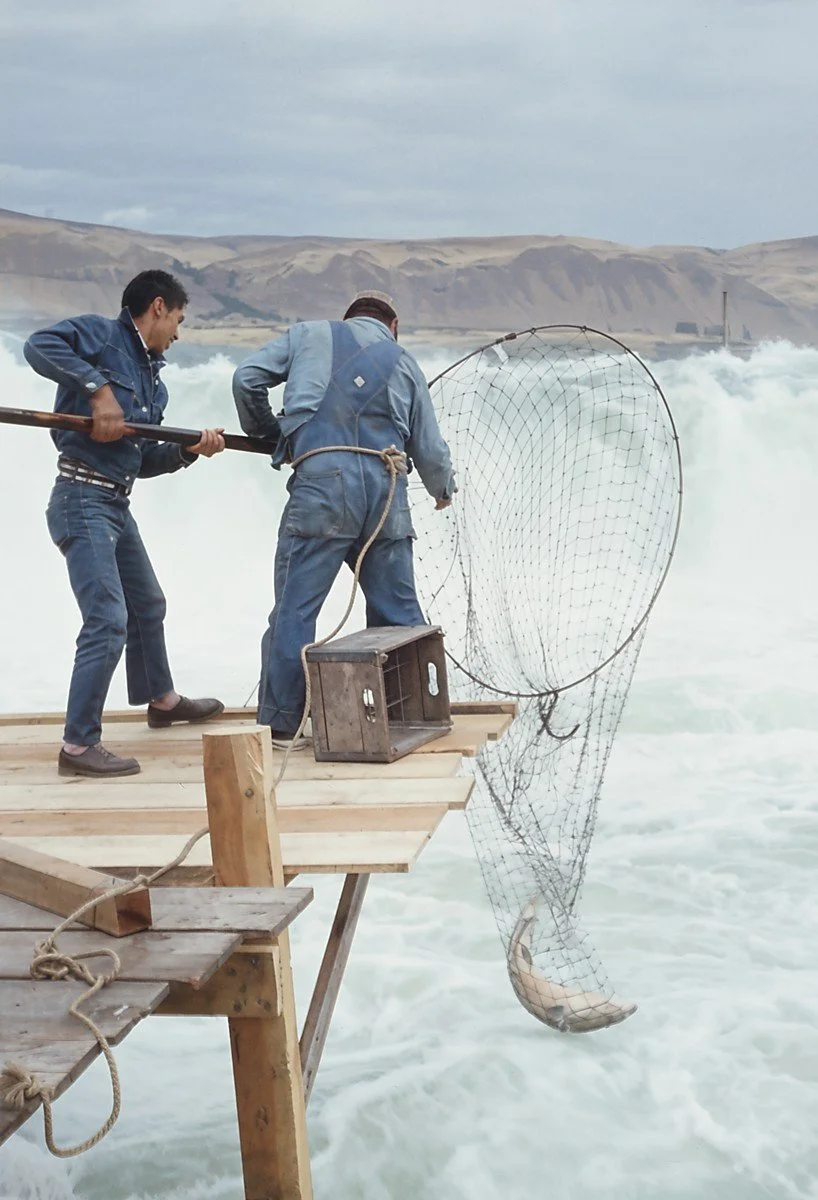
Two fishermen stand on a wooden platform above Celilo Falls. Between them is an enormous dip net, its circular frame nearly as tall as the men themselves.
And at the bottom of the net, clearly visible, is a salmon.
Suddenly an activity that appears small in Richard's sweeping landscapes becomes physical and immediate.
The scale matters.
So does the water behind them.
Richard composed the photograph so that the fishermen and net are set against the pale, rushing Columbia. There is little visual distraction. The platform beneath their feet appears narrow. A wooden box sits between them. A rope encircles one man's waist. Beyond them, the falls fill almost the entire background.
The photograph allows us to appreciate something a distant view cannot convey: the physical reality of working this close to the river.
Yet Richard does not dramatize it.
The men are occupied with the task before them. Their attention is on the net, the fish, and one another.
That restraint is characteristic of this body of work. Richard does not turn fishing at Celilo into spectacle. He watches carefully enough for the work itself to reveal its significance.
Nearly seventy years later, the photograph allows us to do the same.
Estate Edition
Printed from Richard Stefani's original 1956 color negative.
Chromogenic photographic print on Fuji Crystal Archive DP II paper, produced in Germany and mounted under matte, reflection-reducing acrylic glass with aluminum Dibond backing. Presented in a handcrafted Basel black oak floater frame. Ready to hang.
Each work is accompanied by Richard Stefani Estate documentation recording the photograph, edition number, edition size, production specifications, and provenance.
8 × 12 in.
Edition of 25
$1,500
16 × 24 in.
Edition of 15
$3,200
20 × 30 in.
Edition of 10
$6,500
Edition sizes are fixed and will not be increased.
Richard Stefani (1933–2022)
From Before the Water Rose: Celilo Falls, 1956
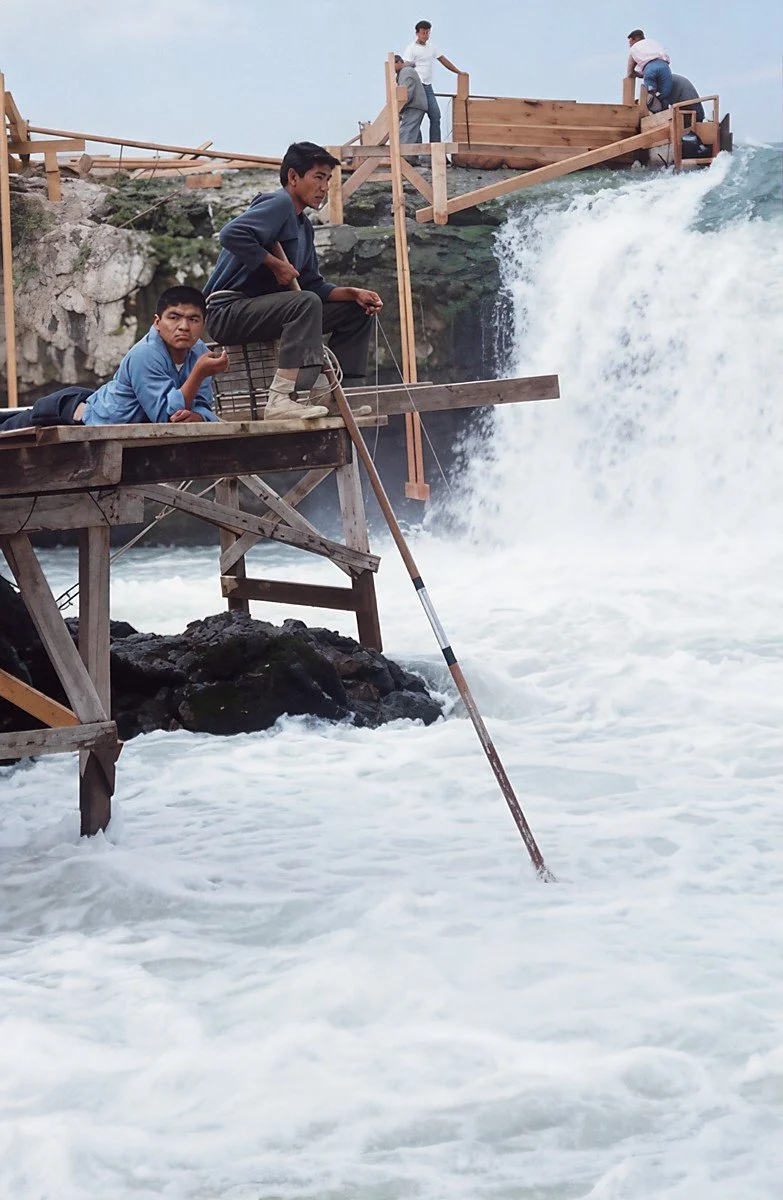
The first thing we notice may be the water.
Then we notice how close everyone is to it.
Two men occupy a wooden platform at the left of Richard Stefani's photograph. One reclines near its edge. The other sits above him beside a long pole extending diagonally toward the river. Behind them, additional figures stand on wooden structures built directly into the rocky landscape.
At the right, the falls descend in a wall of white water.
Richard does not need to exaggerate the physical setting. Its extraordinary nature is already visible.
What makes the photograph compelling is the apparent ordinariness with which the people within it inhabit that setting. The river may command our attention, but it does not appear to command theirs in the same way. They occupy the platforms as working spaces.
This distinction recurs throughout Richard's Celilo photographs.
To an outsider, the falls can appear overwhelming. To the people Richard photographed, the river was also a place understood through experience, work, and accumulated knowledge.
The photograph therefore asks us to see two things simultaneously: the extraordinary power of the Columbia and the human familiarity that existed beside it.
Estate Edition
Printed from Richard Stefani's original 1956 color negative.
Chromogenic photographic print on Fuji Crystal Archive DP II paper, produced in Germany and mounted under matte, reflection-reducing acrylic glass with aluminum Dibond backing. Presented in a handcrafted Basel black oak floater frame. Ready to hang.
Each work is accompanied by Richard Stefani Estate documentation recording the photograph, edition number, edition size, production specifications, and provenance.
8 × 12 in.
Edition of 25
$1,500
16 × 24 in.
Edition of 15
$3,200
20 × 30 in.
Edition of 10
$6,500
Edition sizes are fixed and will not be increased.
Richard Stefani (1933–2022)
From Before the Water Rose: Celilo Falls, 1956
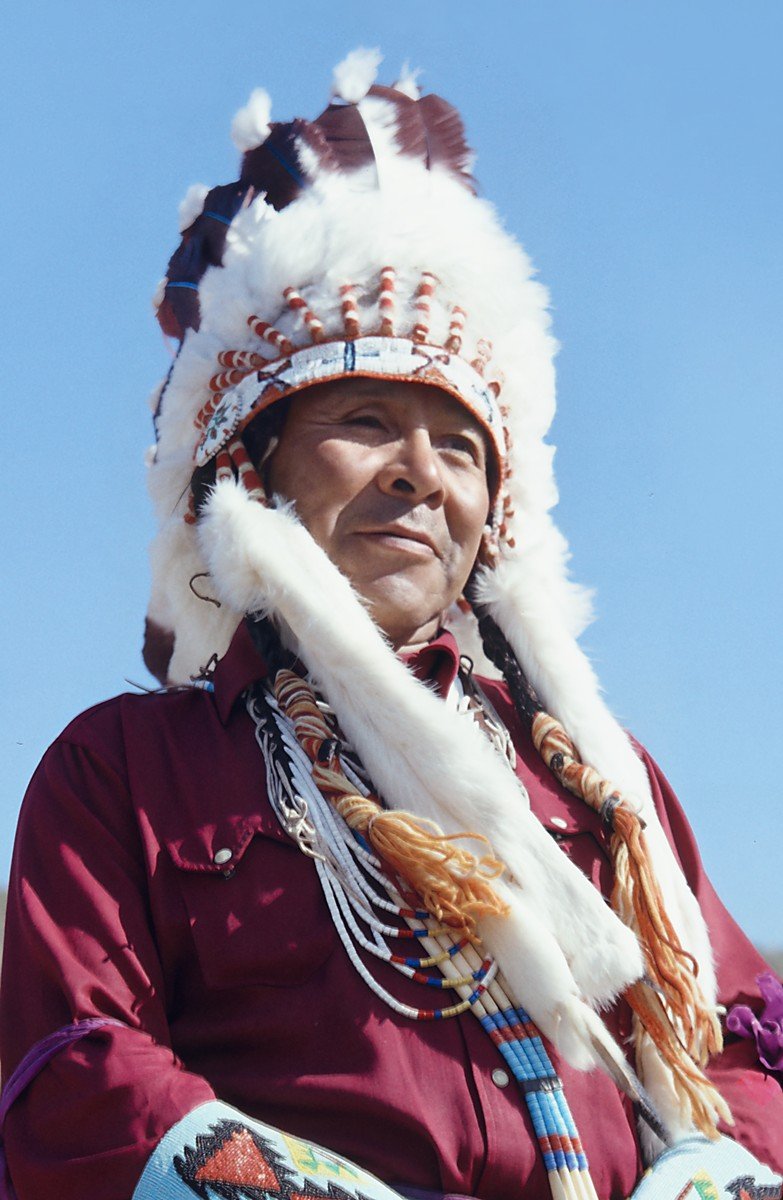
Richard Stefani was twenty-three years old when he made this portrait.
There is almost nothing in the photograph to tell us where he was.
No river.
No falls.
No landscape.
Instead, Richard gives the entire frame to one person.
The man looks slightly beyond the camera. Sunlight moves across his face. Against the uninterrupted blue of the sky, the colors and textures of what he wears become unusually vivid: deep red fabric, strands of beadwork, white fur, patterned elements, and the dark and white feathers rising above him.
We do not yet know his name.
Nor do we have sufficient documentation to explain the specific cultural meaning of what he is wearing.
Those are not gaps to be filled with assumptions. They are questions for further research.
What we can see is Richard's extraordinary attention.
He photographs neither costume nor type.
He photographs a person.
That distinction matters, particularly when viewing photographs made in the mid-twentieth century of Indigenous people. Richard's subject retains his individuality. His expression is his own. Nothing in the composition asks him to represent anything beyond himself.
Seen within Richard's later career, the photograph is also revealing.
The photographer who would become known for portraiture is already present here. The technical confidence matters, but something else matters more: Richard understood that a portrait begins by paying attention to the person in front of the camera.
Estate Edition
Printed from Richard Stefani's original 1956 color negative.
Chromogenic photographic print on Fuji Crystal Archive DP II paper, produced in Germany and mounted under matte, reflection-reducing acrylic glass with aluminum Dibond backing. Presented in a handcrafted Basel black oak floater frame. Ready to hang.
Each work is accompanied by Richard Stefani Estate documentation recording the photograph, edition number, edition size, production specifications, and provenance.
8 × 12 in.
Edition of 25
$1,500
16 × 24 in.
Edition of 15
$3,200
20 × 30 in.
Edition of 10
$6,500
Edition sizes are fixed and will not be increased.
Richard Stefani (1933–2022)
From Before the Water Rose: Celilo Falls, 1956
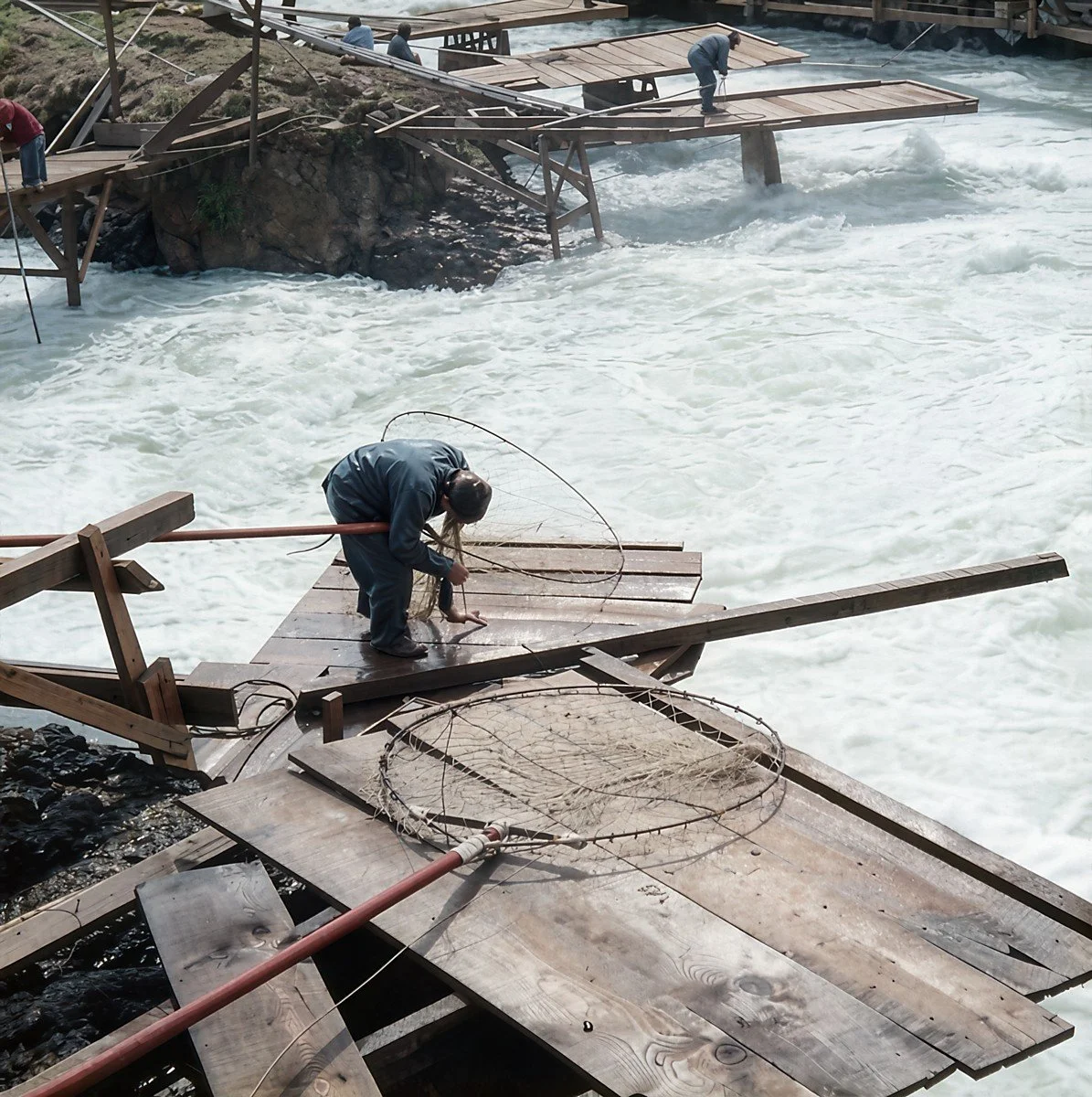
The tools tell part of the story.
A large dip net lies across the foreground platform. Another rests beside a fisherman working below. Beyond him, more wooden platforms project over the river, each positioned in relation to rock and current.
Richard Stefani photographed the scene from above.
That elevated viewpoint changes what we are able to understand.
Instead of confronting the falls head-on, we look down upon an intricate working environment. Platforms overlap. Wooden supports descend toward the water. Nets appear enormous when laid flat. Fishermen occupy different positions across the rocks.
And through all of it moves the Columbia.
The photograph has an almost architectural quality.
Richard seems interested not only in what people are doing, but in how the entire place works.
That makes this image particularly valuable within the larger series. Celilo's fishing platforms were not incidental objects placed beside the river. Their position, construction, and use were intimately related to the water itself.
We should resist claiming more than the photograph tells us until our historical research is complete.
But the photograph tells us quite a lot.
Fishing at Celilo required tools.
It required structures.
It required physical knowledge of the river.
And it required people who knew how all of those things belonged together.
Richard's camera preserved the relationship.
Estate Edition
Printed from Richard Stefani's original 1956 color negative.
Chromogenic photographic print on Fuji Crystal Archive DP II paper, produced in Germany and mounted under matte, reflection-reducing acrylic glass with aluminum Dibond backing. Presented in a handcrafted Basel black oak floater frame. Ready to hang.
Each work is accompanied by Richard Stefani Estate documentation recording the photograph, edition number, edition size, production specifications, and provenance.
10 × 10 in.
Edition of 25
$1,500
20 × 20 in.
Edition of 15
$3,200
30 × 30 in.
Edition of 10
$6,500
Edition sizes are fixed and will not be increased.
Richard Stefani (1933–2022)
From Before the Water Rose: Celilo Falls, 1956
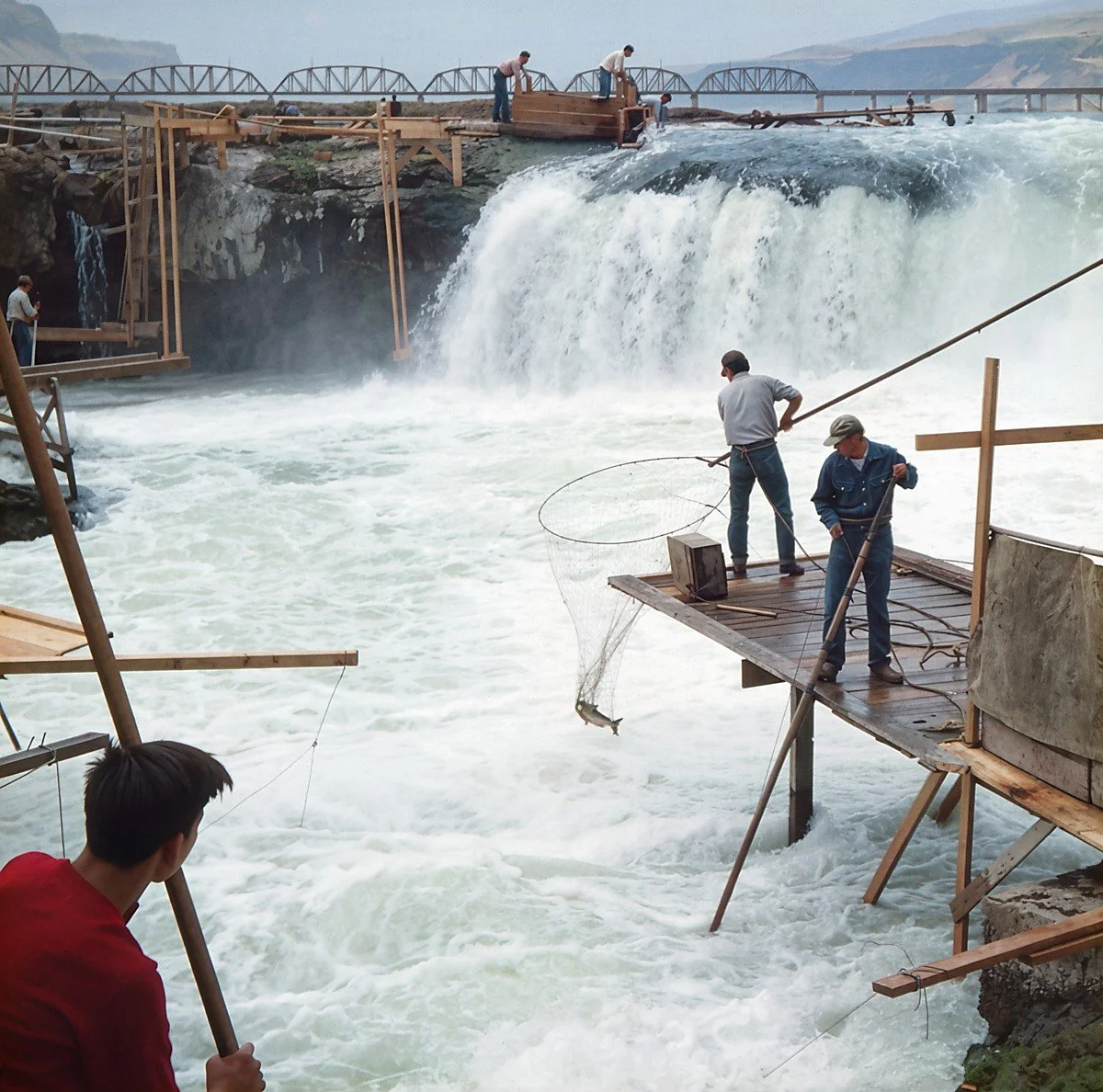
There is almost no stillness here.
Water plunges across the center of the photograph. Fishermen stand above it on wooden platforms, their long poles cutting diagonally across Richard Stefani's composition. A large dip net hangs over the current.
At lower left, another figure enters the frame.
Beyond the falls, still more people work along the rocks. And beyond them, the railroad bridge stretches across the Columbia Gorge.
Richard has compressed an entire world into one photograph.
What is particularly striking is the relationship between the people and the water. The fishermen do not appear separate from the landscape, observing it from a safe distance. Their platforms extend directly over the river. Their equipment reaches into it. Their bodies are positioned in relation to its current.
The photograph makes the physicality of fishing at Celilo impossible to ignore.
Balance mattered.
Position mattered.
The construction of the platforms mattered.
Knowledge of the river mattered.
Richard was photographing an activity, but he was also photographing a system of relationships between human beings, tools, structures, rock and water.
The river dominates the frame.
And yet the people know how to stand within it.
Estate Edition
Printed from Richard Stefani's original 1956 color negative.
Chromogenic photographic print on Fuji Crystal Archive DP II paper, produced in Germany and mounted under matte, reflection-reducing acrylic glass with aluminum Dibond backing. Presented in a handcrafted Basel black oak floater frame. Ready to hang.
Each work is accompanied by Richard Stefani Estate documentation recording the photograph, edition number, edition size, production specifications, and provenance.
10 × 10 in.
Edition of 25
$1,500
20 × 20 in.
Edition of 15
$3,200
30 × 30 in.
Edition of 10
$6,500
Edition sizes are fixed and will not be increased.
Richard Stefani (1933–2022)
From Before the Water Rose: Celilo Falls, 1956
Stand back from the photograph.
Then begin looking.
People are everywhere.
They gather on the rocks at left. They stand beside platforms at right. They cross the middle of the photograph. They watch. They work. They talk. Adults and children occupy the same landscape.
The longer we look, the more populated Celilo becomes.
That is why this photograph matters.
Historical places can become abstract with time.
A name.
A date.
A dam.
A before and an after.
Richard Stefani's photograph resists that abstraction.
Celilo was full of people.
Wooden platforms and ladders extend through the rocky channels. Water moves through the center of the photograph. Groups form and dissolve across the landscape. In the distance, the walls of the Columbia Gorge rise above everything.
Richard gives us no single protagonist.
The community is the subject.
And because of that, this photograph may ultimately become one of the most important historical documents in the series.
It asks us to understand Celilo not merely as spectacular water, and not merely as a location where fishing occurred.
It asks us to see a lived place.
Estate Edition
Printed from Richard Stefani's original 1956 color negative.
Chromogenic photographic print on Fuji Crystal Archive DP II paper, produced in Germany and mounted under matte, reflection-reducing acrylic glass with aluminum Dibond backing. Presented in a handcrafted Basel black oak floater frame. Ready to hang.
Each work is accompanied by Richard Stefani Estate documentation recording the photograph, edition number, edition size, production specifications, and provenance.
10 × 10 in.
Edition of 25
$1,500
20 × 20 in.
Edition of 15
$3,200
30 × 30 in.
Edition of 10
$6,500
Edition sizes are fixed and will not be increased.
The Estate Editions
Each Estate Edition is produced from Richard Stefani's original 1956 color negative under the direction of the Richard Stefani Estate.
Each work is a chromogenic photographic print on Fuji Crystal Archive DP II paper, produced in Germany and mounted under matte, reflection-reducing acrylic glass with aluminum Dibond backing. The photograph is presented in a handcrafted Basel black oak floater frame and arrives ready to hang.
Each work is accompanied by Richard Stefani Estate documentation recording the photograph, edition number, edition size, production specifications, and provenance.
Each size constitutes a separate, strictly limited edition. Edition sizes are fixed and will not be increased.
Estate Editions are offered in three scale categories, with edition sizes of 25, 15, and 10 respectively. Exact dimensions vary according to the original composition of each photograph. Richard's photographs are not cropped simply to conform to standard dimensions.
A very small number of selected photographs may eventually be authorized by the Richard Stefani Estate in a distinct Monumental Estate Edition, at substantially larger dimensions and with a separately defined edition. Monumental Estate Editions are not part of this release.
For availability, edition numbers, institutional acquisitions, or assistance selecting a work, please contact Stefani Art Gallery.
Private and institutional inquiries are welcome.
Request Acquisition Information
For availability, edition numbers, institutional acquisitions, or assistance selecting a work, please contact Stefani Art Gallery.
Private and institutional inquiries are welcome.