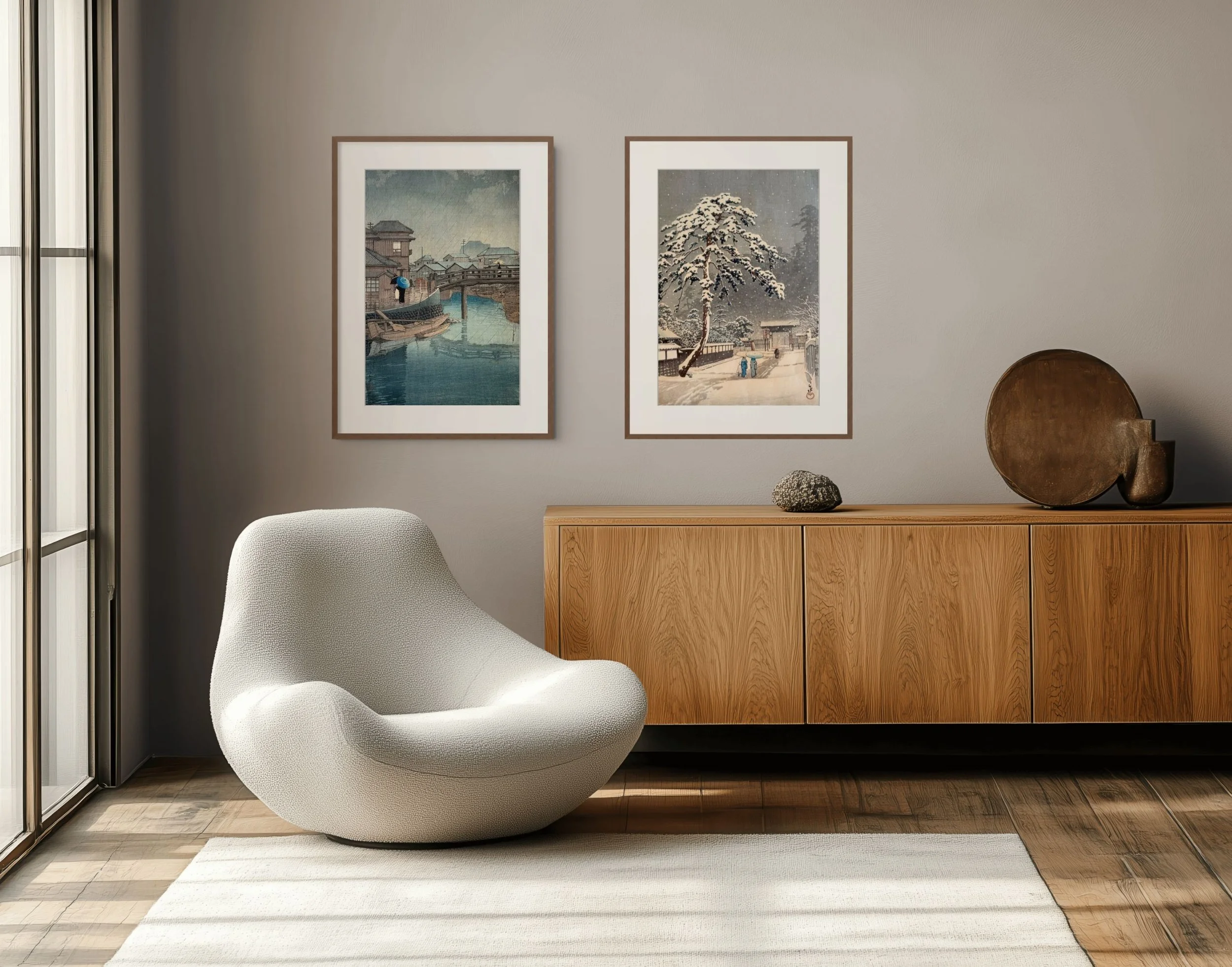
Snow at Honmonji Temple
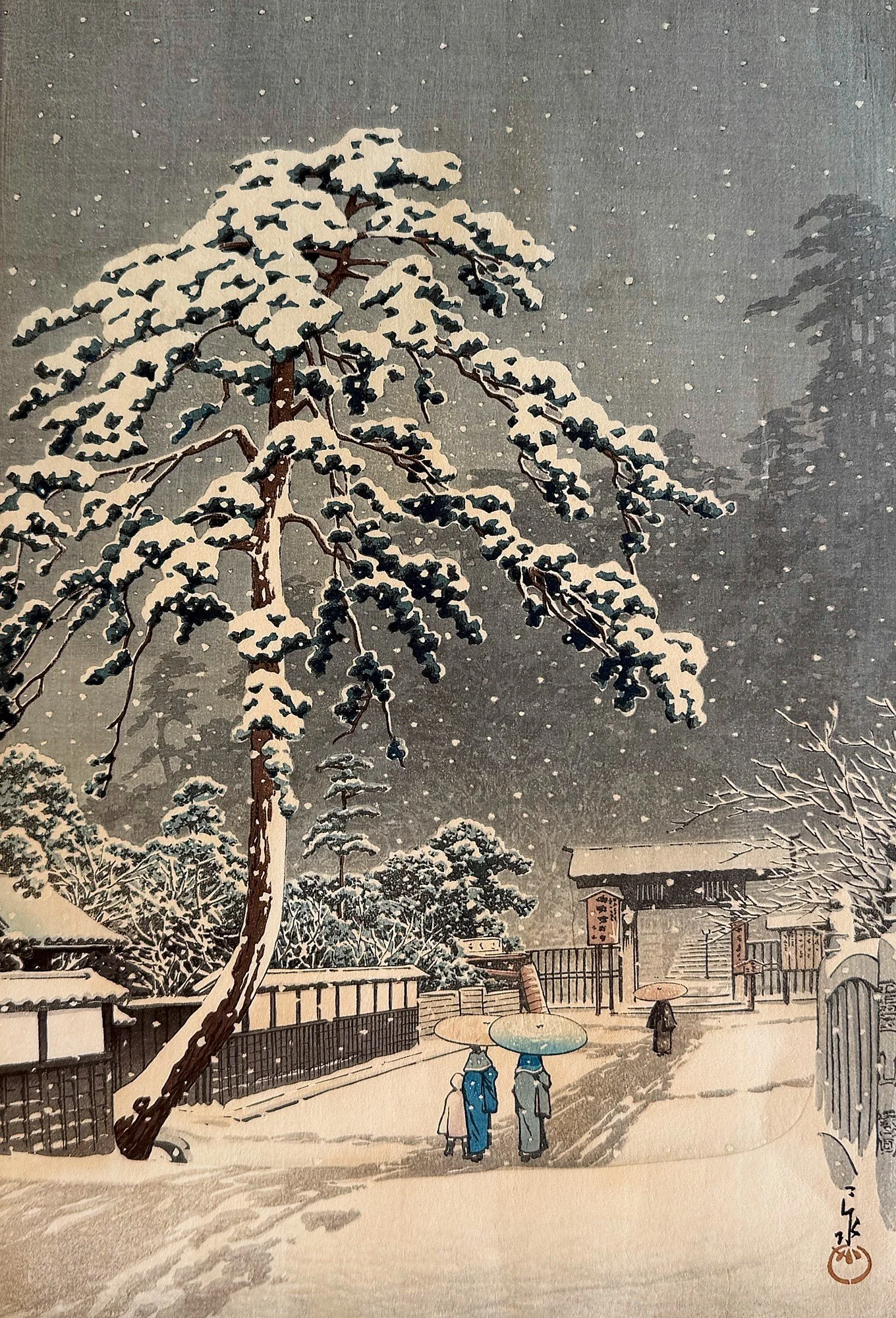
Snow at Honmonji Temple, Tokyo, Kawase Hasui, Japanese Woodblock Print (Shin-hanga)
Learning to See
Essays on Beauty, Craftsmanship, and the Experience of Art
V. The Quiet Beauty of Winter
"Snow does not erase the world. It reveals what was always essential."
There is a curious thing that happens after a snowfall.
The world becomes quieter.
Not only because snow absorbs sound, though it does.
It is quieter because our attention changes.
We walk more slowly.
We notice footprints.
We hear our own breathing.
Familiar streets feel unexpectedly new.
Snow has a remarkable ability to simplify the world.
It softens harsh edges.
It covers distraction.
It asks us to notice form before detail, light before color, stillness before movement.
Perhaps that is why artists have returned to winter landscapes for centuries.
Snow does not merely change what we see.
It changes how we see.
In Snow at Honmonji Temple, Kawase Hasui understood this with extraordinary sensitivity.
At first, the composition appears almost effortless.
Temple buildings.
Tall trees.
A pathway.
One solitary figure beneath an umbrella.
Nothing more.
Yet almost every decision within the print serves the same purpose.
To create stillness.
Notice how the snow gathers upon the rooftops without overwhelming them.
Observe how the dark trunks of the trees rise through the pale landscape like quiet calligraphy.
See how the lone visitor becomes not the subject of the picture, but a measure of its scale.
Without that single figure, the temple would feel empty.
With it, the viewer becomes present.
Hasui has quietly invited us inside.
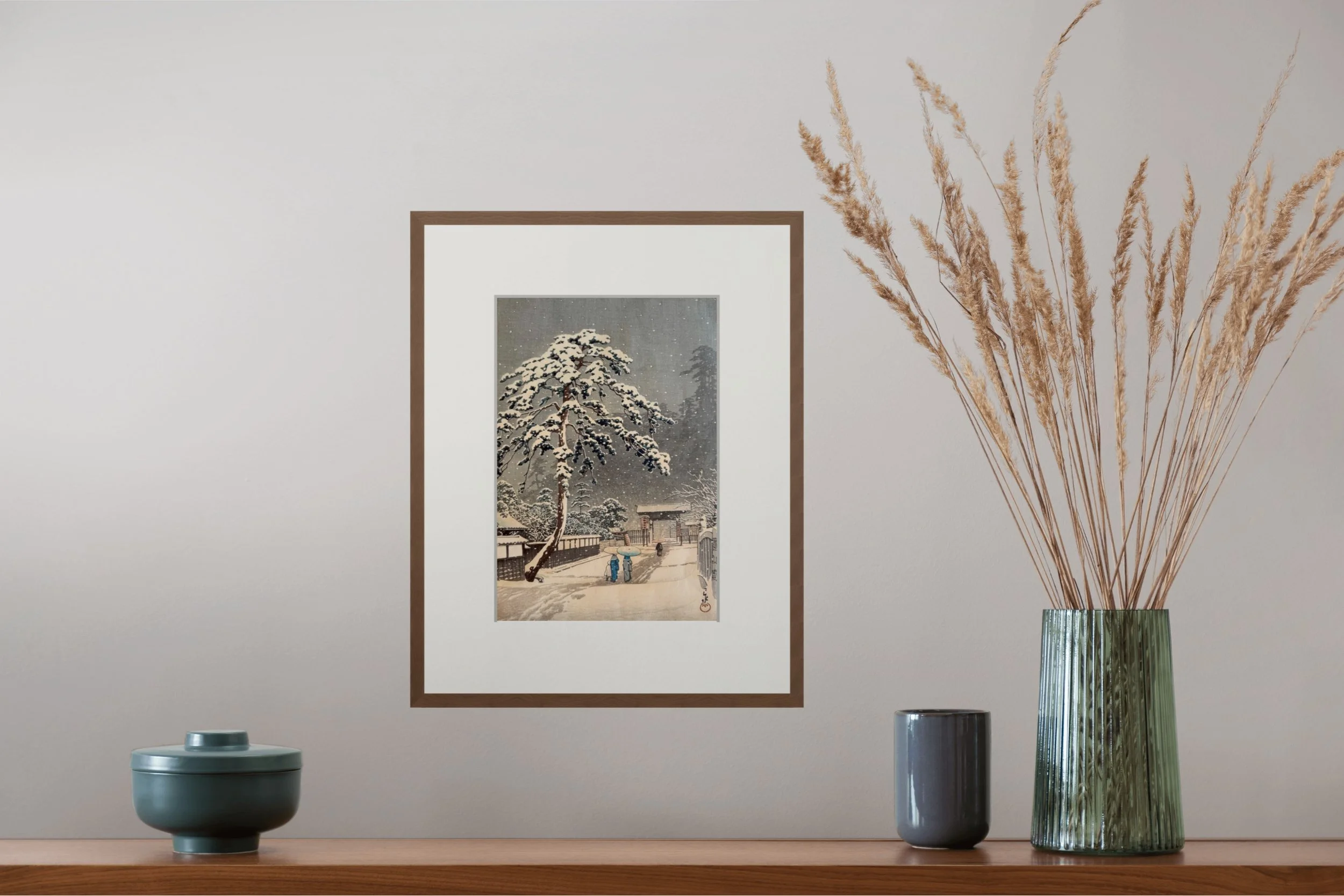
The works we live with longest are not always the ones that first commanded the most attention.
One of the remarkable qualities of winter is that it removes what is unnecessary.
Leaves disappear.
Fields become simplified.
The complexity of summer gives way to structure.
Branches.
Stone.
Rooflines.
Paths.
What remains is the architecture of the landscape itself.
Artists understand this instinctively.
When detail falls away, composition becomes easier to see.
Balance becomes clearer.
Space begins to matter as much as form.
This is one reason snow scenes often feel peaceful.
Our eyes have less to compete with.
The same principle is true far beyond landscape.
A thoughtfully furnished room rarely contains everything that could be placed within it.
A beautifully written sentence rarely contains every possible word.
An elegant garden leaves space for silence.
Beauty often grows through restraint rather than accumulation.
Hasui understood this deeply.
His winter landscapes never feel empty.
They feel complete.
There is an important difference.
Many collectors eventually discover something surprising.
The works they live with longest are not always the ones that first commanded the most attention.
Often they are quieter.
More patient.
Less eager to impress.
Such works unfold gradually across months and years, revealing new relationships each time they are encountered.
They become companions rather than spectacles.
Perhaps that is why so many collectors develop lasting affection for Hasui.
His prints do not ask to be admired from across a room.
They invite us to come closer.
To linger.
To return.
Winter itself offers a similar invitation.
Modern life often teaches us to resist quieter seasons.
We hurry through them, waiting for what comes next.
Yet nature follows a different rhythm.
Winter is not the absence of life.
It is the season in which life becomes less visible and more essential.
Beneath frozen ground, roots continue their quiet work.
Within bare branches, spring already exists.
Snow reminds us that stillness is not emptiness.
It is preparation.
Perhaps that is one reason winter landscapes continue to speak to us so deeply.
They remind us that beauty does not disappear when the world becomes quiet.
Sometimes it becomes easier to hear.
An Invitation
The next time snow falls, if you have the opportunity, step outside before anyone else has walked through it.
Notice how the landscape seems to breathe differently.
Listen to the silence.
Observe how even familiar places seem transformed, not because they have changed, but because distraction has disappeared.
Then remember Hasui.
Not because he painted snow.
Because he noticed what snow teaches.
Looking Ahead
In our final essay on Japanese woodblock prints, we'll move from appreciation to stewardship.
How does one begin collecting Japanese prints? What distinguishes an original woodblock print from a reproduction? What should a collector look for, ask, and learn?
Collecting begins not with buying.
It begins with learning to see.