The Beauty of the Fragment: John Van Dreal and the Human Form
By Christina Stefani for House of Stefani

John Van Dreal, from left: Figure #2, Figure #5, and Figure #1. Sculpted porcelain, oil, graphite, and gold gilt; black walnut and white oak stands.
What three porcelain sculptures can teach us about the body, materials, and the strange power of what is left incomplete.
What happens when an artist gives us only part of the human body?
No face to meet our gaze.
No hands to suggest occupation or gesture.
No clothing to locate the figure in a particular time or place.
Only the body.
Weight. Curve. Balance. Surface. Volume.
John Van Dreal's three porcelain figures are unmistakably human.
And none of them is whole.
At first, we notice what is missing.
Then, if we keep looking, something changes.
We begin to notice what remains.
The three works, recently acquired by Stefani Art Gallery, are sculpted in porcelain and worked with oil, graphite, and gold gilt. Figures #1 and #2 rest on black walnut; Figure #5 on white oak.
When Is Something Complete?
We are accustomed to encountering the fragmented human body in art.
Some of the most familiar sculptures of antiquity have reached us incomplete. Time has removed arms, hands, noses, feet, surface decoration, and sometimes entire sections of the body. Objects once experienced as whole have become fragments.
Over centuries of looking at them, however, the fragment itself has acquired a visual power of its own.
A broken sculpture can cease to feel broken.
Its incompleteness concentrates our attention. A torso without a face no longer asks us primarily to identify an individual. An absent hand cannot tell us what the figure is holding. Without clothing, setting, or expression, much of the usual machinery of narrative falls away.
What remains is form.
The three sculptures by Oregon artist John Van Dreal are not archaeological remnants. Their fragmentation is contemporary and intentional. Yet encountering them inevitably brings that much older sculptural tradition to mind.
Van Dreal describes that reduction as fundamental to the work:
“By reducing the human form to its basic core, the torso, I strip the identity and the body becomes both more universal and more mysterious, a vessel of strength, vulnerability, memory, and time.”
The idea of the fragment, then, is not simply about what has been removed. It is about what becomes possible once individual identity falls away.
Encountering these works inevitably brings to mind the much older tradition of fragmentary sculpture. Yet Van Dreal is not presenting archaeological remnants. He is deliberately using incompleteness as a way of reconsidering wholeness.
They pose an intriguing question:
Does a work have to represent the whole body to feel complete?
Looking at these three figures, the answer becomes increasingly complicated.
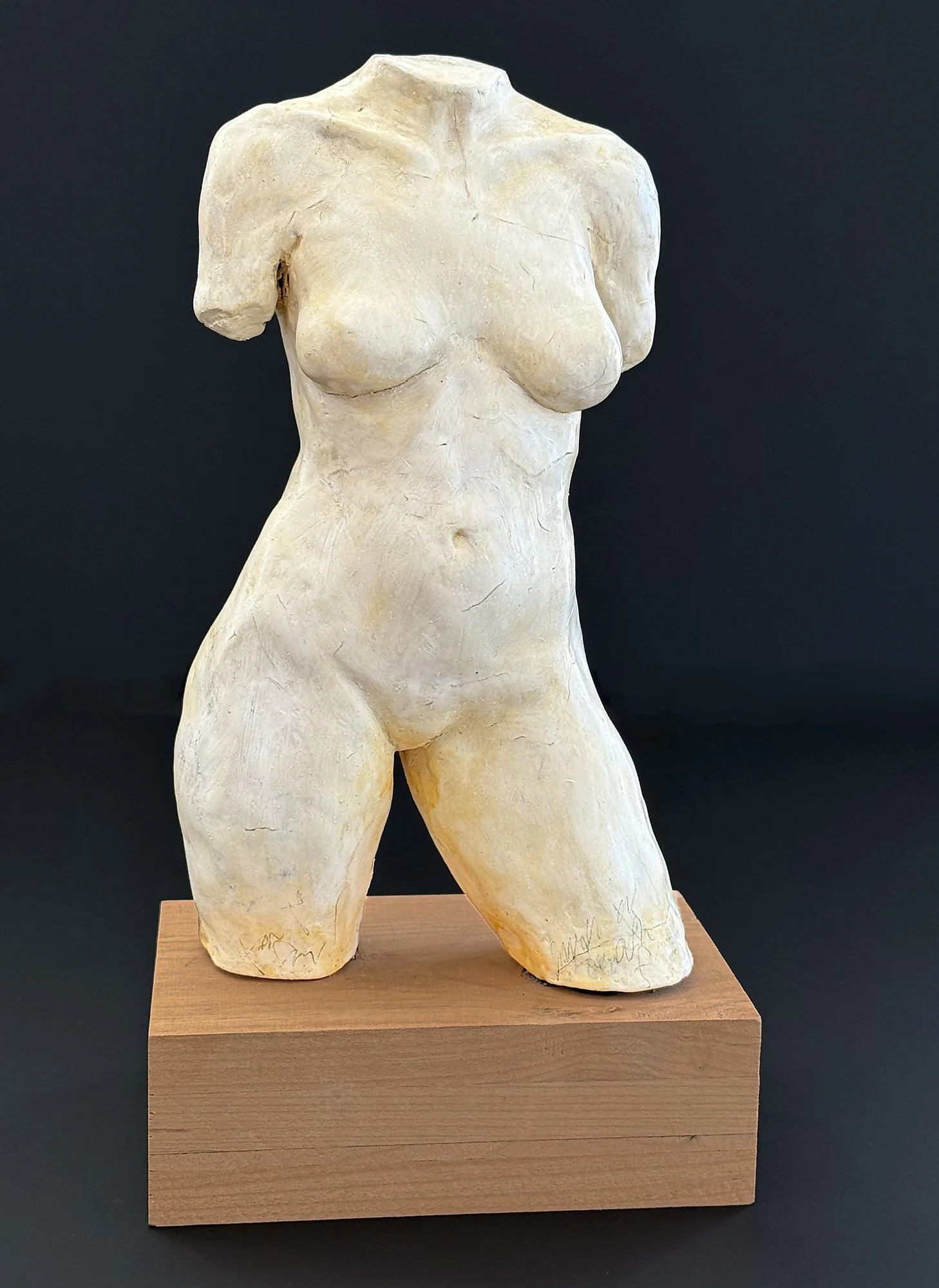
John Van Dreal, Figure #5. Sculpted porcelain, oil, graphite, and gold gilt; white oak stand.
The Body Without a Story
Faces are extraordinarily powerful.
We search them instinctively for information. Expression, age, mood, identity. Give a figure a face and it can quickly become someone.
Hands have a similar narrative force. They hold, point, reach, protect, work, embrace.
Remove both and our attention changes.
In Van Dreal's figures, the body itself must do the speaking.
How much of a body do we need before we recognize a human presence?
A shoulder? A hip? The curve of an abdomen?
Each of these sculptures gives us a different answer.
The curve from waist to hip becomes a gesture. A slight asymmetry between two sides of the torso suggests movement. The relationship between abdomen and thigh becomes composition. Weight appears to shift, even though the object itself is perfectly still.
The human figure has not disappeared.
In some ways, it has become more present.
We are no longer being asked primarily, Who is this?
We begin instead to ask, What am I actually seeing?
That distinction matters.
Much of learning to look at art involves moving beyond recognition. We recognize a tree, a face, a landscape, a body. Recognition happens quickly.
Looking takes longer.
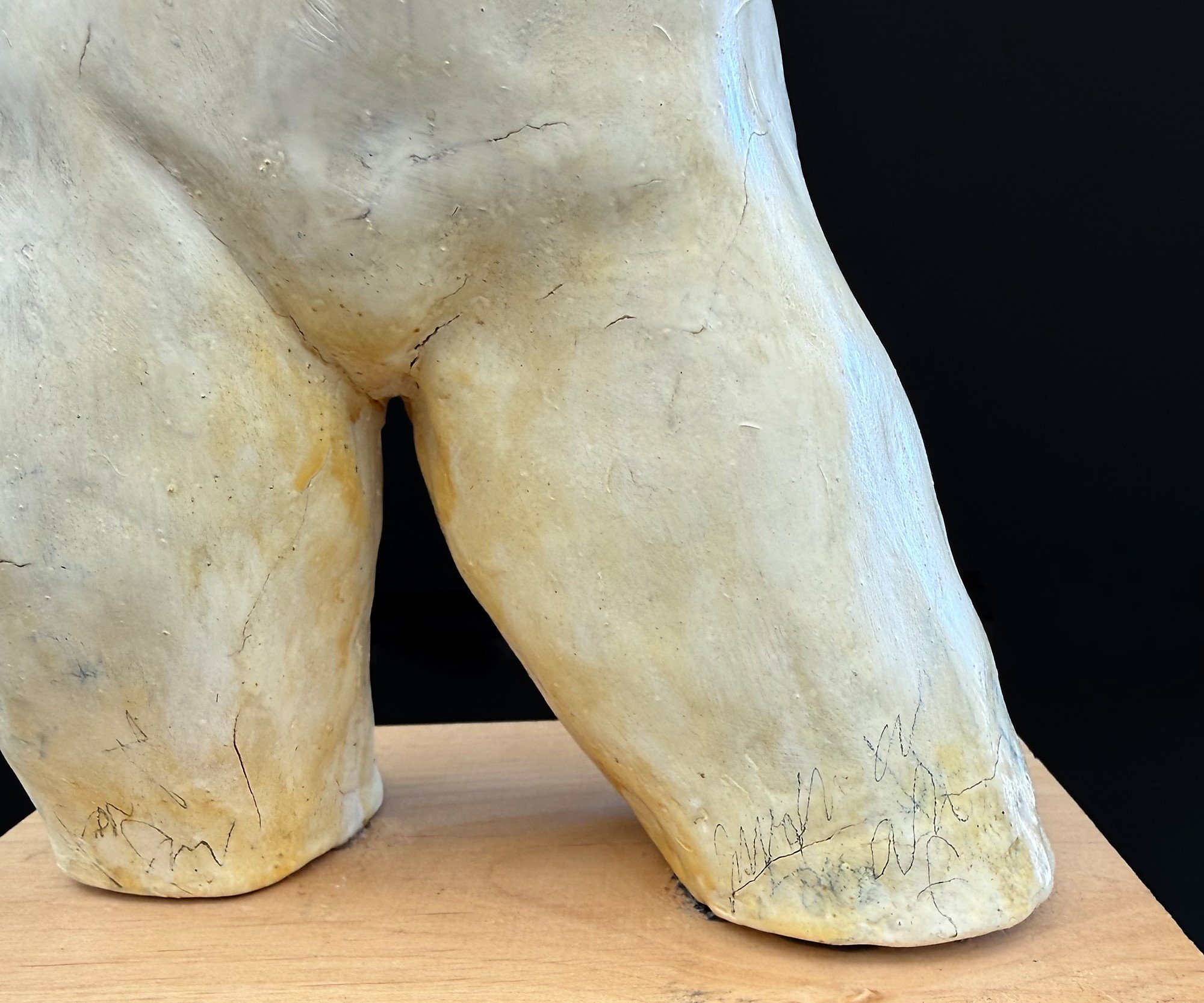
Graphite, incised lines, tonal variation, and traces of the artist's working process remain visible across the porcelain surface.
Evidence of the Hand
Come closer to these sculptures and another transformation occurs.
From a distance, the porcelain appears pale and relatively quiet. Up close, the surfaces become active.
There are graphite lines. Incised marks. Scratches. Subtle shifts in color. Marks that wander across the body and disappear around its contours. There are irregularities that have not been polished away.
The sculptures retain evidence of having been made.
That is especially interesting in the context of Van Dreal's larger practice. Known primarily as a painter, he describes his method as one of building surface and texture through layers and of studying form through drawing and painting simultaneously. His paintings are rooted in traditions of realism and Tonalism, but his stated concern is not simply accurate representation. He is interested in light, form, beauty, and the possibility of creating a personal connection between object and viewer.
Those concerns survive the transition from painting to sculpture.
Perhaps even more interestingly, so does drawing.
The graphite does not merely decorate these porcelain bodies. Line moves across volume. A mark begins on a surface facing us and then disappears around a hip or thigh. Drawing, usually confined to a plane, has been allowed to travel through three-dimensional space.
The sculptures can almost be understood as drawings that have acquired bodies.
Three Bodies, Three Ways of Seeing
Placed together, the three works initially appear to belong to a single family.
Look again, and their differences become pronounced.
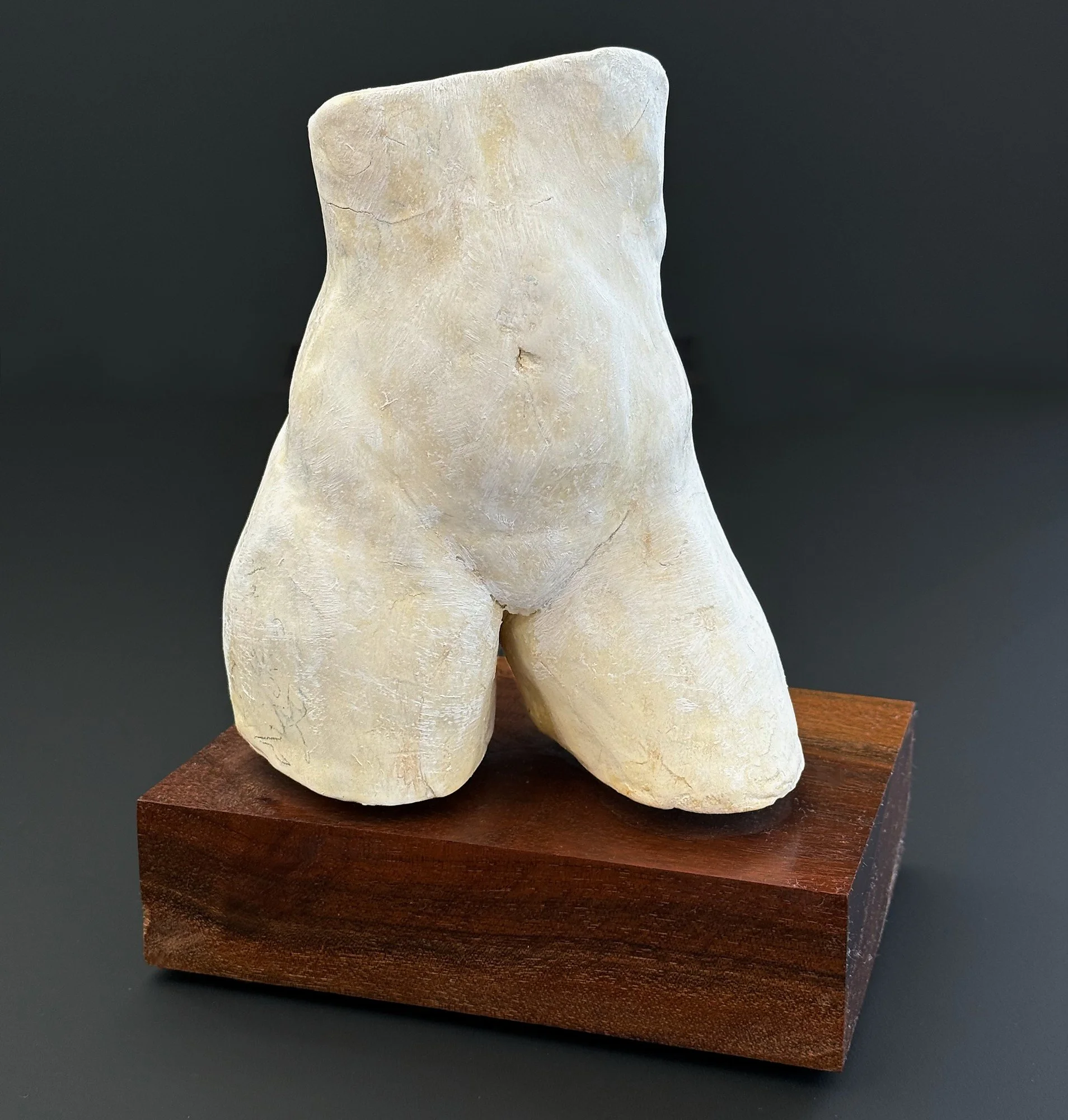
Figure #1, John Van Dreal
Figure #1
Figure #1 is perhaps the quietest.
Its contours are soft and rounded, with a subtle asymmetry that keeps the body from becoming static. The pale porcelain carries faint marks and tonal variations, but nothing overwhelms the form itself.
There is an intimacy to it.
The torso seems less posed than simply present. The black walnut beneath it provides a strong visual anchor, its deep brown setting off the warm, chalk-like surface of the porcelain.
The contrast makes the body appear almost luminous.
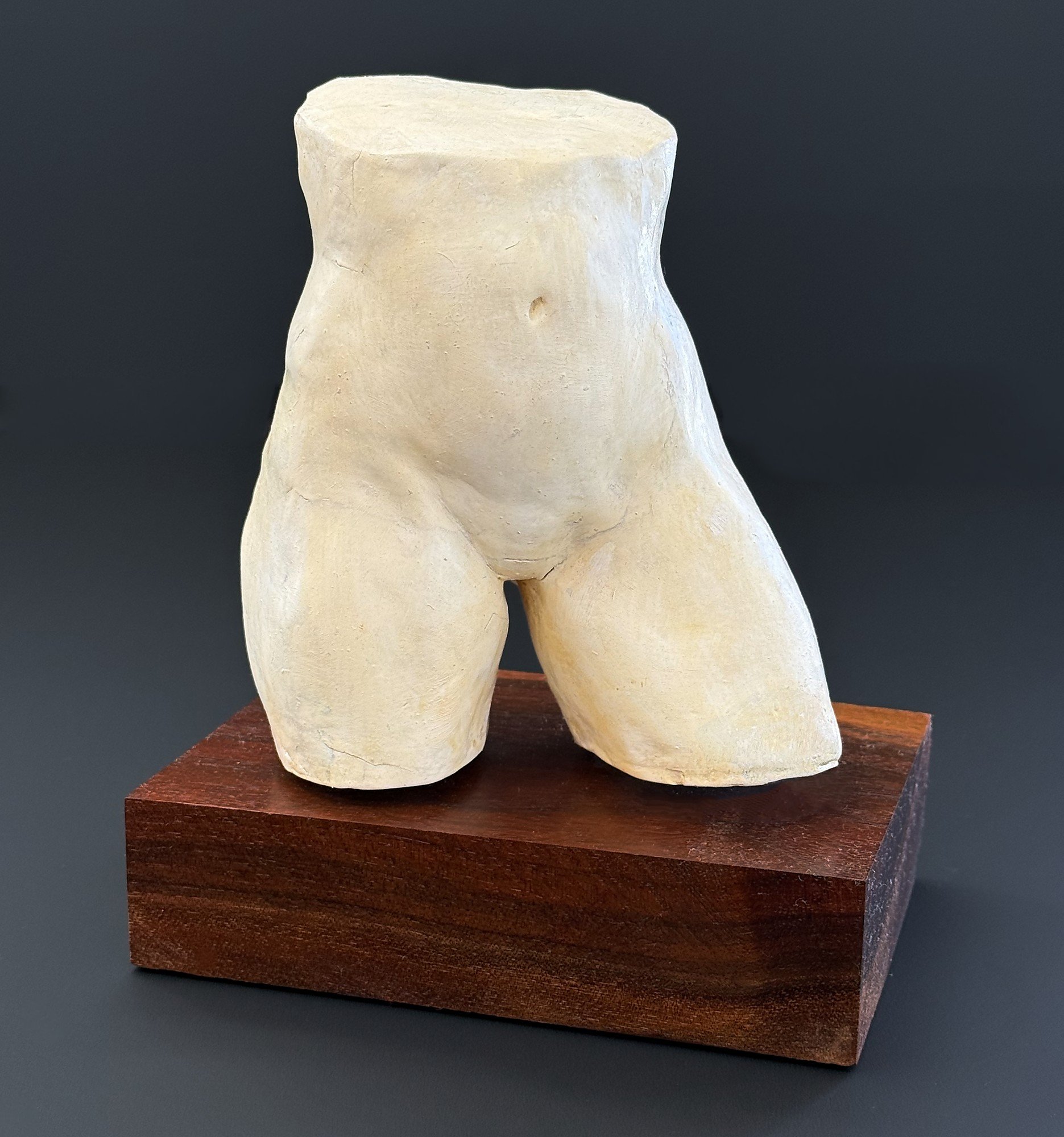
Figure #2, John Van Dreal
Figure #2
Figure #2 feels different.
The body is more compressed, the upper edge broader and more horizontal. Its construction calls attention to mass and proportion. Waist, abdomen, hips, and thighs become an arrangement of volumes.
It is perhaps the most architectural of the three.
Here again, the black walnut base matters. Its geometry establishes a rigid horizontal plane beneath an organic form. Body and base oppose one another: pale and dark, curved and rectilinear, irregular and precise.
The sculpture exists in the tension between them.
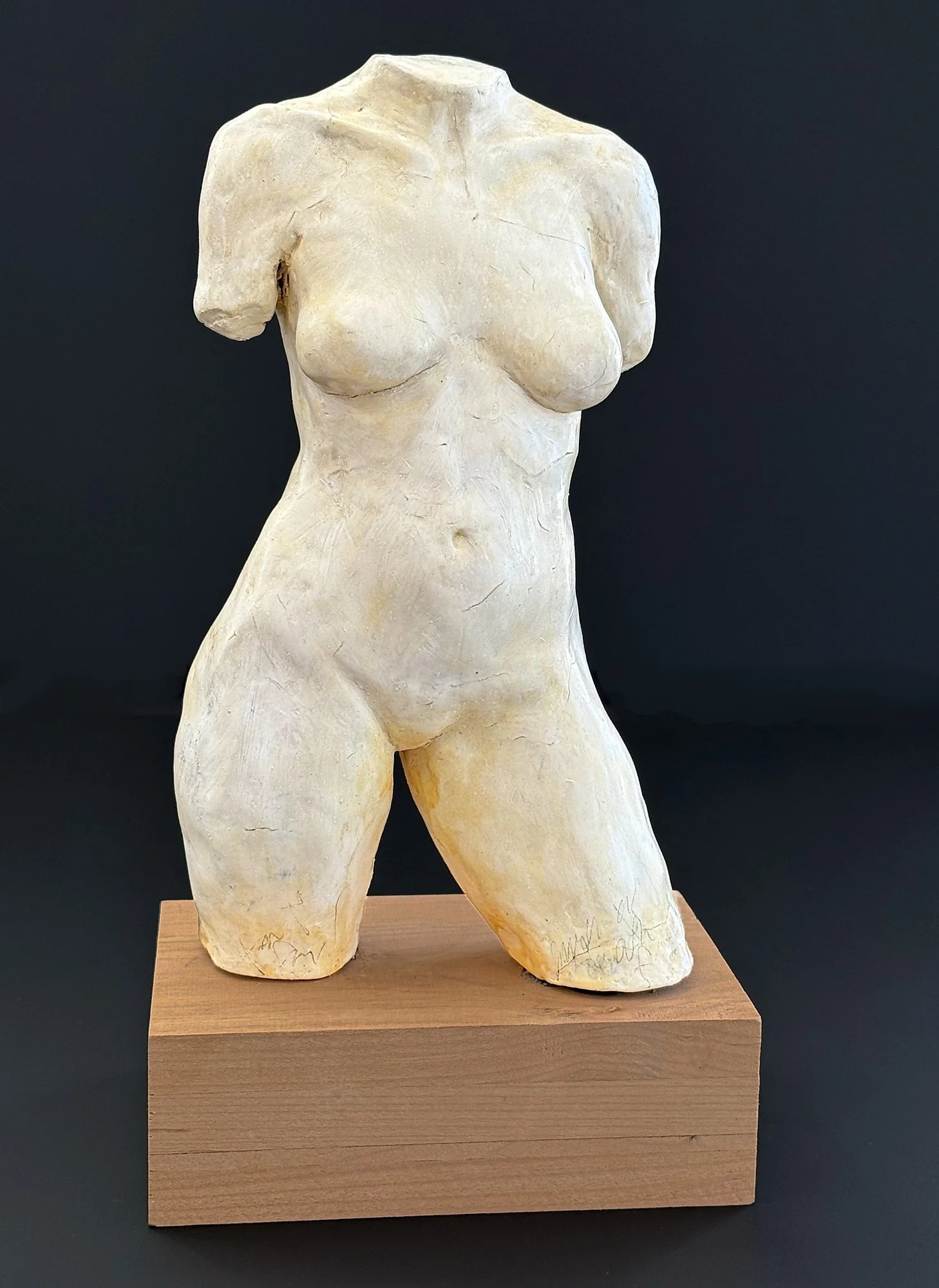
Figure #5, John Van Dreal
Figure #5
And then there is Figure #5.
This figure moves.
Not literally, of course, but the relationship between shoulders, waist, hips, and legs creates an unmistakable sense of shifting weight. One hip moves outward. The torso responds. The shoulders answer in turn.
The body becomes a sequence of counterbalances.
It is also the sculpture in which the marks of the artist seem particularly evident. Graphite and incised lines gather across portions of the surface, especially toward the lower figure. They feel less like finish than thought: traces of looking, measuring, adjusting, and making.
The white oak base also changes the relationship between the figure and the pedestal. Unlike the strong contrast of dark walnut beneath Figures #1 and #2, the warmer, quieter oak belongs to a tonal world closer to the porcelain itself.
Figure and support seem less opposed.
They settle together.
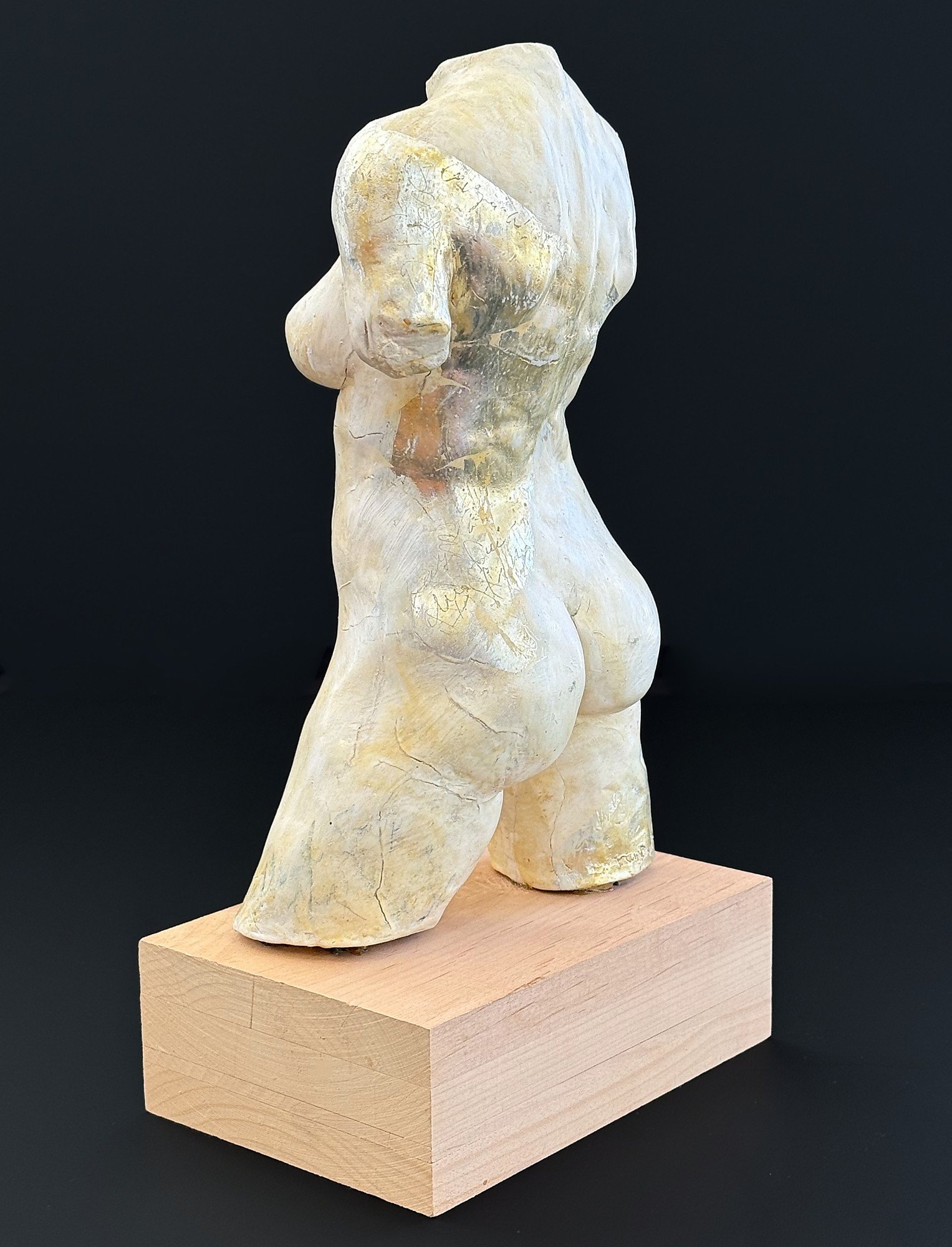
Three-quarter side view of Figure #5, John Van Dreal
The Material of the Body
Porcelain is an interesting material from which to make a body.
We often associate it with refinement and delicacy. Cups. Plates. Vessels. Decorative objects. Things capable of remarkable permanence and remarkable fragility at the same time.
Here, porcelain becomes flesh.
Van Dreal describes the materials themselves as moving “between the fragile, the precious, and the corporeal.” Working from a classical realist tradition, he sculpts the figures in porcelain clay before layering their surfaces with gold gilt, graphite, and oil paint.
That creates a productive contradiction.
The body has mass, but the material suggests vulnerability.
The body appears soft, while porcelain is hard.
Skin gives and changes. Fired porcelain does not.
And yet Van Dreal's treatment of the surface prevents the material from becoming cold. Oil, graphite, gilt, scratches, subtle color, and the irregularities of the modeled surface keep reminding us that a human hand has passed over it.
The material has been worked.
That distinction is important.
Craftsmanship does not necessarily mean eliminating every trace of process. Sometimes mastery lies in knowing which traces to preserve.
Beauty and the Real Body
These figures are not exercises in anatomical perfection.
Their power comes partly from the opposite.
There is asymmetry. Softness. Weight. Irregularity. One side does not perfectly mirror the other. Forms shift and swell. The body responds to gravity.
This makes them recognizably human without making them portraits of particular people.
And something curious happens as we continue looking.
At first, we see a body.
Then we begin to see a line.
A curve.
Weight shifting from one side to another.
Light moving across porcelain.
A graphite mark disappearing around a hip.
The body has not ceased to be human.
We have simply begun to see it differently.
Learning to See the Human Form
This may be one of art's quietest gifts.
It teaches us that recognition and seeing are not the same thing.
We move through the world surrounded by familiar forms. Bodies. Trees. Buildings. Clouds. Chairs. Faces. We become so proficient at identifying them that identification can replace observation.
We know what a body looks like.
Until an artist makes us look again.
Van Dreal has spent much of his career investigating form through painting. These small sculptures carry that investigation into another dimension.
And sculpture changes the relationship.
A painted body exists within a world created for it by the artist.
A sculpted body enters ours.
We walk around it. Light changes across it. One contour disappears while another emerges.
The object occupies the same room we do.
And because these bodies give us less information, perhaps we become even more conscious of the encounter.
There is less to identify.
So we look harder.
Van Dreal describes the transformation he is seeking as something “closer to an artifact: incomplete yet whole, intimate yet timeless, broken yet beautiful.”
Perhaps that is why the fragment has endured as such a compelling form.
The Beauty of What Remains
Perhaps that is why the fragment has endured as such a compelling form.
We often think completeness means having everything.
Art occasionally proposes another possibility.
Remove enough and what remains can become more visible.
Without a face, we notice posture.
Without hands, we notice contour.
Without narrative, we notice material.
Without perfection, we notice the hand that made the object.
And without the whole body, strangely, we may become more conscious of the human body itself.
Perhaps a fragment does not ask us to imagine what is missing.
Perhaps it asks us to pay closer attention to what remains.