This Week in Art, Design, and Culture: What We Carry Forward
Curated by Christina Stefani for House of Stefani

A radically different way of living, expressed through design. The Shakers: A World in the Making is the first major traveling exhibition to place extraordinary Shaker objects alongside the contemporary artists and designers they continue to inspire. Image: Oval box on a workbench, New Lebanon, NY, 2024. © Vitra Design Museum / Alex Lesage, courtesy Shaker Museum, Chatham, New York
I have been thinking about what we carry forward.
Sometimes deliberately.
Sometimes without realizing it.
Knowledge passed from one person to another. A way of making something. A story. A memory. The habits of a lifetime. An object entrusted to our care.
And sometimes, years later, we discover that something we have carried quietly has become part of who we are.
This has been an unusual week at the gallery.
After an unexpected closure, we are reopening. The artwork is safe. The walls are drying.
And photographs Richard made at Celilo Falls nearly seventy years ago are about to meet the public together for the first time.
I have spent months preparing for that moment.
Now that it is here, I find that I do not have much more to say about it.
I am simply grateful the photographs are here.
A World in the Making
At the Milwaukee Art Museum, The Shakers: A World in the Making brings together more than 150 historic Shaker objects and contemporary installations, placing furniture, tools, textiles, and domestic objects beside work by artists and designers who continue to find meaning in Shaker ideas of craftsmanship, utility, shared labor, and intentional design.
What interests me is not simply the beauty of the objects.
It is the knowledge contained within them.
A chair carries knowledge of wood.
A woven textile carries knowledge of fiber and hand.
A vessel carries decisions about proportion, weight, surface, and use.
We do not have to reproduce the past exactly in order to learn from it.
Sometimes what is carried forward is not the object itself.
It is the understanding behind it.
That thought felt particularly close when three new figure sculptures by John Van Dreal arrived at the gallery.
Porcelain.
Gold leaf.
Walnut.
They are entirely contemporary, yet the materials carry histories much older than the work itself.
They arrived as Richard’s photographs were being installed, allowing objects made now to quietly share the gallery with photographs made seventy years earlier.
I like that very much.
The Milwaukee exhibition runs through January 31, 2027, and intentionally puts historic Shaker material culture into conversation with contemporary art and design rather than presenting it as something frozen in the past.
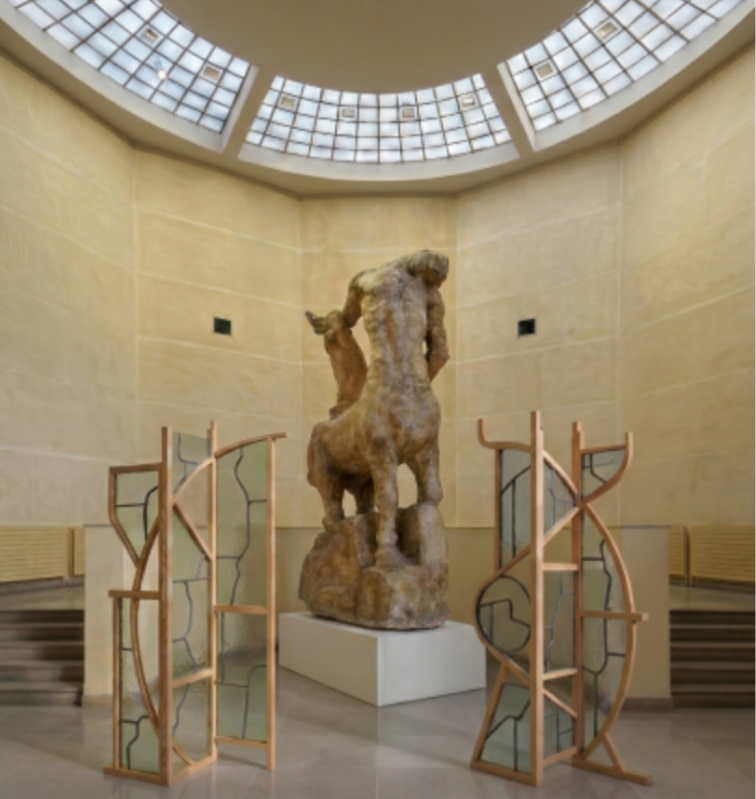
Conceived by Anthony Guerrée as a dialogue between contemporary decorative arts and the sculptural language of Antoine Bourdelle, Contrepoint draws on various artisanal techniques and combines materials such as wood, glass, textiles, and mixed clay. © Bourdelle Museum
Influence Without Imitation
At the Musée Bourdelle in Paris, designer Anthony Guerrée has created Contrepoint, a dialogue between contemporary decorative arts and the sculptural language of Antoine Bourdelle.
Through wood, stained glass, textile, terracotta, and furniture, Guerrée responds to Bourdelle’s forms without trying to reproduce them.
In the great plaster hall, stained-glass and wooden screens cast colored light around Bourdelle’s sculptures. Elsewhere, forms and lines borrowed from the sculptor become new objects in entirely different materials.
That distinction interests me:
influence without imitation.
We can carry something forward without copying it.
We can inherit an idea and allow it to change.
Perhaps that is how a tradition remains alive.
Not by repeating the past perfectly.
By understanding it well enough to make something new.

MODA's newest exhibition traces salt from the terraced salt ponds of Peru to the ancient mines of Austria, from kitschy salt-and-pepper shakers to the Morton's girl who has been walking in the rain since 1914. © Museum of Design Atlanta
A Pinch of Salt
And then there is salt.
The Museum of Design Atlanta’s SALT: A Design Story looks closely at one of the most ordinary and consequential materials on earth.
Salt shaped trade routes and cities. Humans developed extraordinary systems to extract, transport, tax, preserve, and store it. The exhibition moves through landscapes, mines, design, commerce, food, and even a tasting station, tracing a material so commonplace that we rarely stop to consider what it has carried through human history.
All of that history.
All of that landscape.
All of that human ingenuity.
And eventually:
a pinch between the fingers.
Something placed on the table.
Something tasted.
I love that change in scale.
It is easy to overlook the things we encounter every day.
Sometimes the ordinary becomes extraordinary only after we learn how much it carries.
From the Gallery
Richard’s Celilo Falls photographs are being seen together publicly for the first time nearly seventy years after he stood beside the Columbia River with two cameras and two rolls of color film.
I have had the privilege of carrying the photographs this far.
Now they belong, in another sense, to everyone who comes to see them.
That may be one of the beautiful things about stewardship.
Eventually, what we care for has to be allowed back into the world.
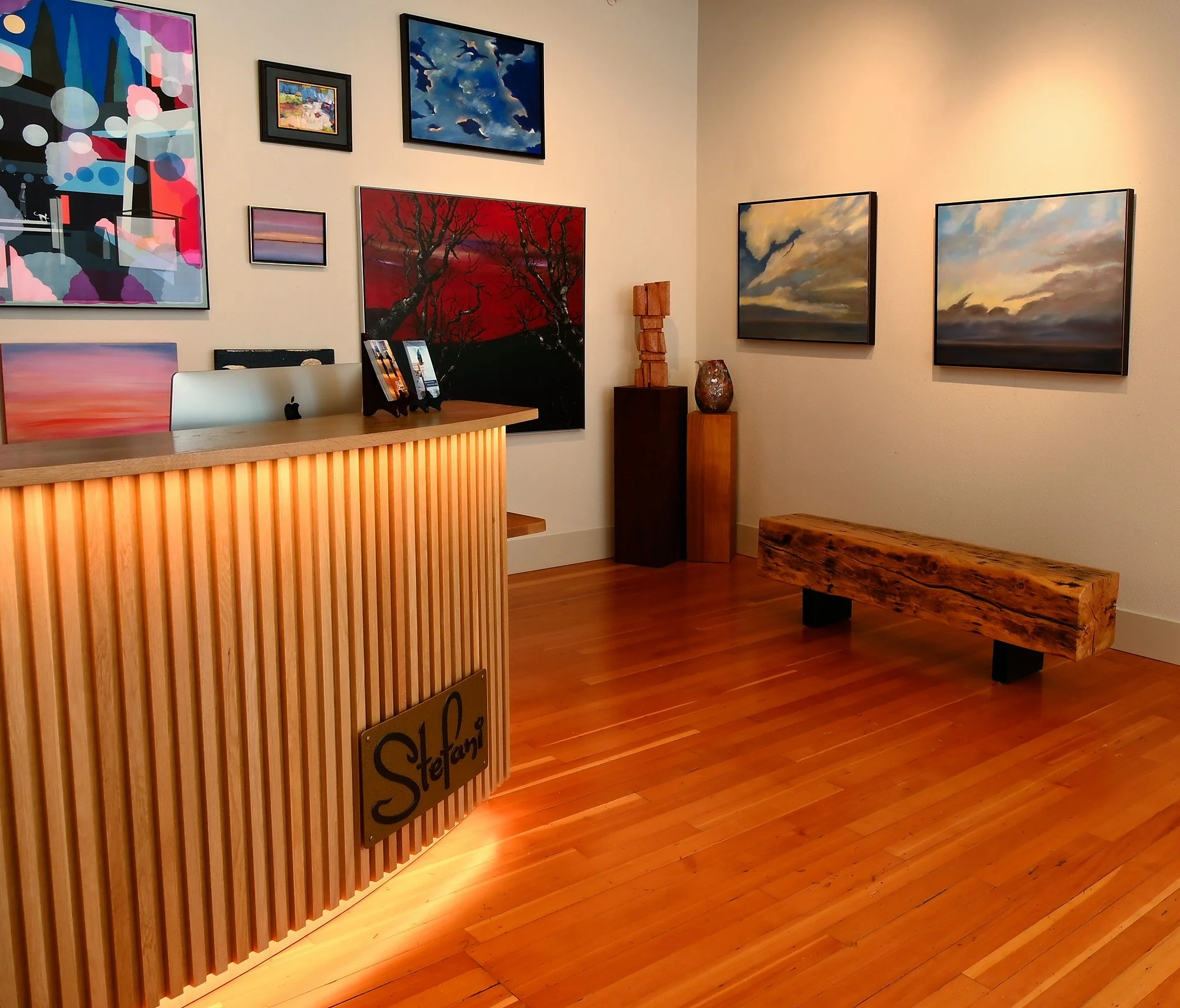
The exhibition opens September 26 at Stefani Art Gallery and is also the inaugural public presentation of House of Stefani.
What I’m Carrying With Me
We carry forward art.
We carry forward knowledge.
We carry forward memories.
We carry forward craft.
We carry forward relationships.
We carry forward what others entrusted to us.
And sometimes we carry forward parts of ourselves we did not fully understand until later.
What we carry forward becomes part of what comes next.
See you next Saturday.
Warmly,
–Christina Stefani | House of Stefani Journal
About the Author: Christina Stefani is an artist, gallerist, writer, and founder of House of Stefani, exploring art, design, and culture.