This Week in Art, Design, and Culture: What Holds True
Curated by Christina Stefani for House of Stefani

Installation view of the exhibition "Full Disclosure: The Edge of Information Design" at the Museum of Modern Art, New York, until June 13, 2027. IN2628.5. Photograph by Jonathan Dorado.
Some cultural stories appear unrelated until we begin looking more closely.
An exhibition about information design. Japanese woodblock prints filled with theatrical drama. A museum reconsidering how it presents the history of design. Two artists whose intertwined lives have complicated how their individual work is understood. A small California house whose systems are deliberately left exposed.
I kept returning to the idea of integrity.
I mean that in the broadest sense: integrity in how something is made, how information is presented, how history is preserved, how one artist remains distinctly themselves while being influenced by another, even how a building reveals the systems that allow it to function.
Integrity matters deeply to me, both personally and in the work we do at House of Stefani. I have always been interested in the relationship between what something appears to be and what it actually is.
These stories come from different places, disciplines, and centuries. Yet each asks, in its own way, how faithfully what we see reveals what is actually there.
That is what holds them together.

Ed Hawkins Warming Stripes. Digital file, data visualization graphics. Courtesy of Professor Ed Hawkins (University of Reading)
When Information Becomes Design
At the Museum of Modern Art in New York, Full Disclosure: The Edge of Information Design considers something we encounter almost constantly but rarely stop to examine: the visual systems through which information reaches us.
It is MoMA's first exhibition devoted entirely to information design.
Thirty analog and digital works explore the ways designers translate raw information into something people can understand, from complex systems and historical records to deeply personal human experiences. Among the works are Ed Hawkins's now-familiar Warming Stripes, Kate Crawford and Vladan Joler's Calculating Empires, and projects examining migration, poverty, computation and other forms of data that are difficult to comprehend until someone gives them visual form.
The premise is deceptively simple.
Data is not yet knowledge.
Before information becomes understandable, someone must decide how to organize it, what relationships to emphasize, what scale to use, what to include and what to leave outside the frame.
Those are design decisions.
And increasingly, they are also decisions about trust.
MoMA describes information designers as interpreters of an increasingly complex world. At a moment when algorithms, machine learning and artificial intelligence shape more of what we encounter, the exhibition argues for looking not only at the information presented to us, but at the structures through which we receive it.
That idea extends far beyond charts and diagrams.
The images, statistics, headlines and narratives we encounter every day arrive already framed in some way. Understanding who made those choices, and how, has become part of learning to see clearly.
It is a question we recently considered from another direction in our House of Stefani Journal essay, AI Art and Transparency: Why Knowing How an Image Was Made Matters More Than Ever. The technologies may change, but the underlying question remains remarkably consistent:
How was this made, and what do I need to know in order to understand what I am seeing?
Full Disclosure: The Edge of Information Design is on view at MoMA through June 13, 2027.
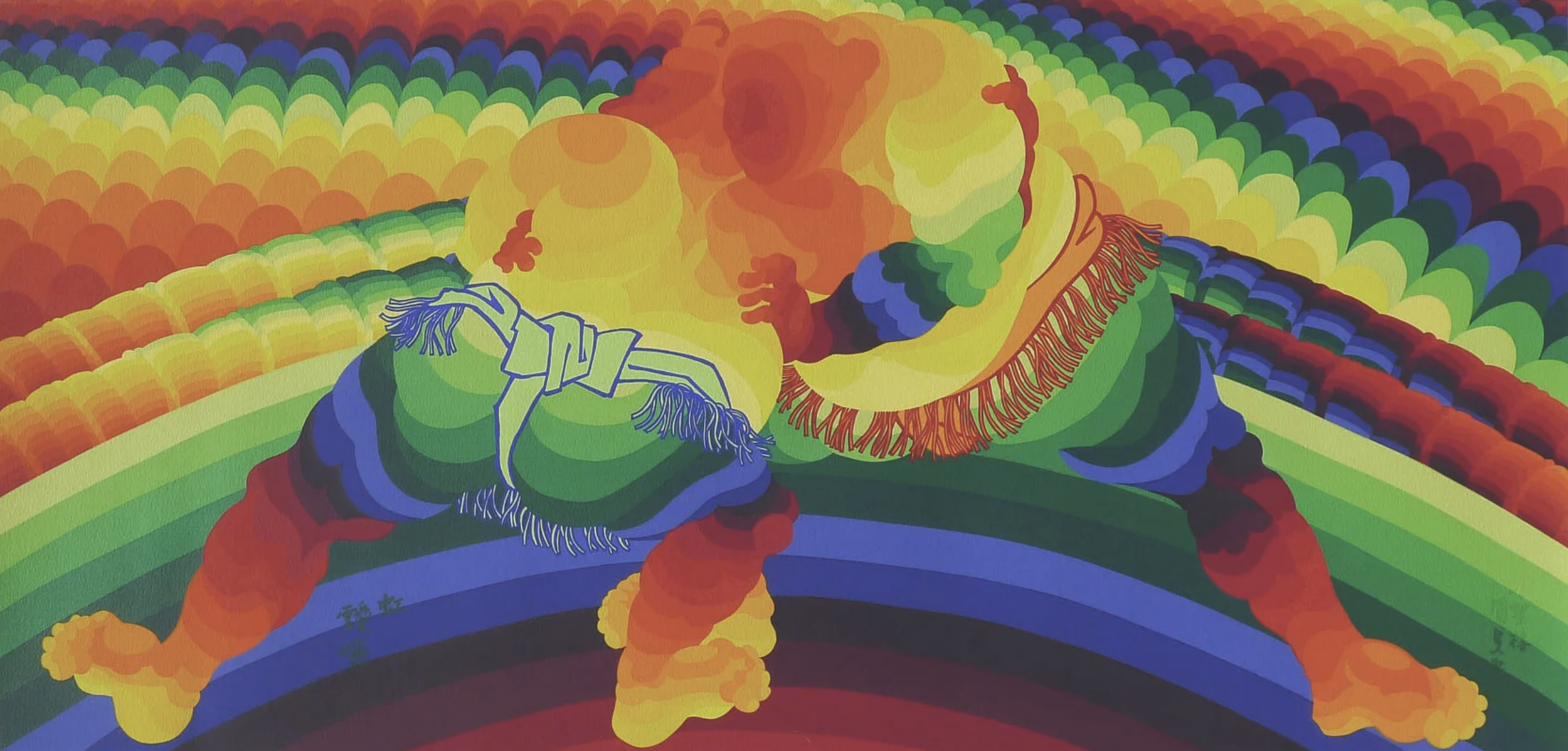
AY-O, Sumo wrestling screenprint, 1984. Courtesy Jordan Schnitzer Museum of Art
High Drama in Eugene
Closer to home, the University of Oregon's Jordan Schnitzer Museum of Art is exploring another kind of visual communication.
High Drama: Japanese Prints of Theater, Heroes and History brings together Japanese woodblock prints from the eighteenth through twentieth centuries around a particularly compelling theme: drama.
Kabuki actors, theatrical settings, expressive bodies, heroes, legends and historical events reveal just how powerfully artists could create movement and emotion within the stillness of a printed sheet.
The exhibition grew partly from research conducted by undergraduate and graduate students in Professor Akiko Walley's Japanese print course, whose work focused on the dramatic qualities of the medium. Recent gifts to the museum by Lee and Mary Jean Michels and Irwin Lavenberg provide much of the material, supplemented by modern and contemporary Japanese prints, paintings, textiles and decorative arts.
There is something especially compelling about Japanese printmaking's ability to condense so much into so little.
A gesture.
A diagonal line.
A patterned robe.
The relationship between two figures.
A sudden field of color.
The artists understood that drama does not necessarily require excess. Sometimes it depends on knowing precisely what to show.
High Drama: Japanese Prints of Theater, Heroes and History is on view in Eugene through October 10, 2027.
Explore High Drama at the Jordan Schnitzer Museum of Art
There is a personal connection for us in this exhibition as well. At Stefani Art Gallery, we are currently stewarding two exceptional woodblock prints by Kawase Hasui, one of the great masters of twentieth-century Japanese printmaking: Rain at Shinagawa and Snow at Honmonji Temple.
Hasui worked in a different register from the theatrical intensity explored in High Drama. His landscapes are quieter, often built from weather, light, architecture, and atmosphere. But seeing these traditions together is a reminder of just how expressive the Japanese woodblock could be, whether depicting a dramatic stage or a snow-covered temple.
For those interested in exploring Hasui’s work further, we have been developing research around the artist alongside the works currently held at Stefani Art Gallery.
Explore Kawase Hasui at Stefani Art Gallery
When a Collection Refuses to Stand Still
At the ADI Design Museum in Milan, more than 400 objects and projects have been reconsidered in the first complete rethinking of the museum's Compasso d'Oro collection since the institution opened.
The Compasso d'Oro, established in 1954, is one of the most important awards in the history of Italian design. Its collection grows with every new edition, which creates an unusual curatorial problem.
How can a permanent collection remain permanent when its story has not finished?
The museum's answer is to treat the collection as an "evolving species."
The new installation places objects alongside drawings, photographs, advertisements, correspondence, magazines, prototypes and models, allowing visitors to see not simply what was designed, but something of the conditions and processes that produced it.
It is a subtle but important shift.
Museums preserve objects, but stewardship involves more than keeping things intact. Context changes. Scholarship changes. New work appears. Connections become visible that earlier generations may not have recognized.
A living collection therefore requires something more demanding than preservation.
It requires continued attention.

Jackson Pollock, Untitled, ca. 1948–49. Dripped black ink and red enamel paint on paper. Gift of Lee Krasner Pollock, 1982 © © 2026 Pollock-Krasner Foundation / Artists Rights Society (ARS), New York
Krasner and Pollock, Reconsidered Together
Krasner and Pollock: Past Continuous, at The Metropolitan Museum of Art from October 4, 2026 through January 31, 2027, brings Lee Krasner and Jackson Pollock together in a major exhibition examining their careers before, during and beyond their life together.
Their relationship is one of the most familiar stories in twentieth-century American art, but for decades the historical narrative was profoundly uneven. Pollock became an almost mythological figure of Abstract Expressionism while Krasner's considerable artistic achievement was frequently described in relation to his.
That understanding has changed substantially.
The Met's exhibition presents both artists on their own terms while also looking closely at the ways their practices intersected, diverged, and influenced one another. More than 120 works trace their respective careers and the complicated creative relationship between them.
It raises a fascinating question about artistic relationships.
How can two people profoundly influence one another while remaining recognizably themselves?
Perhaps influence does not diminish originality when the artist has developed a sufficiently strong language of their own.
Krasner and Pollock: Past Continuous runs October 4, 2026 through January 31, 2027.
Explore Krasner and Pollock: Past Continuous at The Met
A House That Shows How It Works
In Jackson, California, architect Hafsa Burt approached many of the same questions through an entirely different medium: a small experimental house called Null.
Designed as an experiment in climate-resilient residential architecture, the compact home operates without fossil fuels, generates energy through onsite solar power, collects rainwater in 2,500-gallon cisterns and incorporates materials salvaged from another construction project.
But one of its most interesting qualities may be philosophical rather than technological.
Burt describes the design as a "just-enough" approach. Materials are kept to a minimum. Building systems are deliberately visible rather than concealed. Structure is allowed to look like structure.
There is very little architectural pretending.
In an era when sustainability can itself become a layer of marketing added onto buildings, Null begins instead with systems, materials and necessity.
The result is not an argument for austerity.
It is an argument for clarity.
Read more about Hafsa Burt's Null house
What Holds True
Looking across these very different examples, the connection becomes clearer.
Good design can make complexity understandable without pretending that complexity does not exist.
A great print can transform a few deliberate marks into extraordinary drama.
A museum can preserve history while remaining willing to reconsider how that history is understood.
Two artists can influence one another profoundly without becoming the same artist.
And a building can reveal rather than conceal the systems that allow it to work.
I find something reassuring in all of that.
We live in a culture remarkably skilled at constructing appearances: images, brands, narratives, identities, even convincing simulations of things that never existed at all. That makes the relationship between appearance and substance increasingly worth examining.
The things I continue to value most, in art, design, business, and life, tend to have something solid underneath them.
Craft. Thought. History. Work. Character.
Perhaps integrity is not perfection, purity, or resistance to change.
Perhaps it is simply the alignment between what is visible and what is true.
And that is something worth learning to recognize.
–Christina Stefani | House of Stefani Journal
About the Author: Christina Stefani is an artist, gallerist, writer, and founder of House of Stefani, exploring art, design, and culture.