On color, composition, and the remarkable sensitivity of Richard Stefani's early portraiture.
By Christina Stefani | House of Stefani Magazine
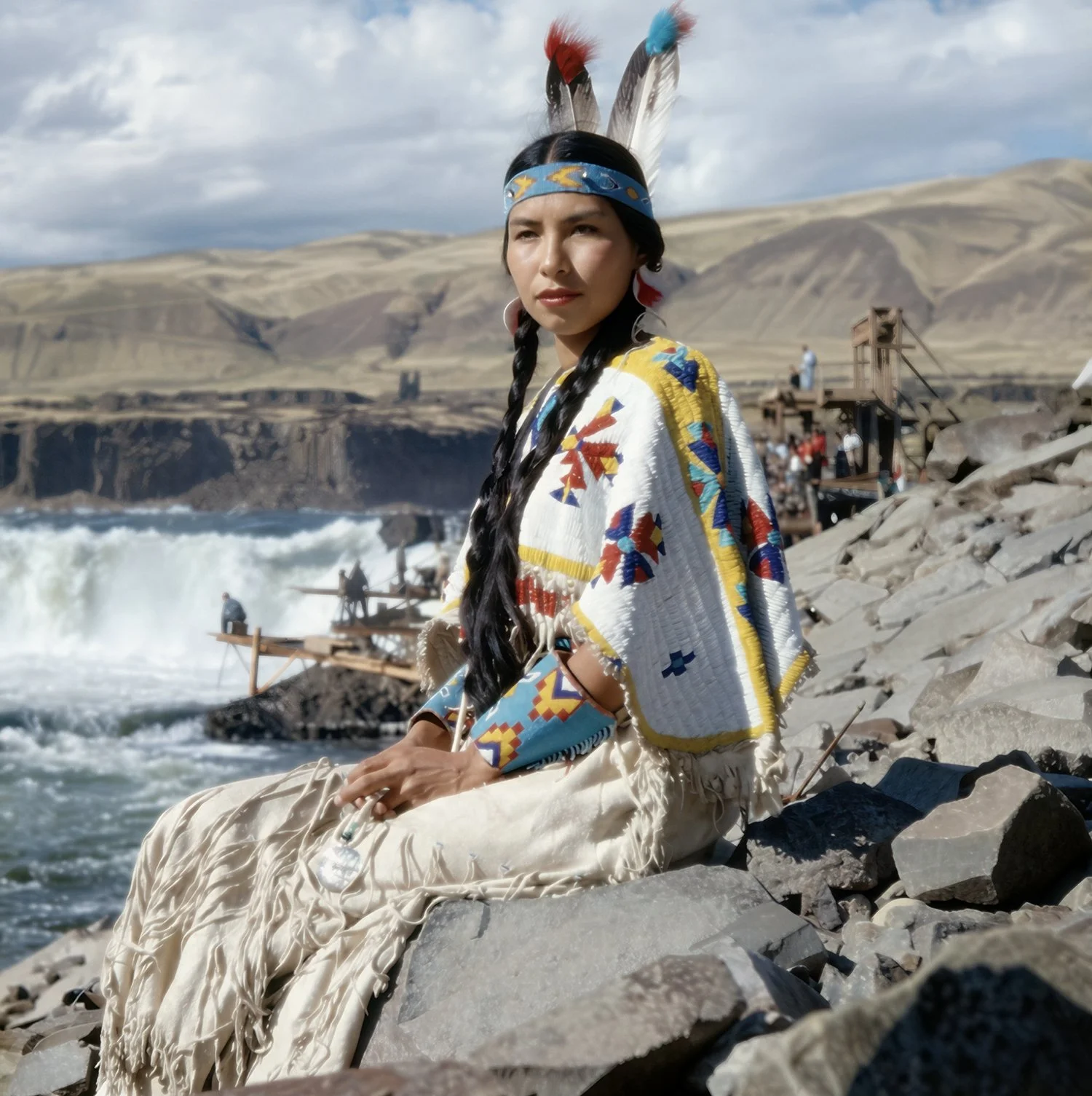
Young Woman at Celilo Falls, 1956, Richard Stefani (1933–2022) From Before the Water Rose: Celilo Falls, 1956
She sits among the rocks beside the Columbia River, looking directly toward the camera.
Behind her, Celilo Falls rushes through the landscape. Wooden fishing platforms extend over the water. People gather in the distance, and the dry hills of the Columbia Gorge rise beneath a broad, cloud-filled sky.
There is an extraordinary amount to see.
Yet our attention settles almost immediately on the young woman.
Her expression is composed. Her posture is relaxed but assured. She looks toward the camera without smiling or turning away.
She is simply present.
And that presence gives the photograph its remarkable power.
The Art of Seeing a Person
Richard Stefani was twenty-three years old when he made this portrait in the fall of 1956.
He had not yet begun the professional photographic career that would later make portraiture such an important part of his work.
But something of the photographer he would become is already apparent.
Richard understood that a compelling portrait requires more than a recognizable face.
It requires attention.
In Young Woman at Celilo Falls, he has allowed his subject to occupy the composition with extraordinary confidence.
She is seated slightly to one side, her body angled across the rocks. Her face turns toward the camera, creating a direct visual relationship with the viewer.
Her hands rest naturally in her lap.
There is no theatrical gesture, no exaggerated expression, no attempt to manufacture drama.
Instead, Richard gives us the opportunity to look at another person.
It is a deceptively simple achievement.
The strongest portraits often depend upon precisely this quality: the ability to hold someone's presence without overwhelming it with the photographer's intentions.
Richard appears to have recognized that instinctively.
A Remarkable Understanding of Color
The photograph's color is extraordinary.
Against the subdued earth tones of the Columbia Gorge, the young woman's clothing introduces a brilliant arrangement of white, yellow, turquoise, red, and blue.
The colors are vivid, but they do not overwhelm the composition.
Her white garment establishes a broad area of light against the darker rocks. Yellow borders and geometric patterns create rhythm. Turquoise details echo the blue-green tones of the river, while small passages of red bring warmth and contrast.
Her dark hair provides another important visual element, carrying our eye from her face through the center of the composition.
Above her, the feathers extend into the sky, introducing a delicate vertical movement that contrasts with the horizontal sweep of the distant hills.
As a painter, I find these relationships particularly compelling.
Color is never simply a collection of attractive hues. It establishes structure, balance, emphasis, and atmosphere.
In this photograph, the relationships feel remarkably complete.
The garment, the landscape, and the light each contribute something distinct, yet nothing seems visually disconnected.
Richard did not arrange the colors as a painter might arrange pigments on a canvas.
He recognized what was before him.
And he understood how to make a photograph from it.
The Complexity Behind the Simplicity
Look beyond the young woman, and the photograph becomes increasingly intricate.
The rocky foreground creates a strong diagonal through the lower portion of the frame. The river moves across the middle distance. Wooden platforms and small human figures introduce a network of vertical and horizontal lines.
Beyond them, the hills stretch toward the horizon.
These elements could easily have produced a crowded or distracting image.
Instead, Richard organizes them into a composition that feels remarkably natural.
The young woman remains the visual center, but the landscape is not reduced to a meaningless backdrop.
It retains its own presence.
This is one of the photograph's most accomplished qualities.
It is both a portrait and a carefully observed relationship between a person and a place.
Richard gives us enough information to understand that she is sitting beside a working river, surrounded by a landscape and community that existed long before he arrived with his camera.
Yet he does not allow the setting to define her.
She remains an individual.
And the photograph is stronger for it.
The Quiet Authority of a Portrait
There is something especially compelling about a portrait in which the subject meets the camera without an obvious performance.
We are accustomed to photographs that ask people to smile, gesture, or communicate a particular emotion.
This image does none of those things.
The young woman's expression is difficult to summarize, and I would not want to try.
It is not our responsibility to decide what she was thinking or feeling.
What we can observe is the extraordinary composure of her presence.
She looks toward Richard's camera.
Nearly seventy years later, we look back.
That simple exchange gives the photograph a quality that is difficult to manufacture.
It feels immediate.
The distance between 1956 and the present becomes less apparent, not because the historical circumstances have disappeared, but because the person before us remains so vividly individual.
We do not yet know her name or tribal affiliation.
The Richard Stefani Estate continues to welcome information that may help identify the people represented in these photographs.
Until more is known, I believe the most respectful approach is to acknowledge what remains uncertain while allowing the portrait itself to speak.
We do not need to invent a story about her to appreciate the artistry of Richard's photograph.
Nor should we confuse the beauty of the image with ownership of the life it depicts.
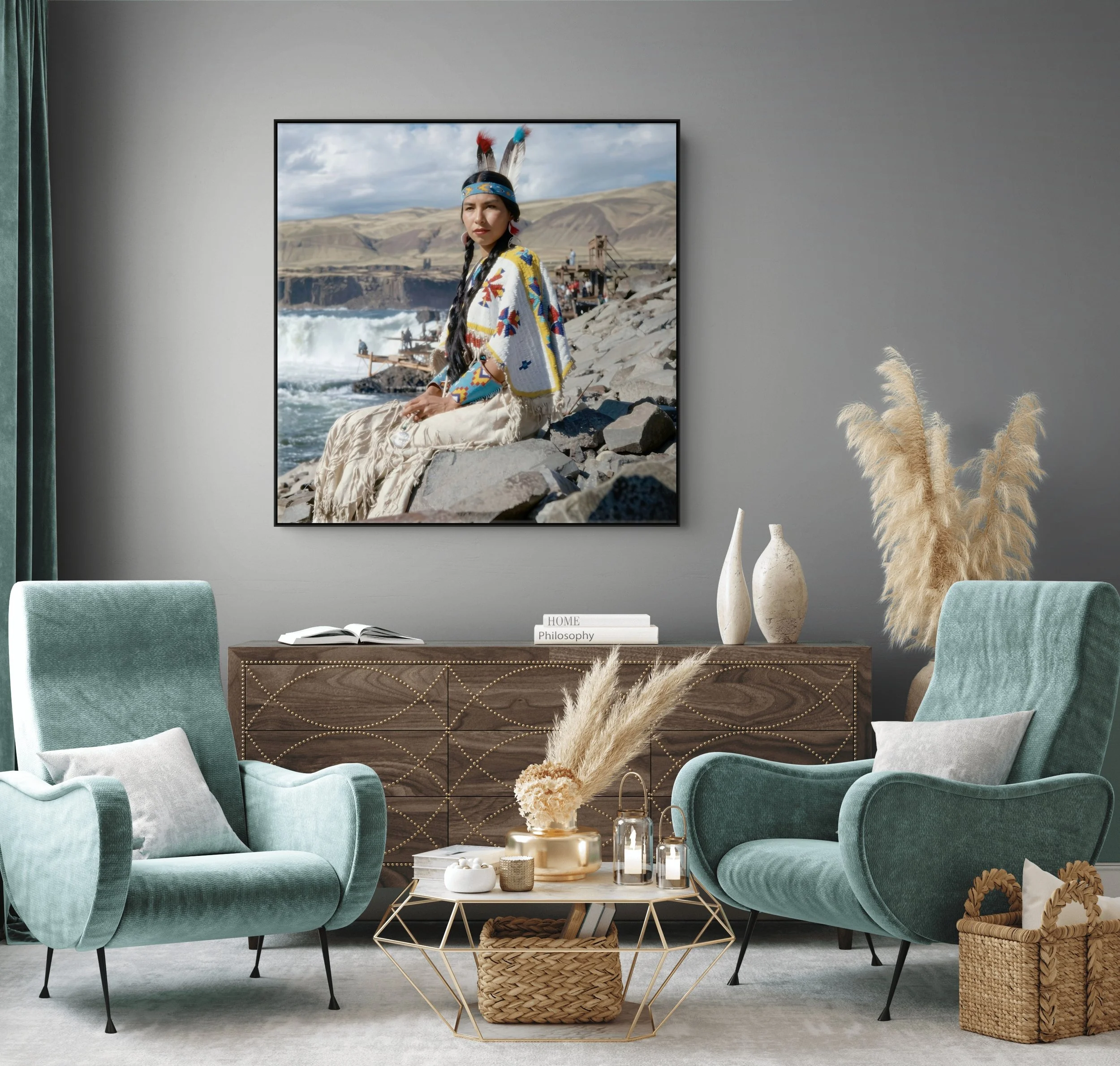
A Work of Art to Live With
One of the pleasures of bringing Richard's original color negatives into their finished Estate Editions has been discovering how differently the photographs reveal themselves at scale.
In the completed portrait, the relationships between color, texture, and composition become especially apparent.
The fine details of the garment, the texture of the stones, the movement of the river, and the subtle transitions of light all reward sustained attention.
But the strongest impression remains the young woman's presence.
This is what I find so compelling about exceptional photographic portraiture.
A photograph can be visually sophisticated, historically meaningful, and beautifully produced.
Yet its greatest strength may be something less easily described.
It can create a lasting relationship between the viewer and the person represented.
Within a thoughtfully designed interior, a portrait of this kind has a particular character.
Its colors are expressive enough to become a visual focal point, while its balanced composition allows it to inhabit a room without overwhelming the surrounding architecture or furnishings.
The square format contributes to that sense of stability.
Unlike a sweeping landscape, which often emphasizes movement across space, this composition holds our attention within a more contained field.
It has both intimacy and presence.
And I believe that combination is one of the reasons photographic portraiture can become such a meaningful part of a personal collection.
We do not simply live with an image.
We return to it.
We notice different details.
We become familiar with its qualities without exhausting them.
The work continues to offer something long after the first encounter.
The Care of an Estate Edition
For the exhibition Before the Water Rose: Celilo Falls, 1956, Richard's original color negatives were newly scanned and carefully prepared for presentation.
The resulting limited Estate Editions are produced in Germany as chromogenic photographic prints on Fuji Crystal Archive DP II paper, mounted with aluminum Dibond backing beneath matte, reflection-reducing acrylic glass.
Each is presented in a narrow Basel black oak floater frame.
The materials and presentation were chosen to support the photographs rather than compete with them.
There are no decorative mats or elaborate framing details.
The emphasis remains on Richard's image: its color, composition, and extraordinary visual clarity.
Each Estate Edition is individually numbered and accompanied by documentation recording the work, edition number and size, production specifications, and provenance.
These decisions are part of the larger responsibility of caring for a photographic estate.
The original negative is an irreplaceable historical object.
The finished Estate Edition is a carefully produced work through which Richard's photograph can be experienced, collected, and preserved.
Both deserve thoughtful attention.
What Endures
There is a historical dimension to Young Woman at Celilo Falls that cannot be separated from the photograph.
Richard made the image only months before The Dalles Dam submerged Celilo Falls beneath the Columbia River.
For generations, Celilo had been a place of fishing, gathering, trade, and cultural continuity for Indigenous communities.
Those cultural relationships endure, even though the physical landscape has changed.
Richard's photograph preserves one moment within that much larger history.
But it also reveals something about his artistic vision.
He was young.
He was working with color film at a time when color photography was far less commonplace than it is today.
And he was already demonstrating an ability to recognize the remarkable visual possibilities of an encounter between a photographer and another person.
The photograph does not need a dramatic expression to hold our attention.
It does not need an elaborate setting, although the setting itself is extraordinary.
It depends upon something quieter.
A person.
A moment.
A photographer who knew how to look.
And an image whose beauty has endured for nearly seventy years.
That, to me, is the remarkable achievement of Young Woman at Celilo Falls.
It is a photograph of a particular person in a particular place at a particular moment in history.
And it is also a work of art whose color, composition, and human presence continue to reward our attention.
The longer we look, the more we recognize the distinction.
Richard did not simply photograph a beautiful scene.
He made a beautiful portrait.
This essay is part of House of Stefani's ongoing exploration of fine art, collecting, craftsmanship, and the photographic legacy of Richard Stefani.
Collecting Young Woman at Celilo Falls, 1956
Richard Stefani (1933–2022)
From Before the Water Rose: Celilo Falls, 1956
Available as a limited Richard Stefani Estate Edition in three square formats: 10 × 10, 20 × 20, and 30 × 30 inches.
Each edition is individually numbered, produced from Richard's original 1956 color negative, and accompanied by Estate documentation.
View Young Woman at Celilo Falls — Estate Editions
Private collectors, interior designers, and institutions are welcome to contact Stefani Art Gallery for assistance with acquisition, scale, and placement.