By Christina Stefani | House of Stefani Magazine
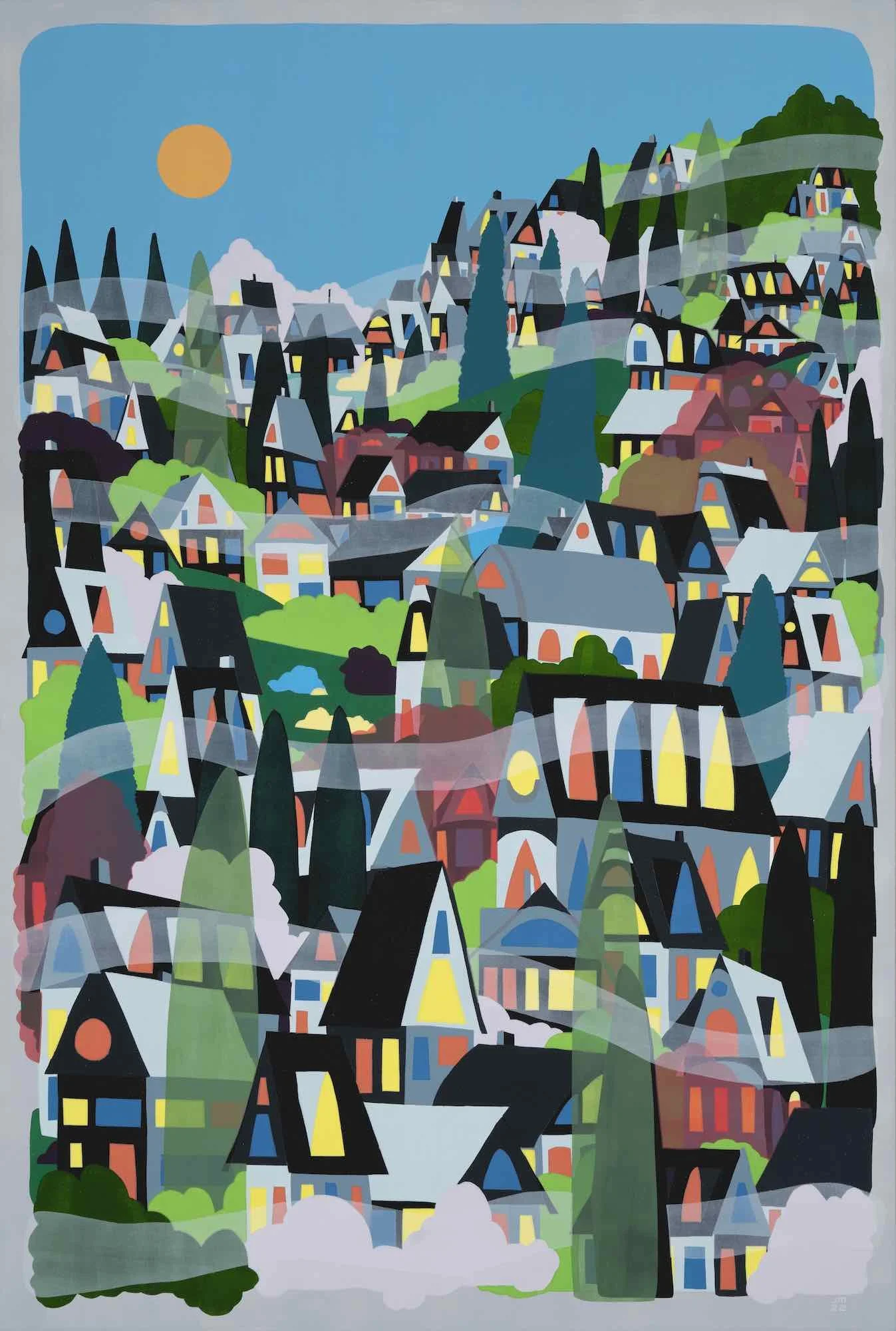
Misty Hill Moon, Jude Morales, Acrylic on Canvas, 2022, 60 x 40 x 1.5 inches. Private collection.
How memory, color, and the discipline of composition transform familiar landscapes into something entirely personal.
Some artists paint what they see. Others paint what remains after they have looked away.
I have been thinking about that distinction while looking at the paintings of Jude Morales, an artist represented by Stefani Art Gallery.
His landscapes are familiar, but not quite as we know them. Trees rise in unexpected colors. Buildings gather into intricate geometric arrangements. Clouds drift across skies that seem to belong as much to imagination as to geography.
An extraordinary amount happens within a single composition. Yet his paintings never feel unnecessarily busy.
They are lively, colorful, sometimes whimsical, and remarkably harmonious.
That balance is one of the things that first attracted me to Jude's work. But there is something else, too. His paintings have an unmistakable sense of optimism. Not an artificial cheerfulness, but a genuine pleasure in looking at the world.
I find that quality increasingly valuable.
The Landscape We Carry With Us
We tend to think of landscape painting as a record of a particular place. A mountain. A coastline. A neighborhood. A stand of trees.
But our experience of a place is rarely so straightforward.
We remember fragments. The way afternoon light fell across a hillside. The relationship between buildings and the trees surrounding them. A particular color. A feeling.
Sometimes the memory becomes more vivid than the details themselves.
When I asked Jude how he develops his paintings, his answer revealed something essential about his approach.
"Currently, I’m mostly working from an internal visualization based on memory of experiencing places," he explained. "From there, I always start with drawing."
Although he has worked from observation, sketches, photographs, and memory throughout his career, his current practice relies heavily on what remains after experiencing a landscape.
"In the back of my mind I’m always taking in the spatial experience of a place, the relationships of forms within a space," he told me.
And then he said something I found especially revealing.
"When I’m recalling these places, I think it’s the emotional impact of the experience that pushes that forward to become a painting."
I love that description.
The landscape provides the experience. Memory begins the transformation. The artist gives it form.
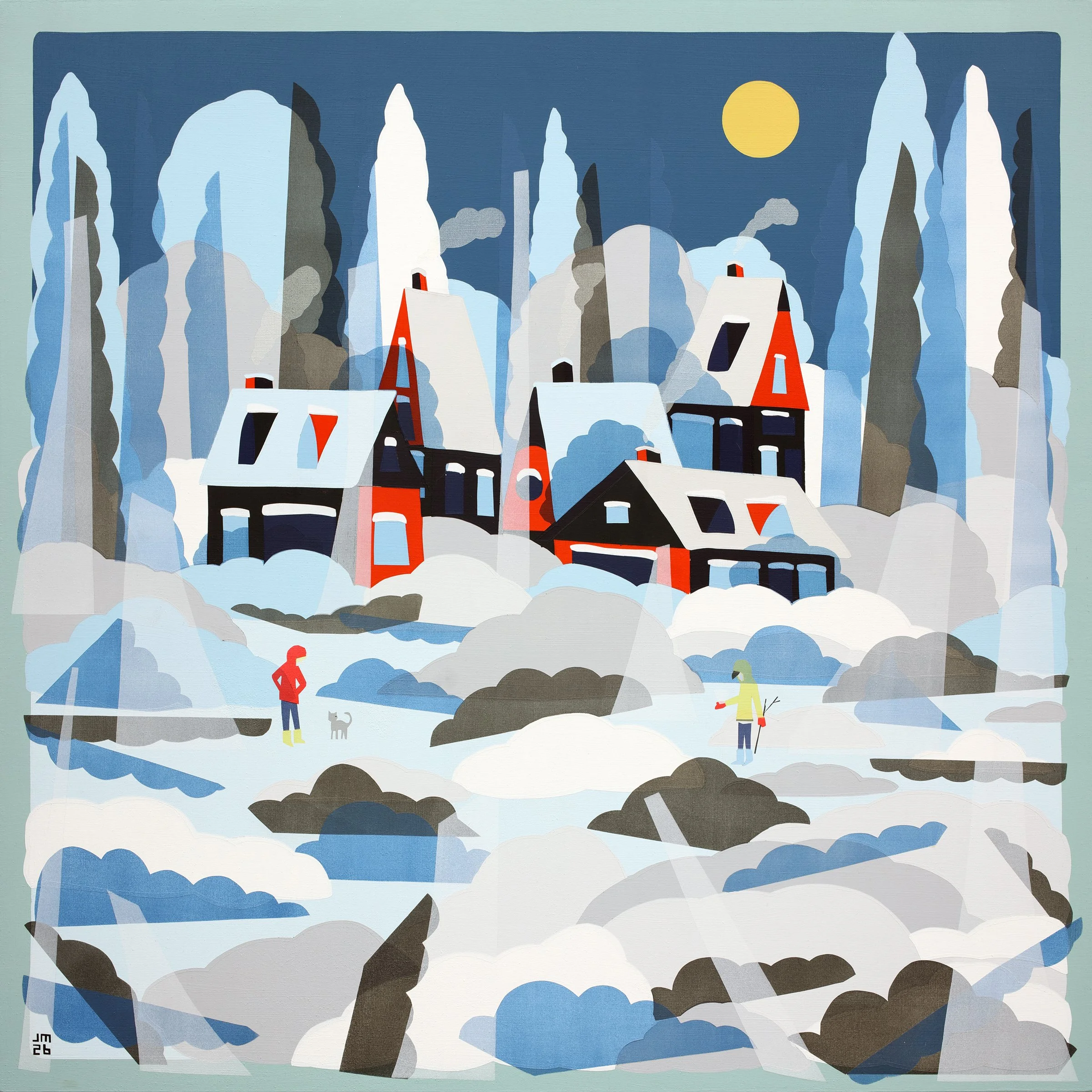
Connection 2: On A Quiet Winter Night, Jude Morales, Acrylic on birch panel, 2026, 30 x 30 inches. Courtesy of Stefani Art Gallery.
The Discipline Behind the Whimsy
At first glance, Jude's paintings can appear playful.
His trees are stylized. Buildings resemble pieces in an elaborate puzzle. Clouds become repeated shapes. Color moves across the surface in unexpected combinations.
But the playfulness disguises considerable compositional discipline.
As a painter myself, I am particularly interested in how an artist organizes visual information.
It is relatively easy to add detail to a painting. It is much harder to determine which details belong, how they should relate to one another, and when the composition has enough.
Look carefully at Jude's work and you'll notice how shapes repeat. A particular color appears in one area and reappears elsewhere. Vertical forms establish rhythm, while horizontal passages give the eye somewhere to rest.
There is repetition, variation, and occasionally a delightful surprise.
I asked Jude how much of a painting he can envision before beginning.
"I usually have the composition mapped out in my head before starting the drawing process," he told me.
But he doesn't follow that initial vision rigidly.
"As the painting progresses, I generally follow this composition mapping but use my intuition to build up to the final result."
He enjoys the surprise of discovering how the finished painting comes together.
I understand that feeling.
Painting requires both conviction and flexibility. We begin with an idea, but the work gradually develops its own demands. A color changes the relationship between two forms. A passage that seemed essential becomes unnecessary. Something unexpected turns out to be exactly what the painting needed.
The artist must know when to lead and when to listen.
Color as a Language
Color is one of the most recognizable qualities of Jude's work.
His palette can be adventurous, combining unexpected blues, pinks, greens, warm oranges, and muted neutrals. Yet the colors rarely compete for attention.
They seem to belong together, even when the combinations are unconventional.
I asked whether his approach to color had changed over the years.
"I think I’ve become more comfortable with variety in my palette choices," he said, "more willing to trust my instincts when balancing out colors within a composition."
That answer speaks to something important about artistic maturity.
Technical knowledge matters. Artists study color relationships, value, temperature, contrast, and harmony. We learn how colors influence one another.
But experience gradually gives us something that cannot be learned entirely from a textbook.
Judgment.
We begin to recognize when a combination works, even if it is unconventional. We become more willing to make decisions that are personal rather than predictable.
Jude's use of color has that quality.
It feels considered without feeling calculated.
Between Abstraction and Recognition
One of the pleasures of looking at Jude's work is the way it moves between representation and abstraction.
We recognize trees, buildings, hills, water, and clouds. But we are never asked to mistake the painting for a photograph.
The shapes have been simplified, rearranged, and transformed.
A forest becomes a sequence of vertical forms. A neighborhood becomes an arrangement of color and geometry. A coastal landscape becomes a conversation between shapes and space.
Yet the sense of place remains.
I think this is one reason his work appeals to such a broad range of collectors.
There is enough familiarity to invite us into the painting, and enough abstraction to keep us looking.
Because the imagery is not entirely literal, we have room to bring our own experiences to it. A painting might remind one person of a childhood neighborhood and another of a favorite coastal holiday.
Neither response needs to be the artist's original intention to be meaningful.
Art creates relationships that continue beyond the studio.
Craftsmanship, Character, and Professionalism
When considering an artist for representation, I look closely at the work itself. But I also pay attention to how the artist approaches the responsibilities surrounding it.
Craftsmanship matters to me. So does presentation.
Jude's paintings demonstrate consistent attention to execution. His framing is carefully chosen, well constructed, and complementary to the artwork.
These may seem like small details, but they are not.
A painting does not stop being an artist's responsibility when the final brushstroke is complete. How it is finished, framed, handled, and presented all contribute to the experience of the collector who will eventually live with it.
I believe those decisions reveal something about an artist's professional standards.
And Jude's standards have consistently impressed me.
There is another reason I value representing him.
He is simply a pleasure to work with.
He attends gallery receptions, engages warmly with collectors, communicates well, and treats our staff with genuine respect.
These qualities matter enormously in the daily life of a gallery.
Art is deeply personal, but the professional art world is also built on relationships. Artists, galleries, collectors, designers, framers, and many others contribute to the journey a work takes from the studio into someone's home.
Those relationships depend on trust.
When I asked Jude what he finds most difficult about sustaining a professional artistic career, his answer was refreshingly concise:
"Navigating the business side of the art world."
I suspect many artists would agree.
The business of art demands skills quite different from those required to make a painting. Pricing, communication, documentation, presentation, contracts, and professional relationships all require attention.
This is one reason I believe so strongly in helping artists understand the professional responsibilities that accompany their creative work.
And why I appreciate artists who take those responsibilities seriously.
Jude does.
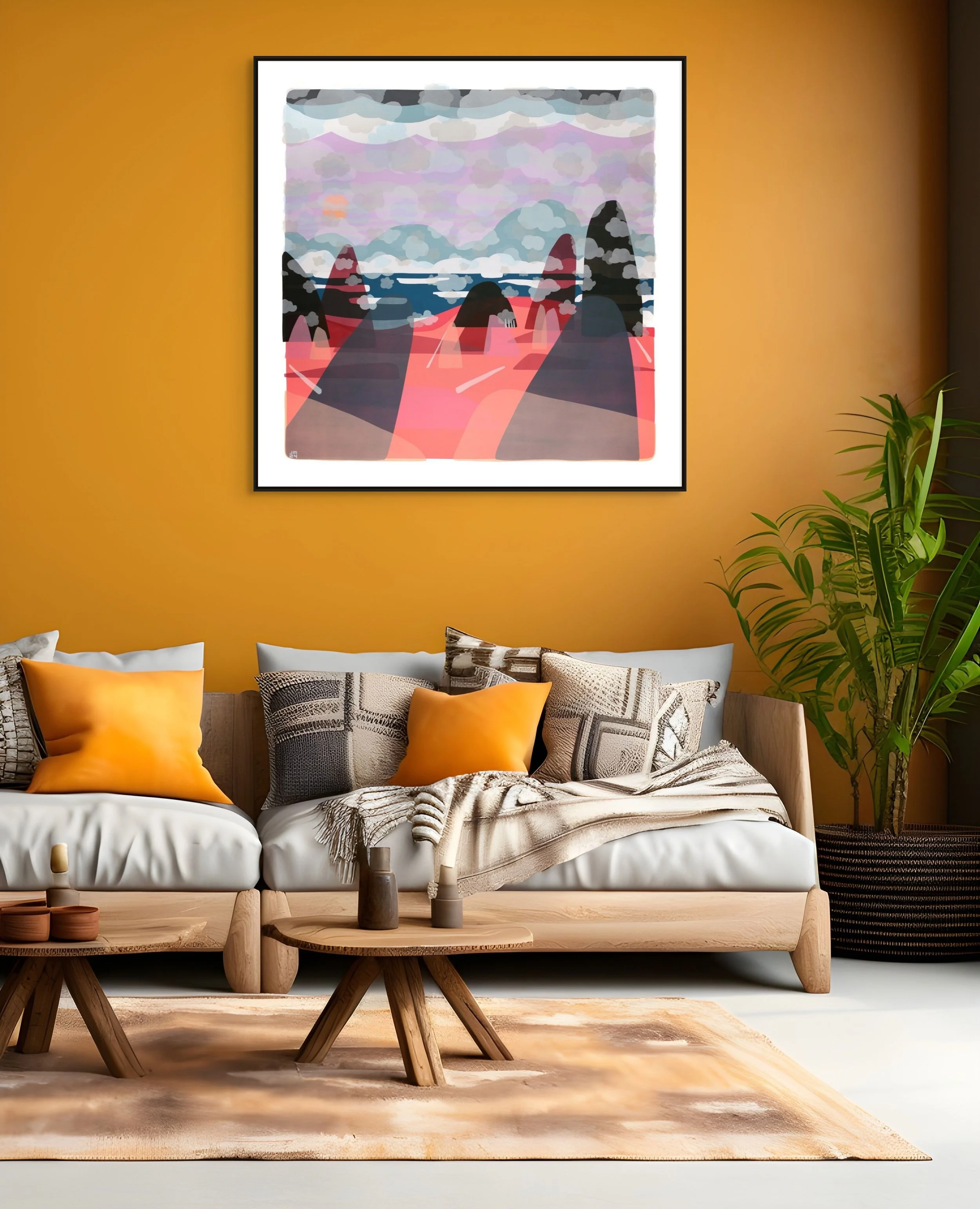
Cloudy Cove, Jude Morales, Acrylic on birch panel, 2024, 36 x 36 x 1.5 inches. Courtesy of Stefani Art Gallery.
Living With a Painting
I often encourage people to consider what it means to live with original art rather than simply admire it for a few moments.
A painting becomes part of our daily environment.
We encounter it in different light. We notice it while walking through a room. We discover details that escaped us when we first saw it.
Over time, our relationship with the work changes.
Jude's paintings are particularly interesting in this respect. Their compositions reward repeated viewing. There are always new relationships to notice, small passages of color to discover, and details that reveal themselves gradually.
And their sense of optimism brings something valuable into a living space.
I don't believe art must always be cheerful. Some of the most important works ever created confront difficult, painful, or unsettling subjects.
But neither should we underestimate the value of beauty, delight, or a sense of possibility.
There is room in a thoughtful collection for all of these experiences.
Jude's work reminds us that visual sophistication and pleasure are not opposing ideas.
A painting can be intellectually engaging and genuinely enjoyable to live with.
What Remains
The more I consider Jude's paintings, the more I return to his description of memory.
He notices the relationships between forms in a landscape. He carries those relationships with him. Later, an emotional response brings them forward, and a painting begins.
What emerges is not simply a picture of a place.
It is a record of having experienced it.
Perhaps that is why his landscapes feel both familiar and unexpected. We recognize the world within them, but we also encounter something distinctly his own.
And that, to me, is one of the qualities that distinguishes an artist with a developed visual language.
The work is recognizable not because it repeats itself, but because it reflects a consistent way of seeing.
I am pleased to represent Jude Morales at Stefani Art Gallery and to share his paintings with people who will continue discovering their pleasures for years to come.
Because the best paintings do not reveal everything at once.
They give us reasons to keep looking.
Jude Morales is a contemporary artist based in Salem, Oregon, whose paintings explore the relationships between landscape, memory, color, and place. His work is represented by Stefani Art Gallery.