Before You Send Your Portfolio: Preparation, Presentation, and the Art of a Thoughtful Introduction
By Christina Stefani | House of Stefani Magazine
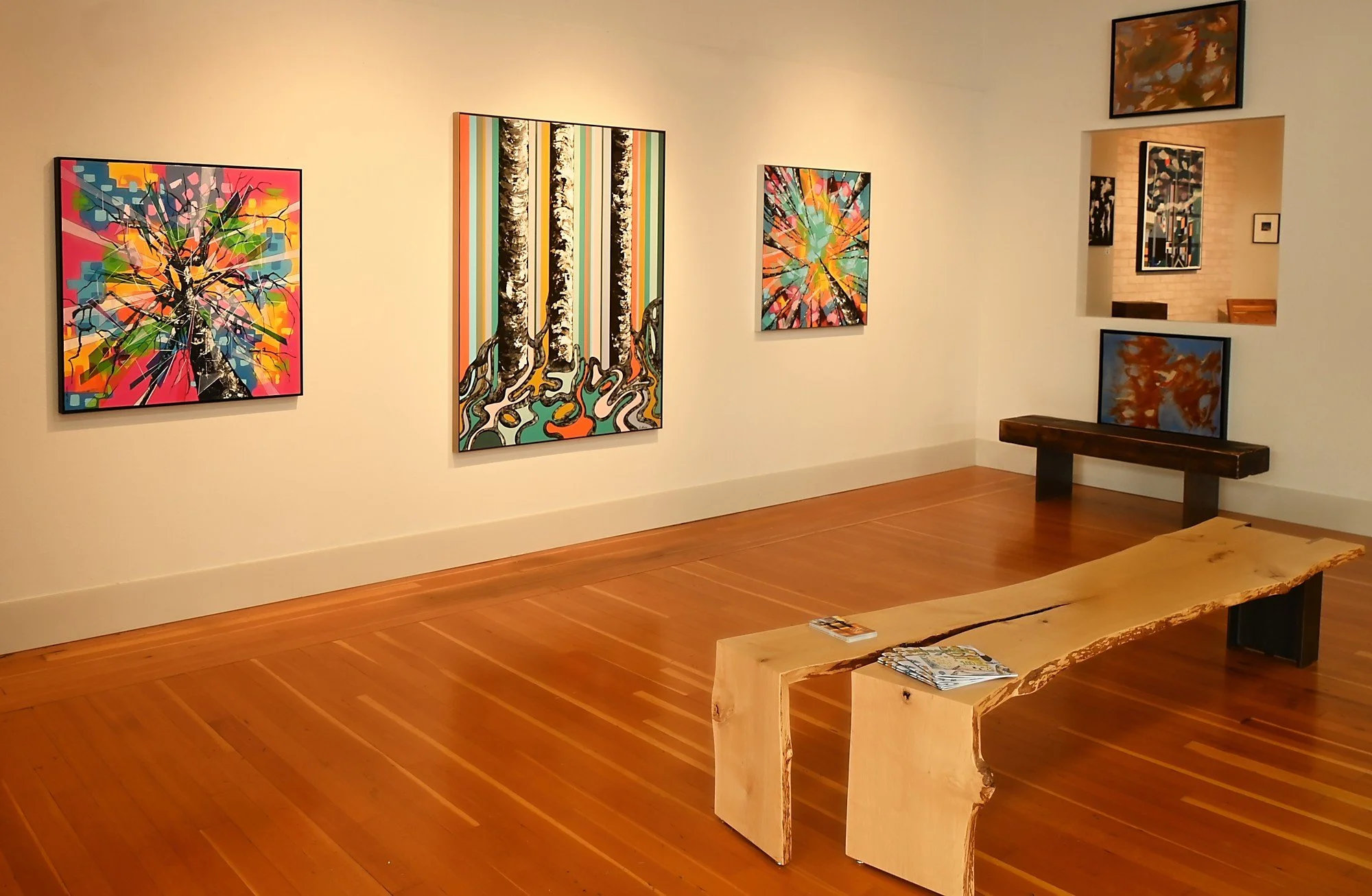
Lee Morrison’s paintings on display at Stefani Art Gallery. The gallery began representing Lee after a respectful, thoughtful introduction.
A gallery submission is not simply an announcement that your artwork is available.
It is an introduction.
And like any meaningful professional introduction, it deserves preparation, consideration, and an understanding of the person receiving it.
At Stefani Art Gallery, we regularly hear from artists interested in exhibiting or establishing a professional relationship. I appreciate that interest. Making artwork requires courage, and sharing it with someone who may evaluate it professionally can feel especially vulnerable.
But I have also noticed something that concerns me.
Some introductions start with a list of conditions and expectations before the artist has shared their work or established whether a professional relationship would be a good fit.
Often, very little has been said about the artwork itself.
I understand the importance of advocating for yourself. Artists should know their rights, ask thoughtful questions, and understand the business arrangements they are considering.
But there is a difference between protecting your interests and beginning a conversation with demands.
One establishes the possibility of mutual respect.
The other can make it difficult for a meaningful conversation to begin.
Fortunately, approaching a gallery professionally is not mysterious. It is a skill artists can learn.
And it begins long before the first email.
Begin With the Gallery, Not the Submission
Before approaching a gallery, spend time understanding it.
Look carefully at the artists it represents.
Study its exhibitions, curatorial direction, and the kinds of work it presents.
Consider the relationship between your work and the gallery's existing program.
Does your work contribute something meaningful to that conversation?
Is the gallery equipped to present it effectively?
Would you genuinely want to be part of its artistic community?
These questions are more important than whether the gallery has an attractive space or a prestigious address.
A gallery may admire your artwork and still recognize that it is not an appropriate fit.
That is not necessarily a judgment of your ability.
It may simply reflect the gallery's identity, commitments, or capacity.
Research also demonstrates respect.
It tells the recipient that you are interested in a particular professional relationship, not simply sending the same message to every gallery whose email address you can find.
A thoughtful introduction begins with understanding where you are writing.
Read the Submission Guidelines
This may be the simplest advice in this entire article.
And it may be the most useful.
If a gallery publishes submission guidelines, follow them.
Some galleries welcome unsolicited portfolios. Others review submissions only during particular periods. Some require an application form, while others prefer email. Certain galleries do not accept unsolicited submissions at all.
There is no universal procedure.
The gallery's published instructions should guide your approach.
If a gallery requests ten images, do not send thirty.
If it requests a portfolio, do not assume a link to your Instagram account is an adequate substitute.
If it asks for a biography, artist statement, or CV, provide the requested information.
And if a gallery does not accept unsolicited submissions, respect that decision.
These instructions are not necessarily arbitrary obstacles.
They help galleries review work consistently, allocate staff time responsibly, and give submissions the attention their programs allow.
Following directions is a small but meaningful demonstration of professional consideration.
Present the Work With Care
Your artwork deserves to be seen accurately.
Poor photography makes that difficult.
An image that is dark, distorted, poorly cropped, or affected by distracting reflections can prevent someone from understanding the quality of the original work.
Color may be inaccurate.
Texture may disappear.
Proportions may become difficult to judge.
And a gallery reviewing dozens of works may be unable to determine what the artwork actually looks like.
You do not necessarily need expensive equipment or a professional photographer.
You do need to take the documentation seriously.
Use even, appropriate lighting. Keep the camera aligned with the artwork. Avoid distracting backgrounds. Check the color against the original. Include detail or installation views when they are relevant and requested.
For each work, provide accurate identifying information, including title, year, medium, dimensions, pricing, and any other details the gallery requires.
A portfolio should be a thoughtful selection of resolved work, not an unedited archive of everything you have made.
Consider what the selection communicates.
Does it demonstrate artistic direction?
Can the viewer understand your materials, technique, and visual language?
Does it represent the work you are making now?
Presentation is not a substitute for artistic excellence.
It is a way of allowing that excellence to be evaluated fairly.
Your Instagram Account Is Not Always a Portfolio
Social media can be a valuable tool for artists.
It allows people to discover new work, follow artistic development, and gain insight into a studio practice.
But an Instagram account and a professional portfolio serve different purposes.
A social media feed may include works in progress, personal photographs, exhibition announcements, older paintings, videos, and other material.
That can be interesting and engaging.
It may not provide the organized information a gallery needs to evaluate a cohesive body of work.
A professional portfolio allows the artist to make deliberate choices.
It presents selected artwork clearly, identifies the work accurately, and helps the viewer understand the artist's direction.
A website can serve that purpose. So can a carefully prepared PDF or another format requested by the gallery.
Social media may provide useful additional context.
But when a gallery asks for a portfolio, the artist should provide one.
Do not expect the gallery to assemble your professional presentation on your behalf.
That responsibility belongs to you.
Introduce Yourself Before Negotiating the Relationship
Artists should understand the financial and practical terms of working with a gallery.
Commissions, transportation, insurance, payment schedules, exclusivity, and the handling of unsold artwork are all legitimate subjects for discussion.
They should be addressed clearly before entering an agreement.
But timing matters.
An initial submission is generally not the moment to establish conditions for an arrangement that has not yet been proposed.
At that stage, the gallery is usually considering more fundamental questions.
Who is this artist?
What is the work?
Does it fit our program?
Is there a reason to begin a conversation?
If the answer is yes, the discussion can move toward the responsibilities and expectations of both parties.
Commercial galleries differ in their business models and the services they provide. In a traditional commission-based relationship, the gallery earns an agreed percentage of artwork sales and may assume substantial responsibilities for presentation, promotion, and collector relationships.
Other exhibition and professional-development arrangements may operate differently.
Artists should understand which model is being offered, what responsibilities each party will assume, and whether the proposed terms are appropriate for them.
No artist should feel obliged to accept unreasonable conditions.
And no gallery should expect an artist to commit without understanding the agreement.
But thoughtful negotiation begins with a willingness to understand the proposed relationship.
There is a difference between asking, “How do you ordinarily handle transportation and insurance under your agreements?” and announcing conditions before either party has established what the relationship might involve.
One opens a professional conversation.
The other may close it before either party understands what is possible.
Write an Introduction That Respects the Reader
A good introductory email does not need to be elaborate.
It should be clear, courteous, and specific.
Introduce yourself.
Briefly explain your artistic practice.
Say why you believe the gallery may be an appropriate place for your work.
Provide the materials requested in its submission guidelines.
A clear and sincere introduction is more persuasive than an elaborate attempt to impress.
You need not diminish your accomplishments. Present them accurately and with confidence.
Then allow the work to speak for itself.
And remember that the person receiving your email may be managing exhibitions, working with collectors, arranging transportation, overseeing installations, and caring for relationships with artists already represented.
A concise, complete introduction makes it easier for that person to give your work meaningful consideration.
Professionalism is not about sounding formal.
It is about communicating with clarity and respect.
Respect the Response, Including Silence
Not every submission will receive a personal reply.
That can be disappointing.
It can also be difficult when an artist has invested considerable time and hope in an introduction.
But galleries differ in their review schedules, staffing, and ability to respond to unsolicited approaches.
Some provide an estimated response period.
Others explain that only selected artists will be contacted.
Respect the stated process.
If follow-up is welcome, one brief, courteous message after an appropriate interval may be reasonable.
Repeated submissions, frequent reminders, or attempts to bypass the stated process are unlikely to improve the relationship.
If a gallery declines, receive the decision professionally.
You may ask whether feedback is available, but do not assume the gallery can provide an individual critique.
Then continue making the work.
A rejection does not define your artistic future.
It is one decision by one gallery at one moment in time.
There are many ways to build a meaningful artistic career, and gallery representation is only one of them.
Professionalism Is an Act of Generosity
I return to this idea often because I believe it matters.
Professionalism is an act of generosity.
It means understanding that our work and decisions affect other people.
When artists prepare their materials carefully, communicate clearly, respect professional boundaries, and honor their commitments, they make it possible for others to do their work well.
The same responsibility belongs to galleries.
Artists deserve clear expectations, accurate information, fair treatment, and respect for their creative work.
A healthy professional relationship cannot be built on one party's obligations alone.
It requires consideration in both directions.
And it begins with the smallest interactions.
The first email.
The first conversation.
The first question.
The way we respond when something does not go as expected.
These moments may seem insignificant.
Over time, they become part of our professional reputations.
A Final Thought for Artists
I am an artist as well as a gallery owner.
I understand how personal the work can be, and how much courage it sometimes takes to share it.
Developing a professional artistic practice requires skills that are rarely taught alongside painting, photography, or other creative disciplines.
Many artists simply have not been shown how these relationships work.
That is something we can change.
If you are preparing to approach a gallery, begin with the work.
Make it as strong as you can.
Document it carefully.
Research the places you approach.
Follow their instructions.
Ask questions with curiosity rather than assumption.
Understand your responsibilities, and expect the gallery to understand its own.
You do not need to be famous.
You do not need a perfect résumé.
You do not need to know someone on the inside.
But you do need to take your work, and the people you hope to work with, seriously.
A thoughtful introduction does not guarantee an invitation.
It does something equally important.
It allows a professional relationship to begin on a foundation of mutual respect.
And that is always a worthwhile place to start.
Continue the Conversation
How to Approach an Art Gallery Professionally explores themes developed in Chapters 3, 6, 7, 8, and 9 of The Professional Artist Handbook: A Guide to Building a Lasting Career in the Fine Arts, by Christina Stefani, published by House of Stefani Press.
The handbook offers practical guidance on artistic development, professional presentation, gallery relationships, agreements, pricing, collectors, and the responsibilities of building a lasting career.
Explore a complimentary chapter, Are You Ready to Approach a Gallery? (Coming soon), and the accompanying Professional Artist Readiness Checklist.
The Professional Artist Handbook
Christina Stefani
House of Stefani Press
A thoughtful guide to craftsmanship, integrity, and the art of building an enduring career.