By Christina Stefani
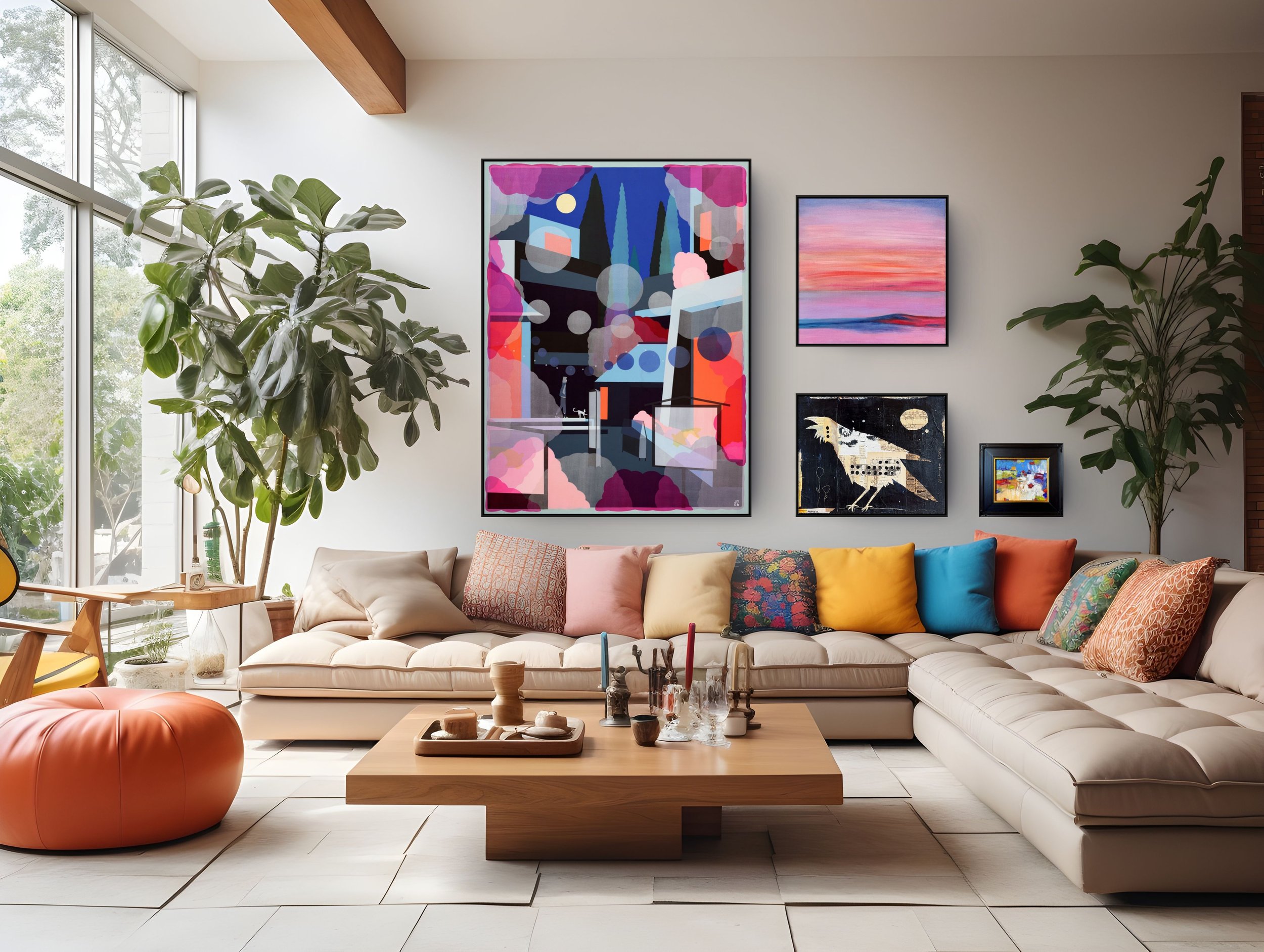
A collection doesn't have to match to belong. Original works currently available through Stefani Art Gallery. Explore the individual artworks below. Interior visualization created for House of Stefani using actual artworks currently represented by Stefani Art Gallery.
A collector once asked me a deceptively simple question:
What makes something collectible art rather than decorative art?
It's a good question, partly because the distinction is not as obvious as it sounds.
After all, art is decorative.
We hang paintings on walls because they bring beauty, interest, color, texture, and meaning into our spaces. We consider scale. We notice how a painting responds to the architecture around it. We may even choose one work over another because its colors feel particularly beautiful in a room.
There is nothing wrong with any of that.
I am an artist, but I am also a designer. I care deeply about how objects inhabit a space.
The problem begins when decoration becomes the only thing we ask of art.
"Do you have something blue?"
"I need something about four feet wide."
"We just need to fill this wall."
Those are perfectly reasonable design questions.
But they are not yet collecting questions.
The difference between decorating with art and collecting art begins when we start asking something more.
Who made this? Why did they make it? What am I actually bringing into my life?
Decorative Does Not Mean Bad
Before going further, I want to make an important distinction.
"Decorative" should not be used as an insult.
Beauty has value.
A thoughtfully designed room can improve the way we experience everyday life. Color, proportion, materials, light, and objects all contribute to that experience.
And sometimes we simply need something beautiful for a particular space.
There is nothing intellectually superior about pretending aesthetics don't matter.
The distinction is intention.
Decorative objects are generally selected primarily because of what they do for a space.
Collectible art is selected because of what the work itself is.
The best interiors often accomplish both.
Collectible Art Has an Identity
One of the simplest characteristics of collectible art is that it has an identity independent of the room where it hangs.
There is an artist.
There is a title.
There is a medium.
There is a date.
There is a physical object with a history.
Perhaps there is provenance, exhibition history, documentation, or an established body of related work.
The painting doesn't become Untitled Blue Painting Over Sofa.
It remains a particular work by a particular artist created at a particular moment.
Move it from a contemporary house in Oregon to an apartment in New York, and it is still the same artwork.
Change the furniture, and it remains itself.
That independence matters.
Collectibility is Not the Same as Price
This is another distinction worth making.
Collectible art does not necessarily mean expensive art.
A small drawing purchased directly from an emerging artist for a few hundred dollars may be a meaningful collectible work.
A painting by a regional artist whose career is still developing may become the beginning of an important collection.
An original print, photograph, study, or work on paper can have tremendous artistic significance without an intimidating price tag.
Conversely, something can be very expensive and still exist primarily as decoration.
Price tells us what something costs.
It does not necessarily tell us what something is.
Look for the Artist Behind the Artwork
When I consider a work as a collector or dealer, I am interested not only in the individual object but also in the person who made it.
Does the artist have a recognizable practice?
Is there a body of work?
Are ideas developing over time?
Is the artist serious about craftsmanship?
Do earlier and later works speak to one another?
This does not mean every artist needs an impressive résumé.
Emerging artists, by definition, are still building one.
What matters is evidence of intention.
You begin to sense that the painting in front of you is not an isolated product created to fill a wall.
It belongs to a larger creative life.
That changes how we see it.
Originality Matters
Collectible art generally carries some meaningful connection to the act of making.
With an original painting, there is only one.
With a drawing, we can see the hand that made the marks.
With traditional printmaking, the artist's process is embedded in the creation of the edition.
With fine-art photography, the artist's decisions extend through composition, capture, editing, printing, materials, and editioning.
This doesn't mean reproductions have no place in our homes.
I own books filled with reproductions of art I love. Museums sell beautiful posters. Prints make important works accessible to millions of people.
But we should understand the difference between an original work of art, an artist-authorized edition, and a mass-produced reproduction.
Again, the goal isn't hierarchy for hierarchy's sake.
It is clarity.
Know what you're buying.
Documentation Becomes Part of Stewardship
As a collection develops, documentation begins to matter.
Who created the work?
When?
What materials were used?
Where did it come from?
Has it been exhibited?
Has it changed hands?
Does an edition number exist?
Are there any condition considerations?
These questions may seem overly formal when someone buys a first painting simply because they love it.
Twenty years later, they may be extraordinarily important.
Collectors become temporary custodians of objects that may outlive them.
Good documentation allows the story of an artwork to travel with it.
That is one of the quiet responsibilities of collecting.
The Room Still Matters
None of this means we should ignore interior design when choosing art.
Quite the opposite.
Scale matters.
Architecture matters.
Light matters enormously.
A powerful artwork hung in the wrong location can lose much of its presence.
Designers understand how proportion, sightlines, materials, color, and negative space affect the way we experience an object.
That expertise can make a collection sing.
The difference is that good design responds to the artwork rather than reducing the artwork to a decorating accessory.
Instead of asking only:
"What will match this room?"
we can also ask:
"What deserves to live here?"
Those questions can lead to very different results.
Buying Art for a Room Versus Making Room for Art
There is a moment many collectors eventually experience.
You encounter an artwork you love.
Then you realize you have absolutely no idea where you're going to put it.
This is usually considered a problem.
I'm not sure it is.
Some of the most meaningful acquisitions begin this way.
The connection happens first.
The logistics follow.
A chair moves.
Another painting finds a different wall.
A room gets rearranged.
Sometimes an entire space becomes better because an artwork required us to reconsider it.
In our recent article about beginning an art collection, I offered a simple piece of advice:
Start with the work. You can find the wall later.
I meant it.
A home should support the life taking place within it. It does not need to remain frozen around a decorating plan.
Neither does a collection.
A Collection Reveals a Person
Perhaps this is where decorative art and collectible art ultimately diverge most clearly.
Consider the works shown at the beginning of this article. They differ in scale, palette, subject, and artistic language. They were not created as a set. Yet placed together, they begin a conversation. That is often how real collections develop.
Featured above: Koi Park, Jude Morales | Lifting Fog, Christina Stefani | Old Friend II, Ruth Orschel | Point of Attraction, Serguei Novitchkov
Decoration tells us something about a room.
A collection tells us something about a person.
Over time, collectors begin noticing patterns in their choices.
Perhaps they repeatedly respond to landscape.
Or abstraction.
Or work made by artists from a particular region.
Perhaps they are drawn to restrained palettes, vigorous mark-making, portraiture, photography, ceramics, or works dealing with memory and place.
They may not have intended any of this.
The collection reveals it.
That's one of the things I love about visiting homes where art has been collected over many years.
The works don't necessarily match.
They belong.
There is a difference.
When Art Becomes Part of a Life
The best collections are rarely assembled all at once.
They accumulate.
A painting purchased on a trip.
A drawing by an artist discovered unexpectedly.
A photograph acquired during an important period of life.
A work inherited from someone we loved.
An emerging artist we believed in before many people knew their name.
Eventually, these objects begin carrying two histories.
The history of the artwork itself.
And the history of our life with it.
No decorating trend can manufacture that.
It takes time.
So, What Should You Buy?
I wouldn't begin by asking whether something is "collectible enough."
I'd ask better questions.
Do I know who made it?
Do I understand what it is?
Is there intention and craftsmanship behind it?
Does it belong to a meaningful artistic practice?
Is it documented appropriately?
And, most importantly:
Would I still want this artwork if I changed everything else in the room?
That last question is surprisingly revealing.
Because a beautifully designed room can give an artwork a wonderful place to live.
But the artwork should still matter when the furniture changes.
That may be the simplest distinction of all.
A Conversation Worth Continuing
There is no single correct way to build an art collection. Some begin with careful research; others begin with an unexpected emotional response to one work. Both can lead somewhere meaningful. If there's something about art, collecting, galleries, or the creative world you've always wanted to ask, we'd love to hear it. Future House of Stefani articles are often inspired by real conversations with our community.
Featured above:
Koi Park, Jude Morales
Lifting Fog, Christina Stefani
Old Friend II, Ruth Orschel
Point of Attraction, Serguei Novitchkov