The Art World This Week: June 20, 2026
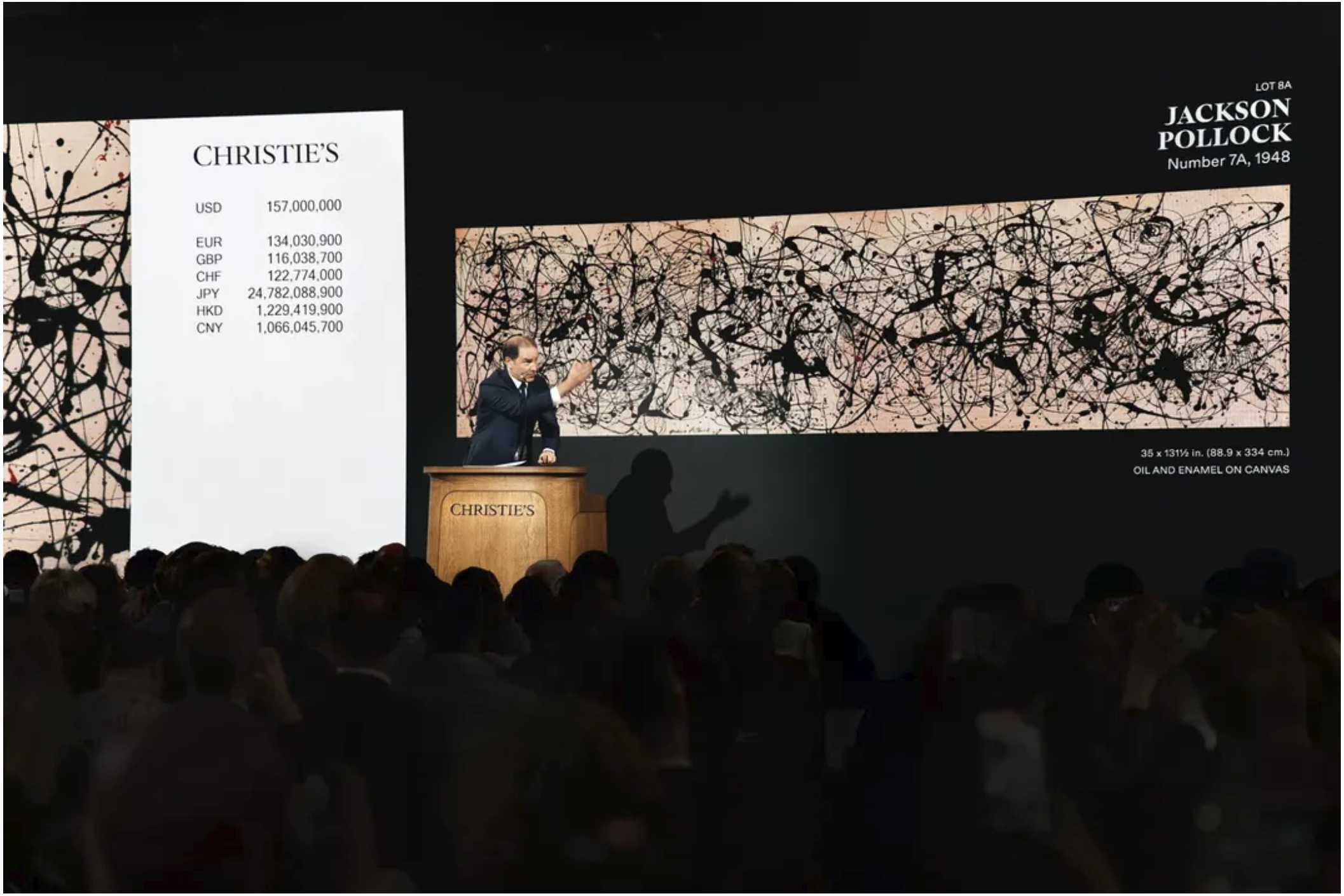
Number 7A, 1948 by Jackson Pollock, sold by Christie's New York for $157 million ($181.2 million with buyer's premium).
This week’s art world is not about volume; it is about discernment. The strongest signal is a return to seriousness: museum-grade works, emotionally resonant exhibitions, provenance-aware collecting, and cultural experiences that reward presence.
Top Developments
Basel is the center of gravity this week. Art Basel’s 2026 edition runs June 18-21 with 290 galleries from 43 countries and territories, plus 59 large-scale Unlimited projects and 21 Parcours public art projects. The fair is signaling breadth: blue-chip modernism, politically engaged contemporary work, public-space commissions, and experiential city programming all at once. Art Basel also introduced “Basel Exclusive,” emphasizing in-person discovery at a time when digital previewing can flatten the magic of seeing. (artbasel.com)
The market mood is selective, not sleepy. The Art Newspaper reported a $35 million Picasso sale on Art Basel’s VIP preview day, with galleries also reporting seven-figure sales across historic and contemporary material. This supports the larger 2026 Art Basel/UBS report: global art sales rose 4% in 2025 to $59.6 billion, but recovery remains uneven and below the 2022 peak. (theartnewspaper.com)(artbasel.com)
Auction houses are leaning hard into trophy works and provenance. Christie’s May New York sales crossed $1.1 billion in one night, led by Jackson Pollock’s Number 7A, 1948 at $181.2 million and a Brancusi at $107.6 million. Sotheby’s London sales next week are similarly anchored by recognizable names: Monet, Freud, Picasso, Doig, Rothko, Banksy, Schiele, and the Lewis Collection. Phillips’ June 26 London sale is smaller but highlights market narratives around South Asian art momentum and accessible contemporary names. (press.christies.com)(sothebys.com)(phillips.com)
Museums are betting on icons and cross-disciplinary audiences. Tate Modern opens Frida: The Making of an Icon on June 25, while MoMA’s Frida and Diego: The Last Dream links visual art to the Metropolitan Opera. The Guggenheim’s Guggenheim Pop: 1960 to Now opened June 5, and The Met’s Costume Art places fashion directly inside the museum’s broader art-historical story. The through-line: museums are programming for cultural magnetism, not only scholarship. (tate.org.uk)(press.moma.org)(guggenheim.org)(metmuseum.org)
Venice remains the art-travel anchor of the season. The 61st Venice Biennale, In Minor Keys, runs May 9-November 22 across the Giardini, Arsenale, Venice, and Forte Marghera, following the late Koyo Kouoh’s curatorial project. The Biennale’s language of slower attention, listening, and repair feels especially aligned with collectors seeking meaning beyond spectacle. (labiennale.org)
Luxury and culture are becoming more structurally intertwined. Louis Vuitton’s three-year Frick Collection partnership, following its Cruise 2027 presentation at the museum, includes support for free evening access and future exhibitions. Salone del Mobile’s 2026 debut of Salone Raritas also confirms that collectible design, limited editions, antiques, and high-end craft are moving closer to the center of the art-and-luxury conversation. (observer.com)(salonemilano.it)
Regulation and provenance are no longer back-office issues. France enacted Law No. 2026-351 on May 9, creating a framework for the restitution of cultural property subject to unlawful appropriation. UNIDROIT’s June workshop on art market integrity brought together cultural heritage, financial crime, law enforcement, and private-sector actors, underscoring that provenance, AML, and cross-border ownership transparency are now part of market confidence. (legifrance.gouv.fr)(unidroit.org)
Emerging Themes
Quality is carrying the market. The strongest activity is around historically significant, institutionally legible, well-provenanced work. The frothier ultra-contemporary temperature is cooler; the appetite for conviction remains.
The experience economy is reshaping art engagement. Basel Social Club’s 2026 edition transforms a vacant office building into a temporary social stage for art, while museums are building programming around opera, fashion, evening access, and travel. Art is increasingly encountered as a lived itinerary.
Galleries are being recognized as cultural infrastructure. Art Basel’s inaugural Gallery Legacy Award to Paula Cooper Gallery, with Chapter NY receiving up to $50,000 toward 2027 participation, is a meaningful signal: the ecosystem is beginning to honor long-term artist stewardship, not only sales velocity. (artbasel.com)
Overhyped vs. Important
Overhyped: Any claim that the art market is broadly “back.” The data shows growth, but uneven growth. A few spectacular sales do not mean all categories are liquid or rising.
Actually important: The return of high-confidence buyers for exceptional work, the growing power of museum-quality provenance, and the convergence of art, travel, luxury, and design into one cultural lifestyle category.
Overhyped: Viral art-world spectacle as proof of depth.
Actually important: The slower, curator-led mood of Venice, the civic and public-space programming at Basel, and the renewed pull of icons like Frida Kahlo suggest audiences want resonance, intimacy, and story.
Key Takeaways
Editorial authority matters. At House of Stefani, we speak as a guide, not a broadcaster. What is beautiful, what is durable, what deserves attention?
Curated travel is here to stay. Basel, Venice, London, New York, Milan, and Paris are functioning as cultural circuits.
Design belongs in the gallery conversation. Salone Raritas and The Met’s Costume Art reinforce the idea that collectors increasingly see art, interiors, fashion, and craft as a single continuum of taste.
Trust is a premium product. Provenance, artist context, edition clarity, condition, and transparent sourcing should always be visible. This is especially important to those who value discretion but expect rigor.
At House of Stefani, we are warm, worldly, and exacting: a place where beauty is not treated as a trend, but as a cultivated way of seeing.
Until next week,
–Christina Stefani | House of Stefani Journal
About the Author: Christina Stefani is an artist, collector, and founder of Stefani Art Gallery and House of Stefani. Her work explores transformation, beauty, love, and the emotional language of abstraction.