
 Image 1 of 2
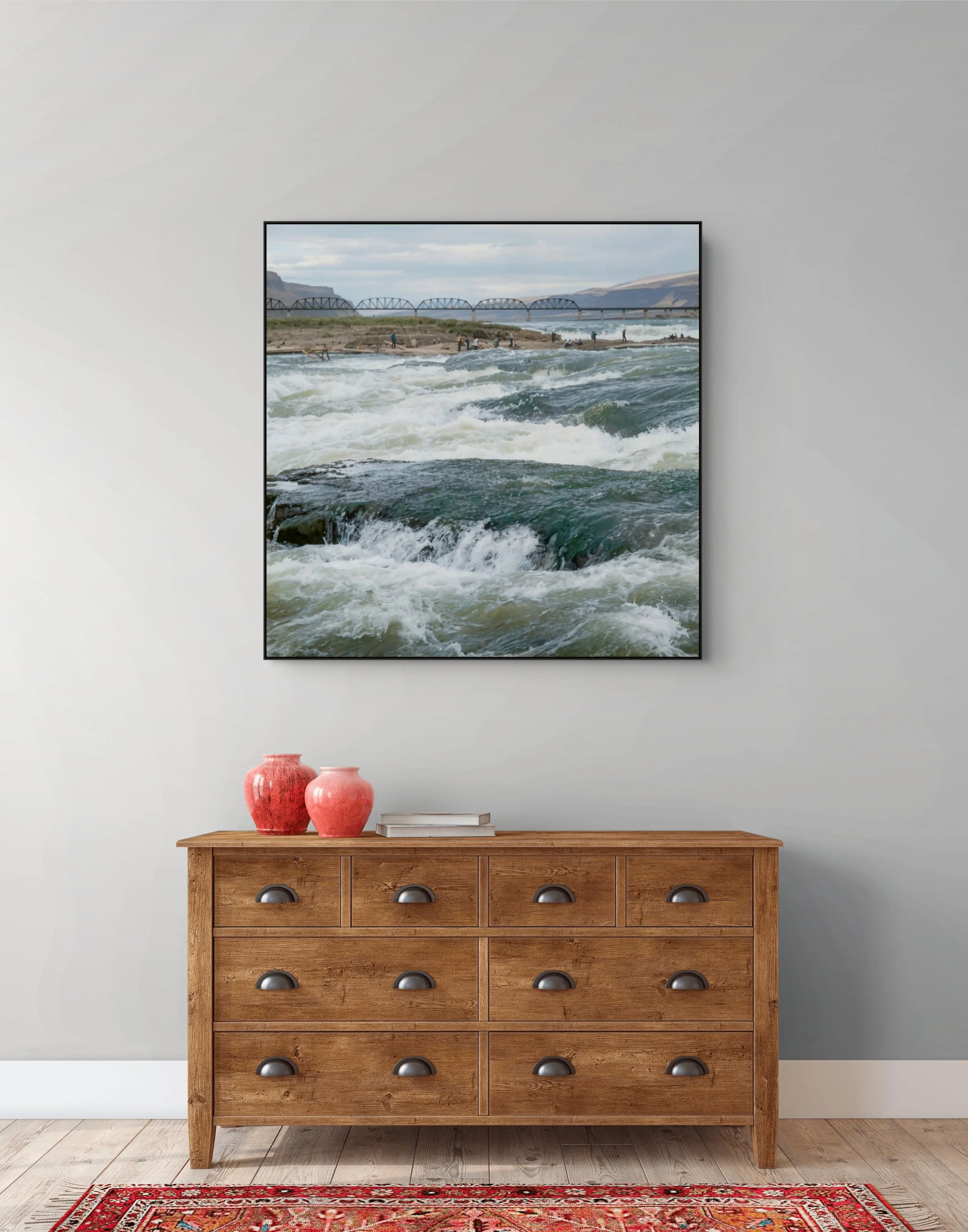 Image 2 of 2
Richard Stefani (1933–2022)
From Before the Water Rose: Celilo Falls, 1956
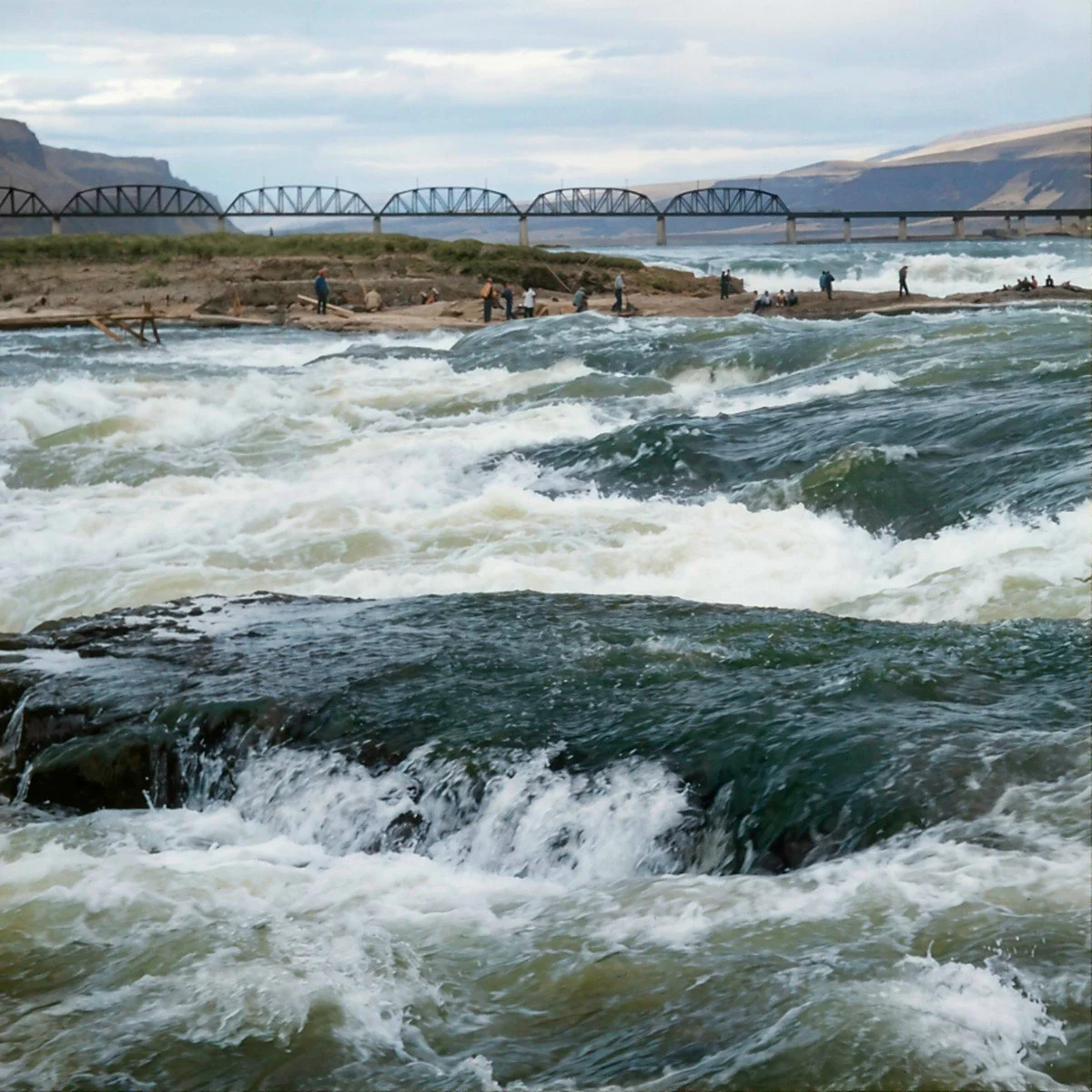
In this photograph, the river nearly wins.
Water fills the foreground and middle distance in successive layers of green, blue and white. The current rises, breaks, falls and gathers again. Richard places us close enough that the Columbia seems to move toward us.
Only gradually do we notice the people.
They are small.
Across the middle of the photograph, figures stand on a long strip of exposed rock. Behind them, the railroad bridge crosses the frame. Beyond it rise the hills of the Gorge.
The scale is extraordinary.
Yet Richard's photograph does something more subtle than demonstrate the power of the river.
It refuses to separate landscape from human presence.
Celilo was both.
A place of immense natural force and a place of human life.
The people may appear small against the Columbia, but they are not insignificant within the photograph. Once we see them, our understanding of the image changes. The river is no longer an empty landscape.
It is inhabited.
That idea runs quietly through Richard's entire Celilo archive.
Again and again, he reminds us that what disappeared beneath the reservoir was not simply a geological feature.
It was a place where people were.
Estate Edition
Printed from Richard Stefani's original 1956 color negative.
Chromogenic photographic print on Fuji Crystal Archive DP II paper, produced in Germany and mounted under matte, reflection-reducing acrylic glass with aluminum Dibond backing. Presented in a handcrafted Basel black oak floater frame. Ready to hang.
Each work is accompanied by Richard Stefani Estate documentation recording the photograph, edition number, edition size, production specifications, and provenance.
10 × 10 in.
Edition of 25
$1,500
20 × 20 in.
Edition of 15
$3,200
30 × 30 in.
Edition of 10
$6,500
Edition sizes are fixed and will not be increased.
Richard Stefani (1933–2022)
From Before the Water Rose: Celilo Falls, 1956
In this photograph, the river nearly wins.
Water fills the foreground and middle distance in successive layers of green, blue and white. The current rises, breaks, falls and gathers again. Richard places us close enough that the Columbia seems to move toward us.
Only gradually do we notice the people.
They are small.
Across the middle of the photograph, figures stand on a long strip of exposed rock. Behind them, the railroad bridge crosses the frame. Beyond it rise the hills of the Gorge.
The scale is extraordinary.
Yet Richard's photograph does something more subtle than demonstrate the power of the river.
It refuses to separate landscape from human presence.
Celilo was both.
A place of immense natural force and a place of human life.
The people may appear small against the Columbia, but they are not insignificant within the photograph. Once we see them, our understanding of the image changes. The river is no longer an empty landscape.
It is inhabited.
That idea runs quietly through Richard's entire Celilo archive.
Again and again, he reminds us that what disappeared beneath the reservoir was not simply a geological feature.
It was a place where people were.
Estate Edition
Printed from Richard Stefani's original 1956 color negative.
Chromogenic photographic print on Fuji Crystal Archive DP II paper, produced in Germany and mounted under matte, reflection-reducing acrylic glass with aluminum Dibond backing. Presented in a handcrafted Basel black oak floater frame. Ready to hang.
Each work is accompanied by Richard Stefani Estate documentation recording the photograph, edition number, edition size, production specifications, and provenance.
10 × 10 in.
Edition of 25
$1,500
20 × 20 in.
Edition of 15
$3,200
30 × 30 in.
Edition of 10
$6,500
Edition sizes are fixed and will not be increased.