
 Image 1 of 2
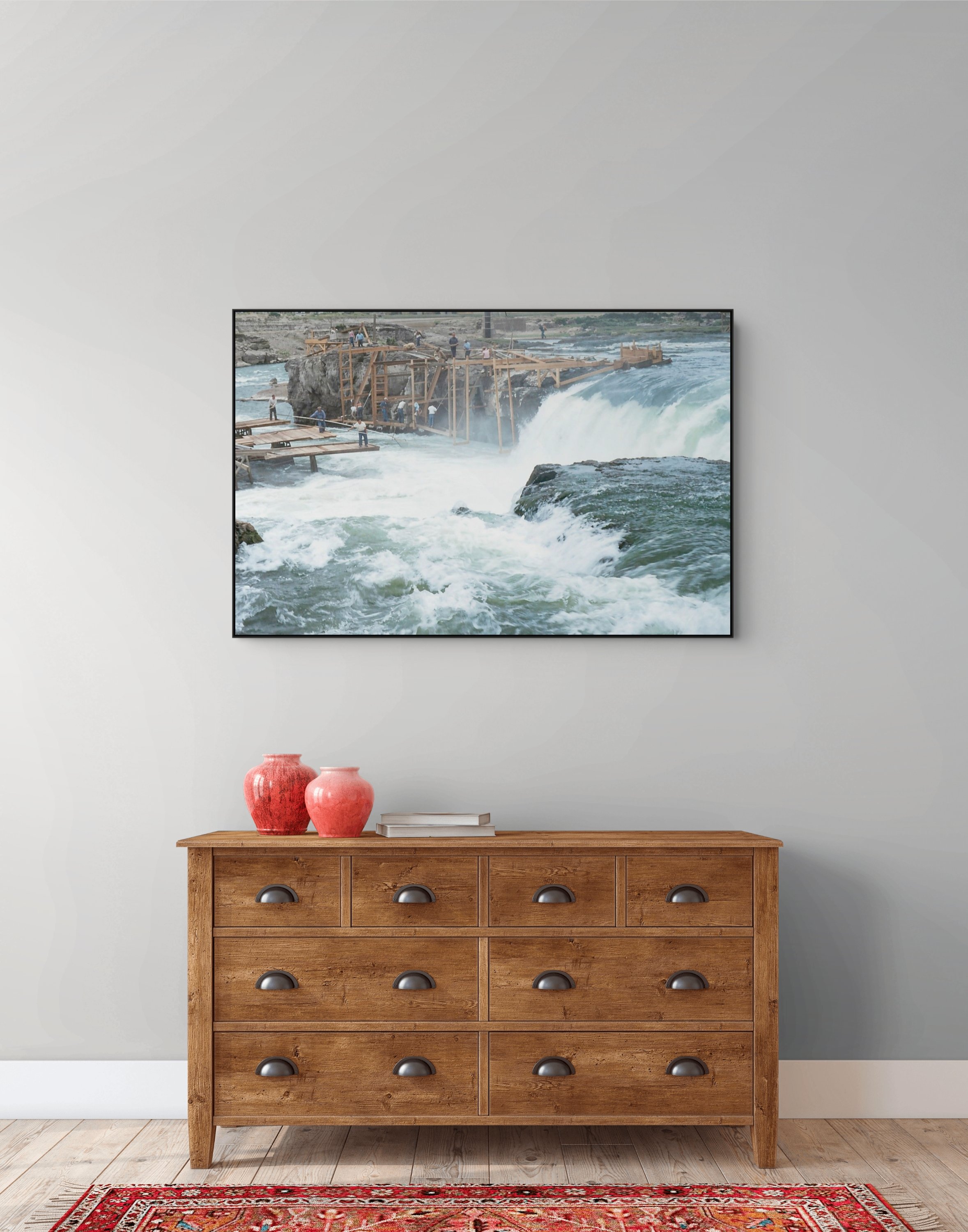 Image 2 of 2
Richard Stefani (1933–2022)
From Before the Water Rose: Celilo Falls, 1956
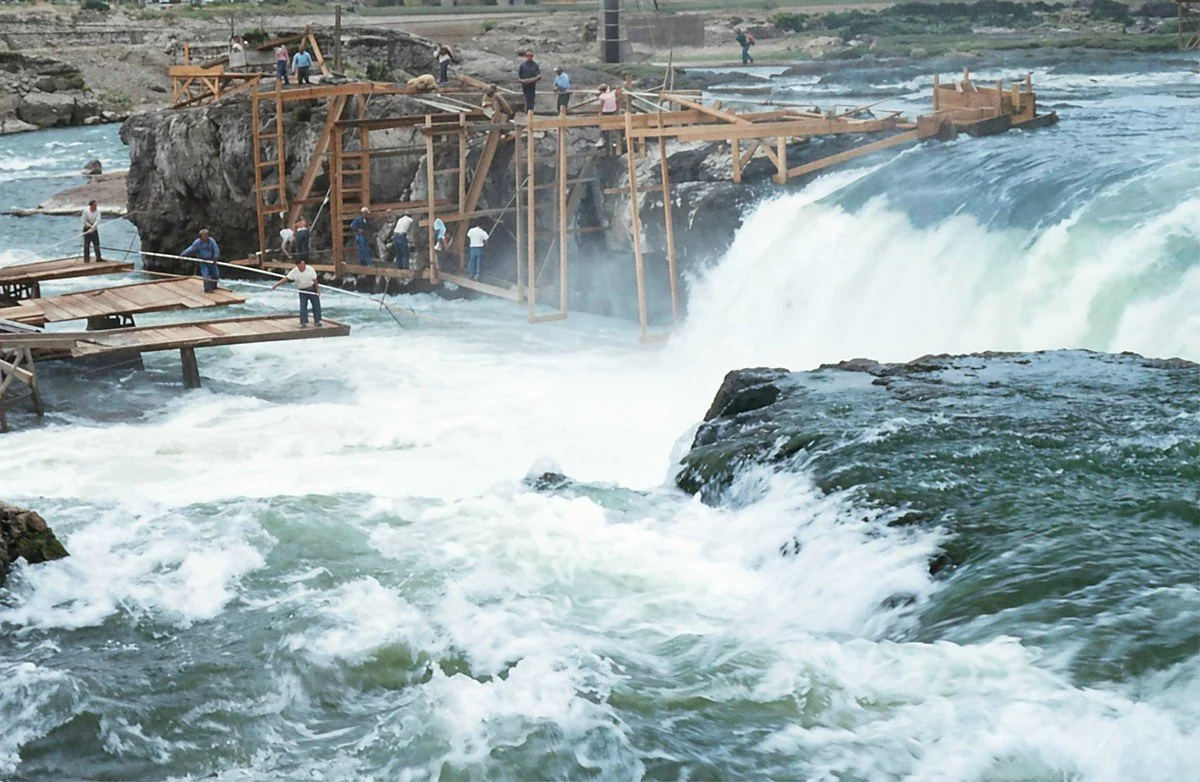
At first, the water dominates this photograph.
Then the structures begin to emerge.
Wooden platforms reach across rock and current. Ladders descend toward the river. Narrow walkways connect one working position to another. Figures stand at different heights, some close enough to the rushing water to be surrounded by spray.
Richard Stefani's photograph reveals Celilo Falls not simply as a landscape, but as a place shaped by generations of human knowledge.
The wooden structures appear almost delicate beside the tremendous volume of the Columbia. Yet their placement suggests something very different: an intimate understanding of where to stand, where the salmon moved, how the current behaved, and how people could work within a river of extraordinary force.
Richard was twenty-three when he made this photograph in the fall of 1956. He did not isolate a single fisherman or attempt to simplify the scene. Instead, he allowed its complexity to remain.
That decision gives the photograph unusual historical value today. We can study the construction of the platforms, the positions of the fishermen, the relationship between rock and water, and the extraordinary physical environment in which the work took place.
Only months later, the landscape would be transformed by the reservoir behind The Dalles Dam.
Here, however, everything is still in motion.
The river rushes through the frame.
People work.
And Celilo is alive.
Estate Edition
Printed from Richard Stefani's original 1956 color negative.
Chromogenic photographic print on Fuji Crystal Archive DP II paper, produced in Germany and mounted under matte, reflection-reducing acrylic glass with aluminum Dibond backing. Presented in a handcrafted Basel black oak floater frame. Ready to hang.
Each work is accompanied by Richard Stefani Estate documentation recording the photograph, edition number, edition size, production specifications, and provenance.
12 × 8 in.
Edition of 25
$1,500
24 × 16 in.
Edition of 15
$3,200
30 × 20 in.
Edition of 10
$6,500
Edition sizes are fixed and will not be increased.
Richard Stefani (1933–2022)
From Before the Water Rose: Celilo Falls, 1956
At first, the water dominates this photograph.
Then the structures begin to emerge.
Wooden platforms reach across rock and current. Ladders descend toward the river. Narrow walkways connect one working position to another. Figures stand at different heights, some close enough to the rushing water to be surrounded by spray.
Richard Stefani's photograph reveals Celilo Falls not simply as a landscape, but as a place shaped by generations of human knowledge.
The wooden structures appear almost delicate beside the tremendous volume of the Columbia. Yet their placement suggests something very different: an intimate understanding of where to stand, where the salmon moved, how the current behaved, and how people could work within a river of extraordinary force.
Richard was twenty-three when he made this photograph in the fall of 1956. He did not isolate a single fisherman or attempt to simplify the scene. Instead, he allowed its complexity to remain.
That decision gives the photograph unusual historical value today. We can study the construction of the platforms, the positions of the fishermen, the relationship between rock and water, and the extraordinary physical environment in which the work took place.
Only months later, the landscape would be transformed by the reservoir behind The Dalles Dam.
Here, however, everything is still in motion.
The river rushes through the frame.
People work.
And Celilo is alive.
Estate Edition
Printed from Richard Stefani's original 1956 color negative.
Chromogenic photographic print on Fuji Crystal Archive DP II paper, produced in Germany and mounted under matte, reflection-reducing acrylic glass with aluminum Dibond backing. Presented in a handcrafted Basel black oak floater frame. Ready to hang.
Each work is accompanied by Richard Stefani Estate documentation recording the photograph, edition number, edition size, production specifications, and provenance.
12 × 8 in.
Edition of 25
$1,500
24 × 16 in.
Edition of 15
$3,200
30 × 20 in.
Edition of 10
$6,500
Edition sizes are fixed and will not be increased.