Familiar Forms, Unsettled Truths: Joshua Blue and the Language of Everyday Life
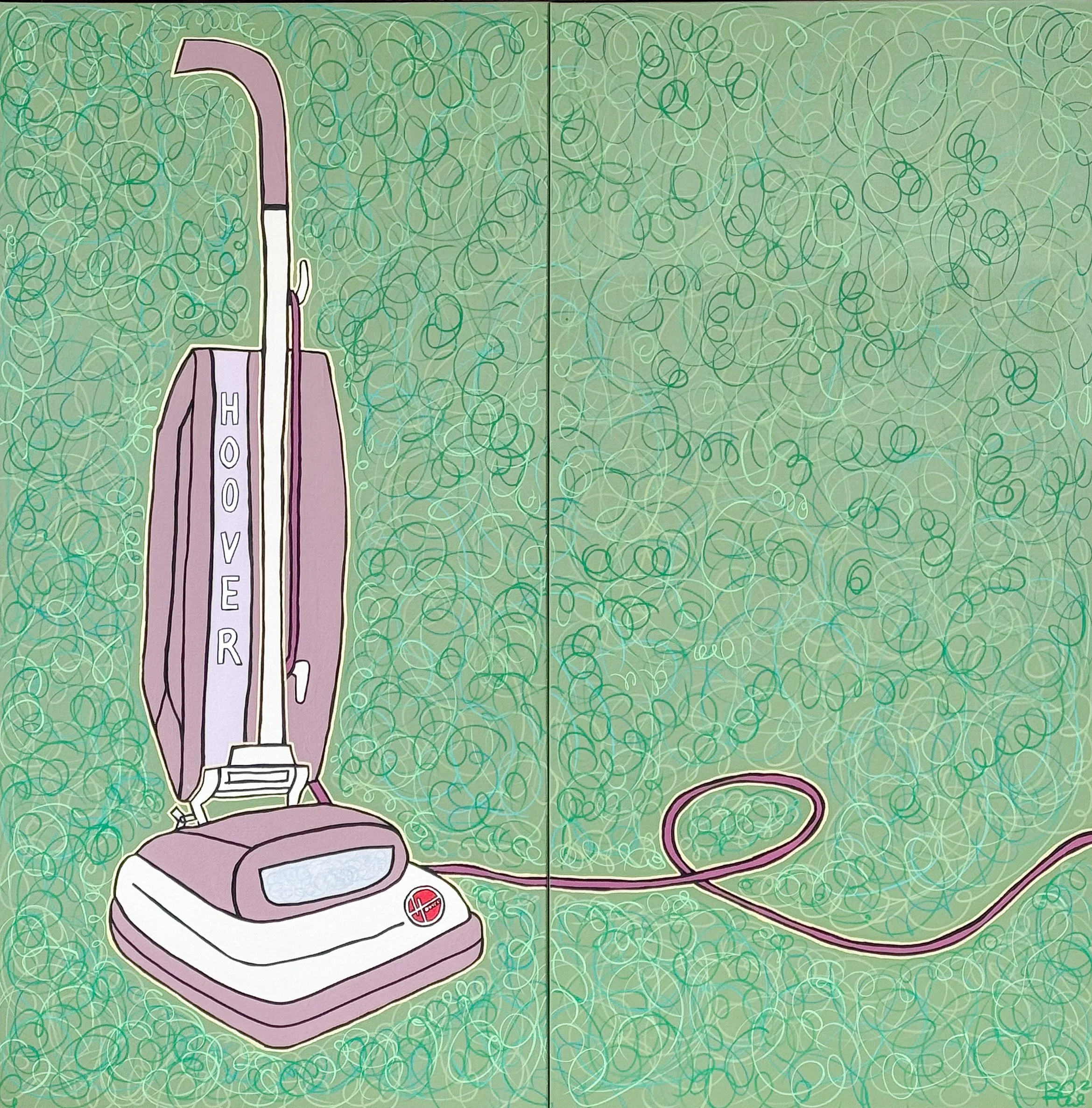
Memory and identity together in an elevated domestic object. Hoover Vacuum Advertisement by Joshua Blue. Courtesy Stefani Art Gallery.
In a moment where image-making is constant and often overwhelming, clarity has become surprisingly difficult to come by.
Much of what we see today tends to fall into one of two extremes: work that is so conceptual it feels distant, or work that is visually immediate but doesn’t hold attention for long. What’s increasingly rare is something that can do both, something that meets you where you are and then asks you to stay a little longer.
Joshua Blue’s work sits comfortably in that space.
At first glance, his paintings feel disarmingly familiar. A pair of condiment bottles. A vacuum cleaner. A carousel horse. A single rose in a vase. These are not dramatic or monumental subjects, and they are not treated with illusionistic precision. Instead, they are simplified, outlined, flattened. There is something almost cartoon-like in their presentation, something that recalls the visual language of everyday media, signage, even childhood memory.
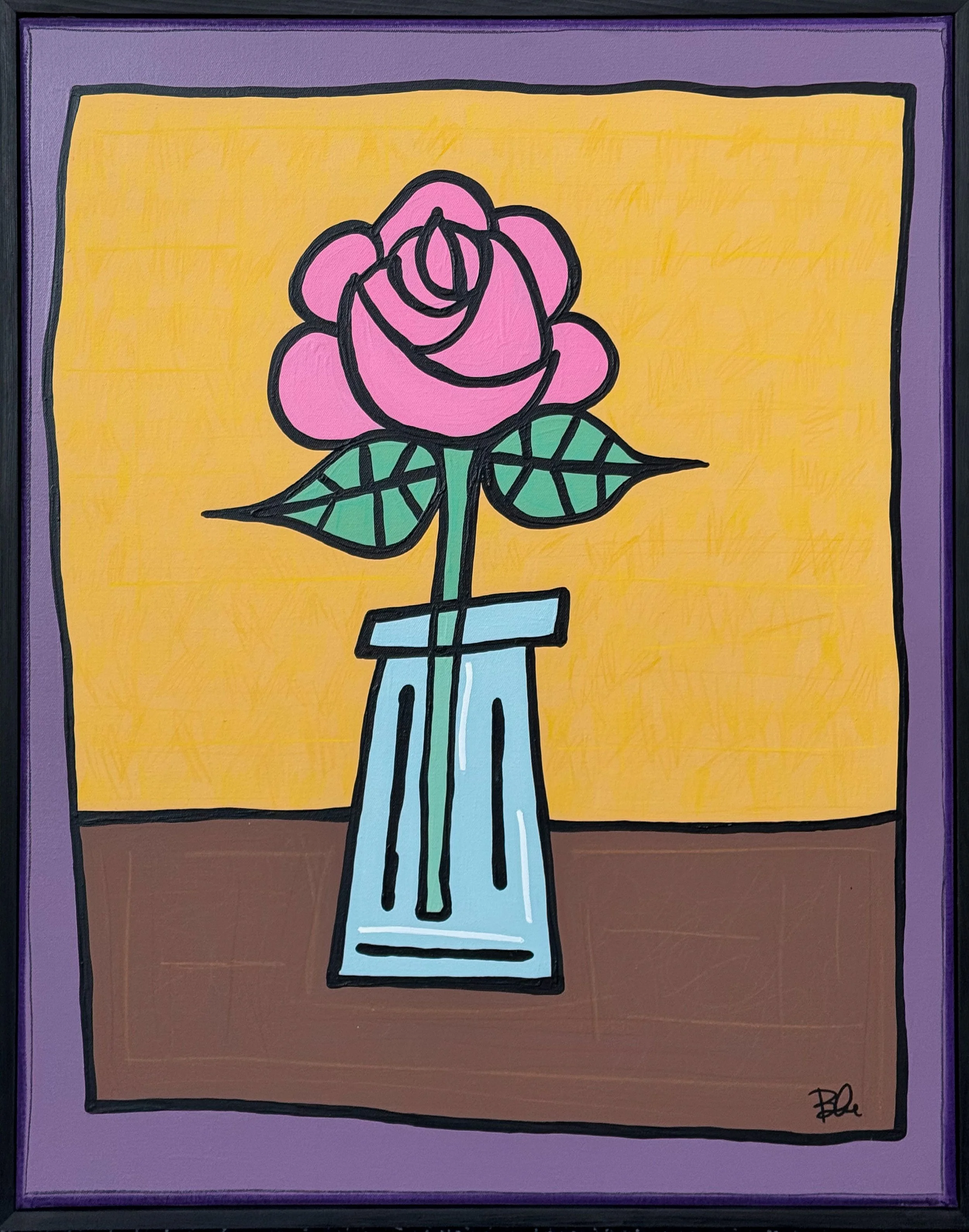
Simplified symbols and emotional shorthand. The Fist & Rose, Minus the Fist III by Joshua Blue. Courtesy Stefani Art Gallery.
And yet, the longer you look, the less simple they become.
Blue uses familiarity as an entry point, not a conclusion. The images draw you in quickly, but they don’t resolve as quickly. Background and foreground begin to blur. Color sits in layers that feel both deliberate and intuitive. Lines guide your eye, then interrupt it. You start to notice decisions, adjustments, moments where the hand of the artist is still present and visible.
There is no attempt to hide that process. In fact, it is central to the work.
Blue has written about this directly, describing his practice as an ongoing attempt at honesty. Not honesty as confession or self-expression in the traditional sense, but honesty as a way of relating, to himself, and to others. For him, the act of making is inseparable from the meaning of the work. The process is not something to refine away; it is something to reveal.
This is where his work quietly resists illusion.
Rather than creating a seamless image that asks to be accepted at face value, Blue leaves space for the viewer to see how the image came into being. Layers remain visible. Edges are not overly resolved. The painting does not pretend to be anything other than what it is: a constructed surface, built over time, through decisions that are both intentional and exploratory.
That openness creates a different kind of relationship with the viewer. You are not being transported somewhere else. You are being asked to stay present, to look more closely, and to consider why these images feel so immediately recognizable in the first place.
Part of that recognition comes from his subject matter. Blue draws from a distinctly American visual landscape, objects and scenes that are embedded in everyday life. There is humor in this, and a sense of ease, but it is never purely nostalgic. A bottle of ketchup or a household appliance carries with it associations: routine, memory, habit, even identity. These objects are not neutral, and Blue seems to understand that instinctively.
What he does with them is subtle but important. He doesn’t exaggerate their meaning, nor does he strip them down entirely. Instead, he holds them in a kind of suspended clarity, familiar enough to recognize, but open enough to reinterpret.
This same balance carries through his broader practice, which moves between abstraction and representation without feeling divided. His abstract works share the same bold outlines and vibrant palette as his more figurative pieces, while his representations retain a sensitivity to surface and composition that comes directly from abstraction. The result is a body of work that feels cohesive, even as it shifts in form.
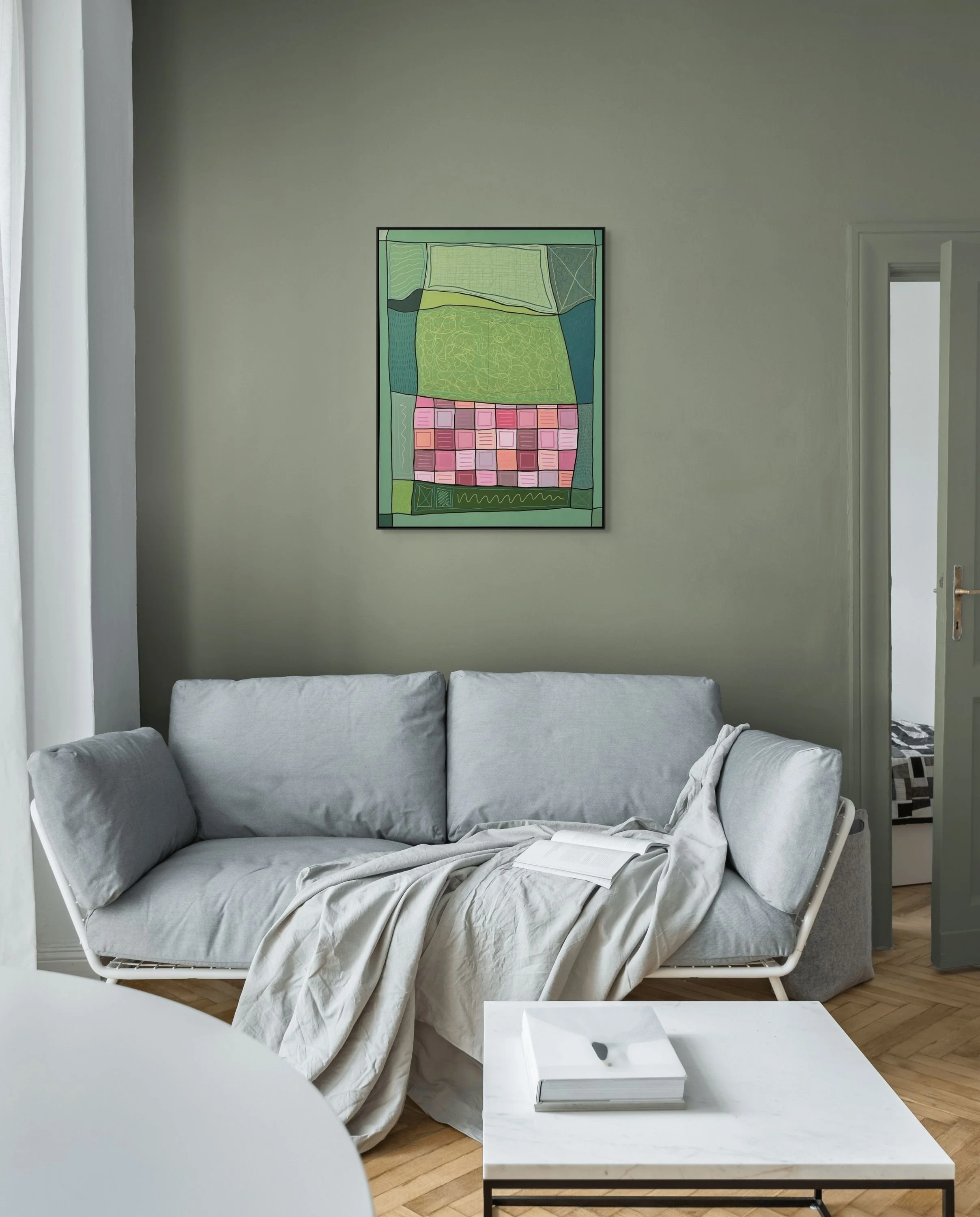
Abstraction, lineage, and process. Plants and People and Places, In Places by Joshua Blue. Courtesy Stefani Art Gallery
There is a discipline to that consistency, but also a sense of freedom.
It’s worth noting that Blue’s work does not rely on irony, which sets it apart from much of the visual language it references. The colors are bright, the forms are approachable, but there is no sense of distance or detachment. If anything, the work leans toward sincerity, something that is becoming increasingly valued in a culture that often defaults to irony as a protective layer.
That sincerity is tied directly to his idea of honesty, not as a fixed outcome, but as an ongoing process. Something you move toward, rather than arrive at. In that sense, the work is never finished in a philosophical way, even when the painting itself is complete.
For collectors, this is where the work begins to open up over time. What feels immediate at first continues to shift with repeated viewing. The visual language is consistent enough to be recognizable, but flexible enough to evolve. There is a clear point of view, supported by both material decisions and a well-articulated philosophy.
That combination is not always easy to find.
Joshua Blue is not trying to create images that overwhelm or distract. He is doing something quieter, and in many ways more difficult. He is creating work that asks to be seen clearly, and in doing so, encourages a kind of recognition that goes beyond the image itself.
Enjoy more of Joshua Blue’s work at Stefani Art Gallery.
–Christina Stefani