Collecting Against the Current: How Global Shifts Are Reshaping the Art Market for 2026
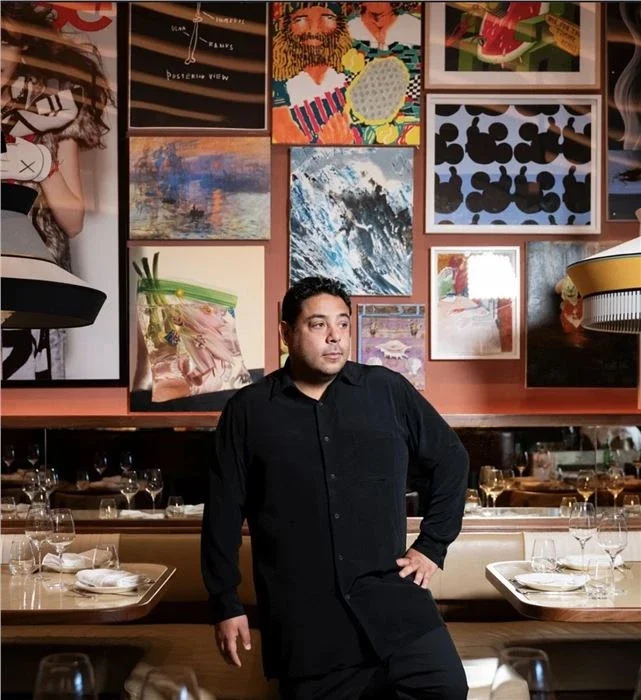
Collector Andre Sakhai. Photograph © Alejandro Chavarria at Le Specialità, Courtesy of Andre Sakhai.
As the art world looks toward 2026, the mood is one of recalibration rather than acceleration. Value is increasingly defined by conviction and context, not speed or visibility. Voices from across Europe, the UK, and the United States point to a market that is decentralizing geographically while slowing intellectually, as new regions rise, and digital tools are re-evaluated as supports for trust rather than shortcuts.
How Collectors Learn to See: Taste, history, and responsibility
As the market cools, collectors are becoming more reflective about how taste is formed and sustained. Rather than relying solely on market signals, many are developing personal frameworks rooted in history, representation, and lived experience.
Collector Ralph Tawil, whose collection focuses on contemporary portraiture and socially engaged practices, describes his approach as guided by close attention to gender representation and art historical reference. For new collectors, he stresses the importance of experience over hesitation. “After making a couple purchases,” he advises, “it’s important to pause to make sure your collection is headed in the right direction.” Living with work, he argues, is essential to understanding one’s own affinities and knowing when to slow down can be just as important as knowing when to act.
Tawil also emphasizes philanthropy as an extension of collecting values. Supporting museums and institutions, he notes, reinforces the cultural ecosystems that allow art to circulate meaningfully. Collecting, in this sense, becomes not only an individual pursuit, but a form of stew
Buying Against the Market: Why conviction matters more than timing
One of the most pronounced shifts shaping collector behavior is a move away from chasing the newest names and toward reassessing artists whose markets have cooled. For many, the current moment presents an opportunity not for retreat, but for strategic reentry.
Collector Andre Sakhai, known for building collections through sustained, in-depth engagement rather than trend alignment, describes his approach as deliberately “buying against the trend.” He points to artists such as Wade Guyton, Seth Price, Sterling Ruby, Christopher Wool, and Richard Prince’s early jokes and Instagram works. These are figures whose markets peaked fifteen to twenty years ago and have since corrected. At the same time, he notes that emerging artists have become increasingly expensive, often priced at levels comparable to more established names whose markets are currently quieter. Despite this, he continues to follow and collect emerging artists he feels strongly about, including Japanese painters Shota Nakamura and Keita Morimoto.
This strategy resonates with London-based dealer Lawrence Van Hagen, who works closely with both emerging collectors and artists across Europe and Asia. “Relationship-building and patience have always mattered,” he notes, “but they will become even more essential moving forward.” In a market saturated with access and information, conviction – not speed – is emerging as the true advantage.
Geography Without a Center: From India to the Gulf, collectors are following curiosity
If conviction defines how collectors are buying, geography increasingly defines where they are looking. The idea of a single cultural center has given way to a more fluid, curiosity-driven map of engagement.
Van Hagen observes a growing desire for in-person experiences, particularly among younger collectors who are traveling more intentionally and engaging directly with regional art scenes. “I’m already seeing the younger generation become more confident, engaged, and influential within the art world,” he says. This shift is evident in the attention being paid to regions such as India, Mexico, the UAE, and Saudi Arabia, locations that are no longer viewed as peripheral, but as central to contemporary discourse. Van Hagen points to the India Art Fair in New Delhi as a critical anchor, alongside the growth of museums, private foundations, and a more educated collector base. What was once framed primarily through cultural heritage is now increasingly understood through a dual lens of historical depth and contemporary relevance.
Sakhai echoes this shift, noting that some of the most compelling momentum is currently happening outside the United States. His recent experiences at the Delhi Art Fair and his growing interest in the Middle East reflect a broader trend toward travel as research. For many collectors, fairs and exhibitions in Qatar, Saudi Arabia, and across the Gulf are no longer speculative excursions, but essential sites of discovery.
Italy’s Structural Advantage: Policy, institutions, and long-term thinking
While emerging regions are gaining momentum, parts of Europe are being reshaped by quieter but equally consequential structural changes. In Italy, recent policy decisions have materially altered the collecting landscape, reinforcing the country’s longstanding culture of research-driven acquisition.
According to Elena Bonanno di Linguaglossa, Executive Director of Thaddaeus Ropac, the reduction of VAT and import duties to five percent has made Italy (particularly Milan) significantly more attractive to both domestic and international collectors. Rather than creating a speculative surge, she notes that the legislation has strengthened an already sophisticated collector base. For Bonanno di Linguaglossa, Milan’s appeal lies not only in market conditions, but in its institutional density. The opening of Ropac’s Milan space was driven by opportunity rather than friction, enabling new collaborations with foundations, museums, and collectors while offering artists a platform rooted in long-term engagement.
Rethinking the Gallery Model: Digital tools as extensions, not replacements
As collectors recalibrate how and where they engage, galleries are also rethinking how best to support artists and audiences in an increasingly hybrid environment. Rather than pursuing digital visibility for its own sake, many are focusing on how technology can preserve depth and context.
Oliver Miro, who co-directs Victoria Miro Gallery and oversees its long-term artist relationships, describes this philosophy through the development of Live/Archive, the gallery’s digital platform for past and present exhibitions. Live/Archive was conceived as a way to honor the full complexity of exhibitions, allowing viewers to move through shows spatially and access layered curatorial context and documentation.
For galleries navigating the digital landscape, Miro offers clear guidance: “Start with intent, not technology.” A digital presence on social media, he argues, should reflect a gallery’s values and artists rather than chase the latest platform. While social media plays a role in visibility, he cautions that “these platforms are designed for speed and broad, multi-purpose use, which makes them powerful for visibility but less suited to slow looking or sustained engagement.” The opportunity, he suggests, lies in creating digital spaces that “complement rather than compete” with those platforms, spaces built for attention, context, and return visits.
This article was written by Daria Borisova in collaboration with MutualArt. Follow her on Instagram for more market insights. –Christina Stefani